
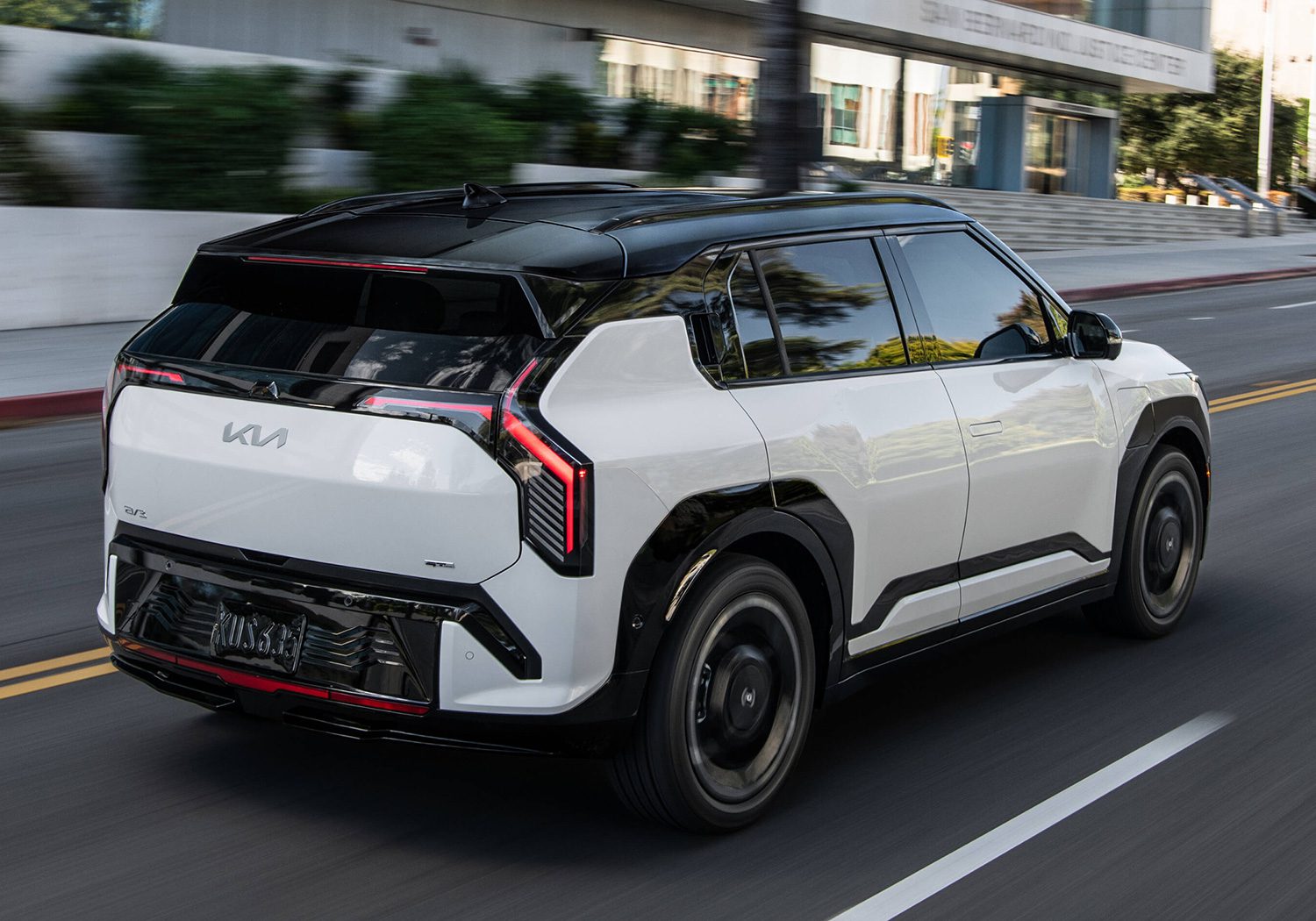
The bustling landscape of the electric vehicle market continues to evolve with significant new entries, as evidenced by the recent media preview day at the New York International Auto Show. Despite prevailing headlines suggesting a slowdown in the adoption of electric vehicles across the United States, two pivotal battery-electric SUVs made their global debut, showcasing the industry’s unwavering commitment to electrification. These unveilings included the compact 2027 Kia EV3 and the expansive 2027 Subaru Getaway, marking distinct strategic moves by their respective manufacturers to capture varied segments of the growing EV consumer base.
These two vehicles, representing opposite ends of the size spectrum, underscore the breadth of innovation and product development still actively underway. The Kia EV3 is poised to become the smallest and most accessible model within Kia’s rapidly expanding electric vehicle portfolio, targeting entry-level consumers. Conversely, the Subaru Getaway asserts itself as the Japanese brand’s largest electric offering to date, designed to cater to families and those seeking ample space and capability. Both models are slated to reach dealerships by late 2026, signaling a robust pipeline of new electric options for American buyers.
Kia EV3: A New Entry in the Compact EV Segment
The 2027 Kia EV3 is set to disrupt the lower-priced end of the electric vehicle market in North America. This compact SUV utility vehicle has already garnered substantial demand and positive reception in several international markets, including South Korea, various European countries, Australia, and New Zealand, where it has been available for nearly two years. Its impending arrival in the U.S. positions it as a formidable competitor against established models like the Chevrolet Bolt (starting at $28,995), the Nissan Leaf ($31,485), and Ford’s anticipated midsize electric pickup, projected to start around $30,000. Final pricing and detailed specifications for the US-bound EV3 will be announced closer to its launch, with all figures inclusive of mandatory delivery fees.
Performance and Range Specifications
For its US trim, the Kia EV3 promises an impressive EPA-rated battery range of up to 320 miles on specific versions. This comfortably surpasses the 300-mile benchmark, which is increasingly becoming a critical psychological threshold for American consumers concerned about range anxiety in the electric vehicle market. The EV3’s design visually echoes the larger, boxier EV9 three-row SUV, projecting a robust yet modern aesthetic. Despite its upright stance, Kia engineers have achieved a commendable drag coefficient of 0.275, an impressive feat for a vehicle of its size and shape, contributing to its efficient range.
Kia offers the EV3 with two primary battery capacity options to cater to different consumer needs and price points. The entry-level EV3 Light model features a 58.3-kilowatt-hour battery pack, exclusively driving the front wheels, and is projected to deliver an estimated range of 220 miles. This variant is expected to anchor the EV3’s competitive base price in marketing efforts. For higher trim levels, including Wind, Land, GT-Line, and GT, battery capacity significantly increases to 81.4 kWh.
All-wheel drive capability is offered as an option on the Wind and Land trims and comes standard on the sportier GT-Line and GT variants. Powertrain output for all-wheel-drive models is rated at a robust 261 horsepower (192 kW), further increasing to an exhilarating 288 horsepower (212 kW) on the high-performance EV3 GT model, promising a dynamic driving experience.
Charging Infrastructure and Bi-Directional Capabilities
Charging for the EV3 is facilitated through a NACS (North American Charging Standard) port conveniently located on the right-front fender. Kia asserts competitive DC fast charging times, enabling a 10 to 80 percent charge in approximately 29 minutes for the smaller battery pack and 31 minutes for the larger one. It is important to note, as with all charging claims, these figures are achieved under ideal conditions, including optimal battery temperature, ambient temperature, and a charging station capable of delivering the sustained high current required.
Adding to its convenience, the EV3 comes standard with Plug and Charge functionality, streamlining the charging process by allowing users to simply plug in and walk away once the system is initially set up. While Kia has yet to provide specific ratings for onboard AC charging, the EV3 distinguishes itself with advanced bidirectional power capabilities. It will offer vehicle-to-load (V2L) power outputs, transforming the EV into a portable energy source for various devices. Furthermore, when paired with a compatible bidirectional Wallbox home charging station, the EV3 will provide vehicle-to-home (V2H) capability, allowing it to supply power to a residence during outages, enhancing its utility beyond mere transportation.
Design, Interior Features, and Platform Innovation
Inside the cabin of this compact electric SUV, Kia’s signature dual 12.3-inch displays are horizontally integrated across the dashboard, creating a modern and intuitive digital cockpit. The EV3 is slated to offer a suite of features and options uncommon in subcompact vehicles in the US market, including a head-up display (HUD) for critical driving information projection and a Surround-View monitor for enhanced parking and maneuverability. A power liftgate will also be available, providing easy access to a versatile cargo area offering 26.1 cubic feet of volume behind the second row, which expands significantly to 56.5 cubic feet when the rear seats are folded down.
Crucially, the EV3 is constructed on a cost-optimized variant of the Hyundai-Kia E-GMP battery-electric platform. A notable distinction from its larger siblings, such as the EV6 hatchback utility and EV9 three-row SUV, is its adoption of a 400-volt battery architecture instead of the more expensive 800-volt system. This strategic choice aims to keep production costs competitive, directly impacting its accessible pricing strategy in the electric vehicle market. This lower-cost platform also underpins the Kia EV4, a sleek compact sedan whose US launch was postponed indefinitely in October, reportedly due to the market’s increasing preference for utility vehicles over sedans. Production of the North American EV3 is expected to take place in Mexico, at the same Kia facility that manufactures the K4 model, further optimizing its market entry.
Subaru Getaway: Expanding the Three-Row Electric SUV Horizon
At the opposite end of the size spectrum, the 2027 Subaru Getaway 3-row SUV represents a significant expansion of the small Japanese automaker’s electric vehicle offerings. This model is poised to become Subaru’s largest EV, targeting the premium segment of its lineup. The Getaway serves as the direct electric counterpart to the brand’s long-standing gasoline-powered Ascent 3-row SUV and marks the tenth distinct model line for Subaru in the US market, highlighting the brand’s commitment to diversifying its electric vehicle market presence.
Strategic Positioning and Market Context
The Getaway is designed to offer a practical, family-friendly solution with seating for seven passengers. Its design, while featuring a light re-imagining, will be familiar to keen observers, as it is a platform-mate with the Toyota Highlander battery-electric SUV, which was announced earlier this year. This collaboration is part of a broader strategy, making the Getaway the fourth Subaru EV to be developed as a derivative of a Toyota platform. Previous collaborations include the Solterra hatchback (a clone of the Toyota bZ4X), the Uncharted small hatchback (based on the Toyota C-HR EV), and the Trailseeker wagon or utility vehicle (derived from the Toyota bZ Woodland). While the Trailseeker uniquely managed to retain a distinct Subaru aesthetic, the Getaway extends this partnership into the large SUV segment.
Powertrain and Performance Metrics
The Getaway will be powered by a substantial 95.8-kWh battery pack, providing a projected range of more than 300 miles, a crucial benchmark for consumer confidence in the electric vehicle market. In line with Subaru’s long-standing brand identity, every Getaway will come standard with all-wheel drive, a hallmark feature since the 1990s. This capability is delivered by a pair of electric motors, generating a combined output of 420 horsepower (309 kW). Such power enables the seven-passenger SUV to achieve a 0-to-60-mph acceleration time quoted at “less than 5 seconds,” positioning it as a surprisingly spirited performer for its class. Furthermore, the Getaway boasts a respectable towing capacity of up to 3,500 pounds, enhancing its utility for active lifestyles.
Charging and Range Capabilities
Consistent with industry trends, the Subaru Getaway will also feature a NACS port on its right-front fender for charging. Subaru estimates a DC fast charging time of approximately 30 minutes to replenish the battery from 10 to 80 percent, assuming ideal conditions and a charging station capable of delivering up to 150 kW. To optimize charging efficiency and battery longevity, standard battery preconditioning is included. A thoughtful design touch is the integration of the front Daytime Running Lights (DRLs), which double as visible charging-status indicators when the vehicle is plugged in. Looking ahead, Subaru plans to introduce a “standard-range” model in the first half of 2027, which will feature a slightly smaller 77.0 kWh battery capacity, though it will still retain the standard all-wheel-drive configuration. Further details on this variant will be released closer to its launch.
Interior Comfort, Utility, and Manufacturing
The interior of the Getaway prioritizes comfort and connectivity, befitting a modern three-row SUV. It features a 12.3-inch digital instrument cluster, a standard interface seen in many Toyota models, complemented by a large central 14-inch touchscreen display. Standard amenities include heated front seats, with options for a heated steering wheel and an array of heated and ventilated seats for the second and third rows, depending on the trim level. Practical family-oriented features abound, such as three-zone climate control with dedicated vents for the third row, a cup holder for every passenger, and USB-C charge ports in each row. An optional panoramic moonroof further enhances the cabin’s airy feel.
A distinctive Subaru trait, the ladder-type roof rails, will be standard on “most” versions of the Getaway. This thoughtful inclusion allows current Subaru owners to seamlessly utilize their existing Thule carriers and other roof accessories, underscoring Subaru’s commitment to outdoor enthusiasts. In a move that aligns with strategic manufacturing and tariff considerations, the 2027 Subaru Getaway will be assembled in the United States. Production will take place at the Toyota plant in Georgetown, Kentucky, the same facility that builds its Toyota Highlander twin. This marks a significant development for Subaru, as it will be only their second US assembly plant, complementing the Lafayette, Indiana, plant where a majority of its gasoline models are built.
Broader Implications for the Electric Vehicle Market
The simultaneous debut of the Kia EV3 and Subaru Getaway at the New York Auto Show serves as a potent reminder that the electric vehicle market is far from stagnant. Instead, it is undergoing a profound diversification, driven by consumer demand for a wider array of EV options that span various price points, sizes, and capabilities. These launches underscore a strategic industry shift to cater to different segments of the car-buying public, from urban dwellers seeking compact efficiency to larger families requiring spacious, all-weather capable transport.
As manufacturers continue to invest heavily in battery technology, charging infrastructure, and novel platform designs, the entry of vehicles like the EV3 and Getaway promises to further democratize access to electric mobility. They represent not just new models, but concrete steps towards a future where electric vehicles are integral to the everyday automotive landscape, offering enhanced performance, reduced emissions, and innovative features that cater to evolving consumer expectations.