
Key Takeaways (TL;DR)
- Building electric vehicles (EVs) and internal combustion engine (ICE) cars on the same platform, while initially cost-effective, leads to significant design and functional compromises for both vehicle types.
- Analysis of models like the BMW i5 reveals inefficient packaging in shared platforms, with large hoods concealing power electronics rather than providing usable storage space (frunks).
- Dedicated EV platforms, as exemplified by Tesla’s Model 3 and Lucid Air, offer superior packaging, greater cargo and passenger space, and often better range and weight distribution.
- The compromises extend to ICE vehicles on shared platforms, making them heavier and taller than their predecessors, highlighting a ‘master of none’ scenario.
- Automakers, including BMW with its upcoming Neue Klasse platform, are recognizing these limitations and shifting towards purpose-built EV architecture for optimal performance and consumer benefits.
The Enduring Debate: Shared Platforms vs. Dedicated EV Architecture
The automotive industry’s rapid transition towards electric vehicles (EVs) has brought forth a critical engineering dilemma: should manufacturers continue to build EVs on existing internal combustion engine (ICE) platforms, or invest in entirely new, dedicated EV architecture? For a time, the former approach, often termed a ‘multi-energy platform,’ appeared to offer a pragmatic path, promising cost efficiencies and production flexibility. However, a closer examination of vehicles emerging from this strategy reveals inherent compromises that impact performance, packaging, and ultimately, the consumer experience.

When BMW first announced its ambitious plan in 2021 to roll out a full suite of electric sedans – the i4, i5, and i7 – on shared underpinnings with their gas-powered counterparts, skepticism was widespread. The notion of cost-cutting through platform sharing seemed to inherently limit the potential of these electric models. Yet, surprisingly, the initial reception for these vehicles defied expectations. The i4 proved to be a wonderful machine, the i7 undeniably sumptuous, and the i5, an impressive and competent daily driver.
Despite their individual merits, these models often succeed in spite of their foundational limitations, rather than because of them. The core issue lies in the fundamental design requirements of electric powertrains versus traditional engines. This distinction becomes glaringly obvious when scrutinizing the physical manifestations of shared EV platform architecture.
Unpacking the Compromises: A BMW i5 Case Study
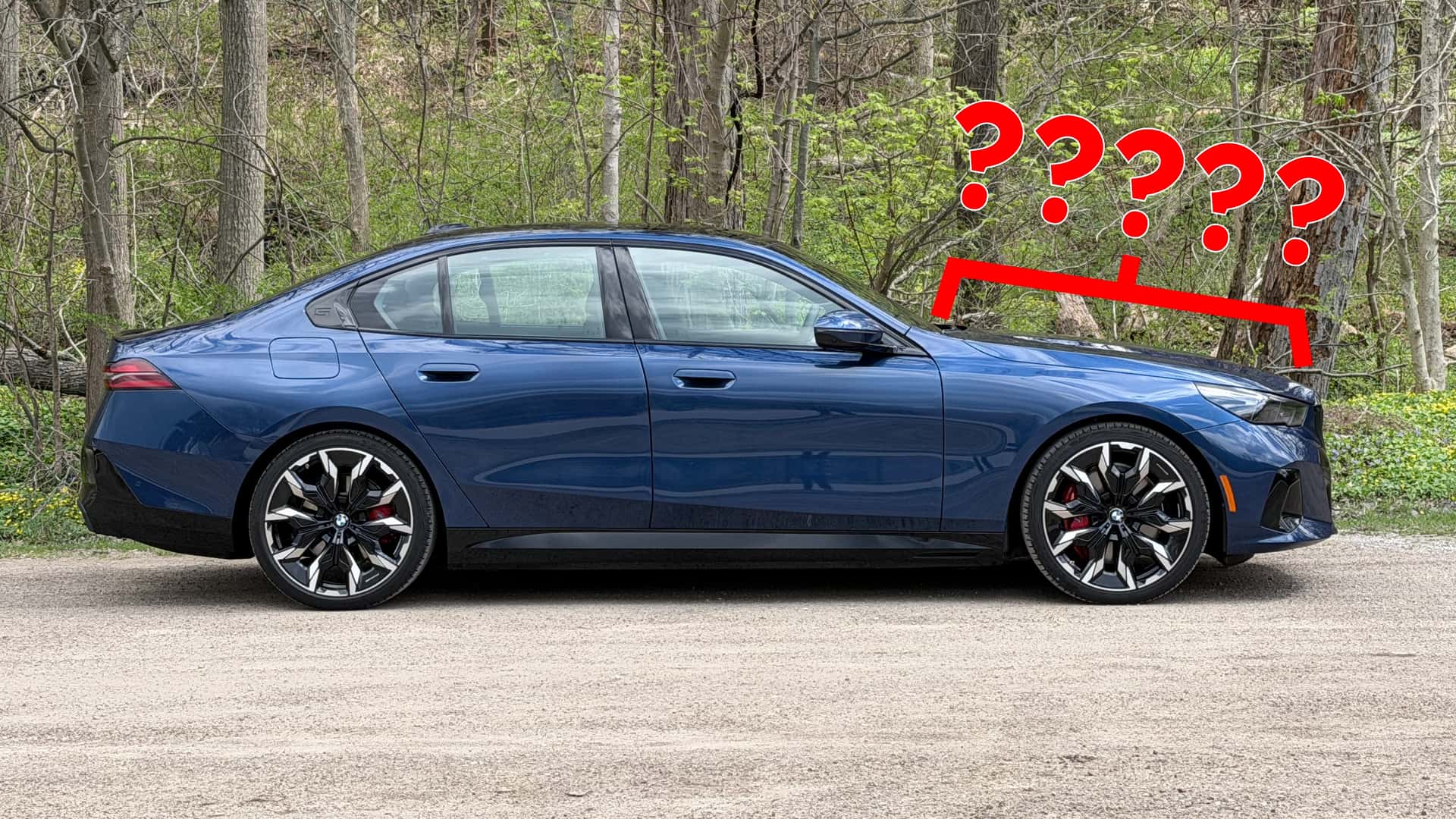
Consider the BMW i5, a prominent example of a vehicle built on a flexible platform designed to accommodate both electric and gasoline powertrains. A key visual indicator of this compromise is the car’s proportions, particularly its expansive hood. Roughly 35% of the i5’s overall length is dedicated to this front section, a design choice traditionally dictated by the need to house a large internal combustion engine.

However, beneath the i5’s significant hood, there isn’t a conventional engine in its EV guise. Instead, a large plastic cover conceals power electronics, such as the inverter, the front motor (in all-wheel-drive models), and the heating, ventilation, and air conditioning (HVAC) system. While these components are essential, their placement in such a cavernous space highlights an inefficient use of vehicle volume, a direct consequence of adapting a platform initially conceived for a different purpose.
This approach stands in stark contrast to vehicles designed from the ground up as EVs. The extended front end, a legacy of ICE vehicle design, becomes an unavoidable feature in shared platform EVs, consuming valuable real estate that could otherwise be allocated to passenger comfort or additional storage. This design choice underscores the inherent challenges in optimizing EV platform architecture when constrained by multi-energy considerations.
Dedicated EV Architecture: The Tesla Model 3 Advantage
To truly understand the implications of shared platforms, it is crucial to compare them with vehicles engineered from a purely electric perspective. Take the Tesla Model 3, for instance. Its hood is notably shorter, yet it ingeniously accommodates a drive motor, the vehicle’s power electronics, the HVAC system, and crucially, a user-accessible ‘frunk’ (front trunk) offering 3.1 cubic feet of additional storage space. This efficient packaging demonstrates the advantages of a software-defined, purely electric EV platform architecture.
The Model 3’s nose occupies a significantly smaller proportion of its overall length relative to its passenger compartment. While the Model 3 is a smaller vehicle than the i5, competing more directly with the i4, this comparison is precisely the point. The Model 3 is 2 inches (51 mm) narrower and approximately 1,000 pounds (453 kg) lighter than the i5. It is also over a foot shorter, measuring 186.9 inches (4747 mm) compared to the i5’s 199.2 inches (5,059 mm).
Despite these smaller external dimensions, the Model 3 boasts significantly more combined cargo space at 24.1 cubic feet, versus the BMW i5’s 17.3 cubic feet. Furthermore, the Model 3 offers 1.4 inches more front legroom. This packaging efficiency is a direct benefit of a dedicated EV platform architecture, unburdened by the need to accommodate a traditional engine or transmission tunnel.
Luxury EV Benchmarks: Lucid Air’s Packaging Prowess
Extending the comparison to a more similarly sized vehicle, the Lucid Air provides another compelling example of what dedicated EV platform architecture can achieve. The Lucid Air is just over 3 inches shorter than the i5, 1.4 inches wider, and yet the BMW is a significant 4.2 inches taller. Despite its lighter weight, the Lucid Air often offers superior range compared to any i5 variant.
More importantly, the Air dramatically outperforms the i5 in terms of packaging. It offers more headroom and legroom in both rows, a larger rear trunk, and a spacious frunk. When both cargo areas are combined, the Lucid Air provides 32.1 cubic feet of storage space, nearly double that of the i5. This remarkable feat of spatial optimization underscores the transformative potential when automotive engineering focuses exclusively on electric powertrain requirements without the constraints of legacy designs.
Even though the i5 is as long as some three-row SUVs, its shared EV platform architecture means it struggles to fully utilize its footprint for practical space. The Model 3 and Lucid Air exemplify how pure EVs, without the need for massive engine bays or complex hybrid component integration, can offer superior practicality and interior volume within comparable or even smaller external dimensions. The ability of dedicated platforms to maximize cabin and cargo space is a significant draw for consumers seeking utility from their electric vehicles.
The Burden on Internal Combustion Engines
The compromises of multi-energy platforms are not exclusive to EVs; they also impose limitations on their gasoline-powered counterparts. The latest gas-powered 530i, for instance, is two inches taller and nearly 300 pounds heavier than its predecessor. While direct causality with platform sharing cannot be definitively proven without manufacturer disclosure, the trend suggests that adapting a single platform for diverse powertrains often leads to an overall increase in vehicle mass and dimensions across the board.
This ‘porker’ effect is particularly evident in high-performance hybrid models. The range-topping plug-in hybrid BMW M5, which integrates both a powerful turbocharged V-8 engine and hybrid hardware, weighs an extraordinarily hefty 5,390 pounds. This places its mass on par with, or even exceeding, dedicated high-performance EVs like the Lucid Air Sapphire and hundreds of pounds heavier than a Tesla Model S Plaid. Critics often highlight the weight of EVs, but in this instance, a complex PHEV on a shared platform demonstrates how integrating multiple systems can lead to an equally, if not more, substantial vehicle mass.
Strategic Rationale vs. Engineering Realities
The strategic allure of shared platforms is undeniable for automakers navigating a volatile market. The ability to offer a diverse range of powertrains—from serene electric and butter-smooth inline-sixes to fire-breathing V-8s—all from a single underlying EV platform architecture provides immense manufacturing flexibility. This allows companies to swiftly adjust their production mix of EVs, plug-in hybrids (PHEVs), and traditional gas cars in response to evolving market demands and regulatory landscapes.
However, engineering realities dictate that this flexibility comes at a cost. A platform designed to be a ‘jack of all trades’ inevitably becomes a ‘master of none.’ The inherent design requirements for efficient battery packaging, electric motor integration, and crash structures in an EV fundamentally differ from those needed for an internal combustion engine, its fuel tank, and exhaust system. Attempting to reconcile these disparate requirements on a single chassis necessitates compromises for both types of vehicles, preventing either from reaching its full potential.
The Road Ahead: BMW’s Neue Klasse Platform
Encouragingly, leading automakers like BMW have recognized these limitations. The good news for enthusiasts and the industry alike is the impending shift towards dedicated EV platform architecture. BMW’s future electric vehicles will migrate to its purpose-built Neue Klasse platform. Early indications suggest this new architecture will deliver superior driving dynamics, optimized packaging, and advanced software integration—attributes that are challenging to achieve with shared underpinnings.
The iX, BMW’s lone dedicated-platform EV of the previous generation, notably stood out as a highlight within the brand’s electric lineup, proving what a focused EV design can deliver. This success serves as a clear blueprint for the future. With the new i3 on the horizon, followed by larger sedans on this cutting-edge dedicated EV platform architecture, the automotive world anticipates significant advancements.
These purpose-built EVs are poised to offer not just superior performance and range, but also maximized interior space, enhanced efficiency, and a truly optimized electric driving experience. The initial phase of shared-platform EVs, while impressive in some respects, can be seen as necessary waypoints on the journey towards this fully electric destination. The industry’s evolution towards dedicated EV platform architecture is not merely an engineering preference; it is an imperative for unlocking the full potential of electric mobility.
Frequently Asked Questions (FAQ)
What is a shared platform in automotive manufacturing?
A shared platform refers to a single underlying vehicle structure and architecture designed to accommodate multiple powertrain types, such as gasoline engines, hybrid systems, and electric drivetrains. It aims to reduce development and manufacturing costs by standardizing components across different models.
Why are shared platforms considered a compromise for EVs?
Shared platforms typically necessitate design compromises for EVs. They often result in less efficient battery packaging, larger front ends (designed for engines), and reduced interior or cargo space, as the platform must also cater to the bulky requirements of internal combustion engines and their associated components.
What are the benefits of a dedicated EV platform?
Dedicated EV platforms are designed from the ground up for electric powertrains. This allows for optimal battery integration, maximized interior and cargo space (e.g., frunks), superior weight distribution, enhanced driving dynamics, and greater design flexibility, leading to more efficient and purpose-built electric vehicles.
How does the BMW i5 exemplify shared platform compromises?
The BMW i5, built on a shared platform, features an unusually long hood that, in its EV variant, mostly conceals power electronics and HVAC components rather than providing usable storage like a frunk. This design is a carryover from its gas-powered counterparts, illustrating inefficient space utilization for an EV.
Which car manufacturers are moving towards dedicated EV platforms?
Many major automakers are transitioning to dedicated EV platforms. BMW, for example, is developing its Neue Klasse platform. Other manufacturers like Volkswagen (MEB platform), Hyundai-Kia (E-GMP), and General Motors (Ultium) have already launched or announced dedicated EV architectures to optimize their future electric vehicle offerings.
Do shared platforms also negatively impact gasoline cars?
Yes, shared platforms can also impact gasoline cars. To accommodate electric components like batteries, the overall structure might become taller or heavier than if designed purely for an ICE. This can lead to increased weight and altered proportions, as seen with some modern gasoline models built on flexible architectures.