
When BMW unveiled its first wave of electric sedans – the i4, i5, and i7 – starting in 2021, the automotive world watched with keen interest. The German luxury automaker had made a strategic decision: these new electric models would share their underpinnings with their conventional, gas-powered counterparts. This approach aimed to cut costs and streamline production during the nascent stages of EV adoption.
Initially, this strategy invited skepticism from many, including seasoned automotive journalists, regarding the potential for compromise. The concern was that adapting a platform originally designed for an internal combustion engine (ICE) to accommodate electric powertrains would inevitably lead to inefficiencies and suboptimal vehicle performance.

Surprisingly, the BMW i4 proved to be a remarkable vehicle, the i7 offered a luxurious experience, and the recently launched i5 has garnered praise as a competent and impressive daily driver. However, this success, as observed, came despite the shared architecture, not because of it. A closer examination, particularly through the lens of design and packaging, reveals the inherent compromises that a dedicated EV platform meticulously avoids.
Key Takeaways: The Platform Dilemma
- BMW’s initial EV strategy of sharing platforms with gas cars yielded surprisingly capable vehicles (i4, i5, i7) but involved inherent compromises.
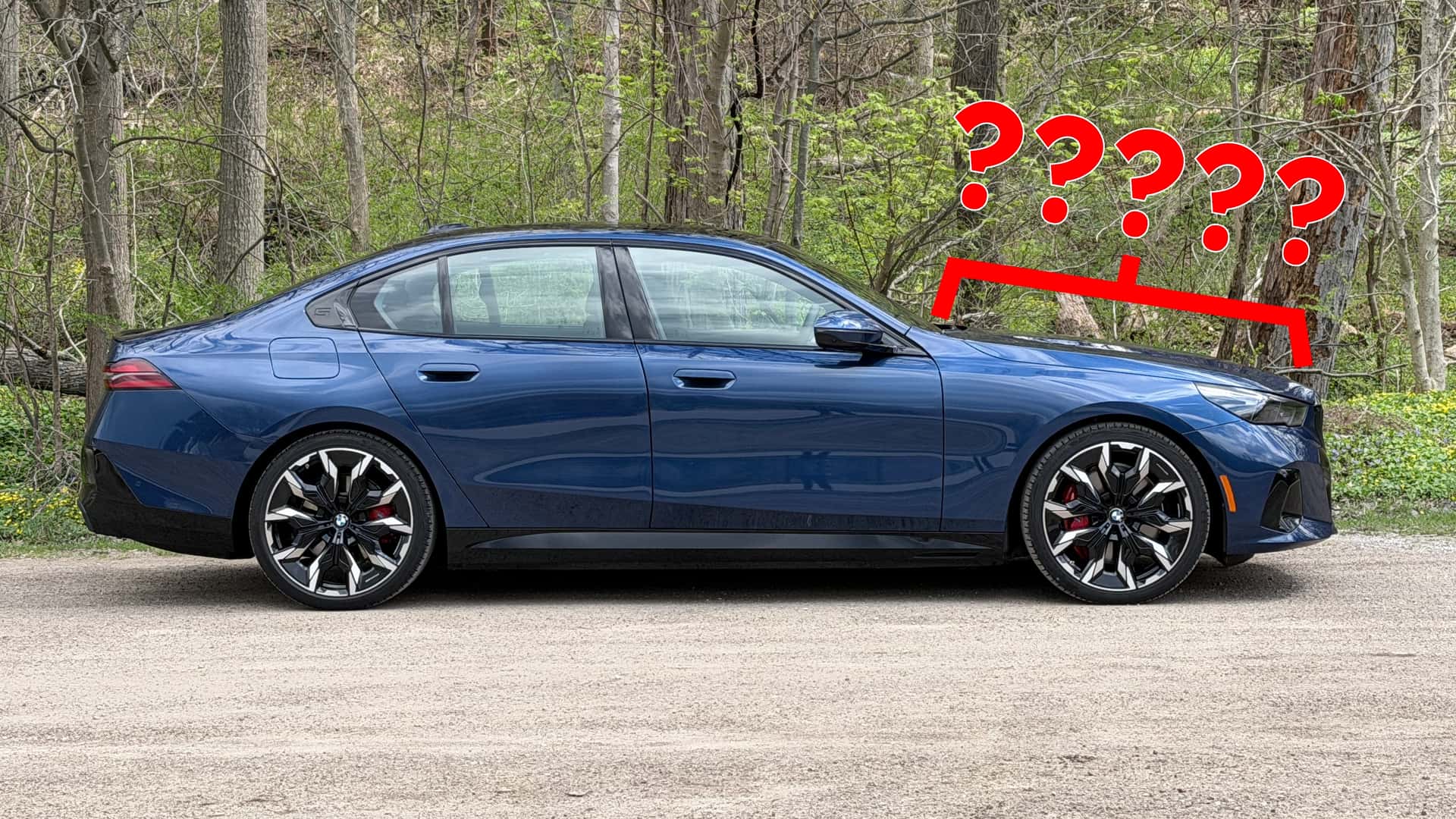
- A visual comparison of the BMW i5’s lengthy hood, which primarily houses power electronics and HVAC components rather than offering significant storage, highlights inefficient space utilisation.
- In stark contrast, electric vehicles built on a dedicated EV platform, such as the Tesla Model 3 and Lucid Air, demonstrate superior packaging, offering larger ‘frunks’ and greater combined cargo and passenger space despite similar or smaller external dimensions.
- The necessity to accommodate both bulky ICE components and EV powertrains on a shared chassis leads to increased vehicle weight and less flexible design, impacting overall practicality and efficiency.
- BMW has acknowledged these limitations and is transitioning to its new Neue Klasse platform, a dedicated EV platform promising enhanced driving dynamics, superior packaging, and advanced software for future electric models.
Unpacking the Shared Platform Compromise: The BMW i5 Case Study
Visual Evidence: An Oversized Hood Reveals Design Constraints
A compelling visual argument against platform sharing emerges from observing the BMW i5. Approximately 35% of the vehicle’s total length is dedicated to its hood. In a traditional gas-powered car, this substantial front section is necessary to house the engine, transmission, and cooling systems.
However, for an electric vehicle like the i5, which lacks a conventional engine block, such a voluminous hood immediately raises questions about efficient space utilisation. The visual disproportion suggests a design dictated by the needs of its fossil fuel-powered siblings rather than optimized for an electric powertrain.

What Lies Beneath: Inefficient Space Utilisation
Lifting the hood of the BMW i5 reveals a large plastic cover. Beneath this cover, one finds essential power electronics, such as the inverter, the front motor in all-wheel-drive variants, and the entire heating, ventilation, and air conditioning (HVAC) system. While these components are crucial for any EV, their placement within such a vast, engine-sized cavity highlights a critical design limitation.
The space occupied by these components, while necessary, does not fully exploit the potential benefits of an electric architecture. Crucially, there is no user-accessible front trunk, or ‘frunk,’ which has become a hallmark of efficiently designed electric vehicles. This absence points directly to the compromises inherent in adapting a chassis originally designed for an internal combustion engine.
The Advantage of Dedicated EV Platforms: A Comparative Analysis
Tesla Model 3: A Masterclass in Packaging Efficiency
To fully grasp the implications of a shared platform, it is instructive to compare the BMW i5 with vehicles engineered from the ground up as electric vehicles. The Tesla Model 3, though a significantly smaller vehicle than the i5, provides a clear example of superior packaging efficiency on a dedicated EV platform.
The Model 3 features a considerably shorter nose, yet it manages to integrate a drive motor, all necessary power electronics, the HVAC system, and a convenient, user-accessible frunk. This frunk offers an additional 3.1 cubic feet of storage space, a testament to the intelligent design allowed by a purely electric architecture. Despite its smaller overall footprint, the Model 3’s front-end design optimises space for both essential components and practical utility.
The dimensional comparisons further underscore this point. The Model 3 is 2 inches (51 mm) narrower and over a foot shorter than the i5 (186.9 inches vs. 199.2 inches, or 4747 mm vs. 5059 mm). Despite these smaller external dimensions, the Model 3 boasts significantly more combined cargo space (24.1 cubic feet) compared to the i5’s 17.3 cubic feet. It also offers 1.4 inches more front legroom, showcasing how a dedicated EV platform prioritises interior volume and usability.
Lucid Air: Redefining Space in Luxury EVs
For a more direct size comparison, the Lucid Air presents an even more compelling case for a dedicated EV platform. The Lucid Air is roughly the same size as the BMW i5, being just over 3 inches shorter and 1.4 inches wider. Yet, despite the i5 being a substantial 4.2 inches taller and significantly heavier than the lightest Air model (which still offers superior range), the Lucid Air far surpasses it in packaging efficiency.
The Air provides more headroom and legroom in both rows, a larger trunk, and a functional frunk. When both cargo areas are combined, the Lucid Air offers an impressive 32.1 cubic feet of space – nearly double that found in an i5. This remarkable difference illustrates the profound benefits of designing a vehicle exclusively for electric propulsion, where every cubic inch can be optimised for passenger comfort and cargo capacity.
Engineering Trade-offs: Why Shared Architectures Fall Short
The fundamental reason for these packaging discrepancies lies in the engineering compromises required by shared platforms. A vehicle chassis designed to accommodate large inline-six turbocharged engines, bulky V-8 hybrid powertrains, and extensive exhaust systems simply cannot be as space-efficient when adapted for an electric drivetrain. The architecture must retain the structural integrity and space necessary for the largest possible internal combustion engine (ICE) variant in its lineup.
This ‘lowest common denominator’ approach means that even the electric versions are saddled with design decisions that are irrelevant to their electric powertrain. The extensive front-end structure needed for crash absorption in an ICE vehicle, combined with the volume for engine components, dictates the proportions and, consequently, limits the potential for a large, functional frunk or a more cab-forward design that maximises passenger space.
In essence, while it might seem economically advantageous initially, building diverse powertrains on a single platform forces each variant to carry the burdens of the others’ requirements. For EVs, this translates into wasted space and compromised interior and cargo volume.
The Weight Conundrum: A Shared Burden
The compromises extend beyond mere space. Platform sharing also contributes significantly to vehicle weight. The latest gas-powered BMW 530i, for instance, is two inches taller and nearly 300 lbs heavier than its predecessor. While attributing this entirely to platform sharing might be an oversimplification, it is a strong indicator that the underlying structure is being beefed up to accommodate the heavier electric components and batteries, which in turn impacts the ICE variants.
This phenomenon is even more pronounced in high-performance plug-in hybrids. The range-topping BMW M5, which integrates complex plug-in hybrid hardware with a turbocharged V-8 engine, weighs an extraordinarily hefty 5,390 lbs. To put this into perspective, this places the M5’s mass on par with that of a dedicated performance EV like the Lucid Air Sapphire and hundreds of pounds heavier than a Tesla Model S Plaid. This substantial weight, often cited as a drawback for EVs, is clearly a challenge even for advanced hybrid models on shared platforms.
The ability for an automaker to offer serene electric powertrains, smooth inline-six engines, and powerful V-8s all on one platform is undeniably appealing from a manufacturing and market flexibility standpoint. It allows for easier adjustment to changing market demands for EVs, PHEVs, and traditional gas cars. However, the engineering reality, as demonstrated by these comparisons, remains clear: a jack of all trades will always struggle to be a master of any one.
BMW’s Forward Vision: Embracing the Dedicated EV Platform Future
Fortunately, industry leaders like BMW have recognised these inherent limitations and are pivoting their strategies. The future of BMW’s electric vehicle lineup will transition to its dedicated EV platform, known as the Neue Klasse. This new architecture is specifically engineered for electric propulsion, promising a radical improvement in design, performance, and efficiency.
Early indications suggest that the Neue Klasse platform will deliver superior driving dynamics, optimised packaging, and advanced software integration, surpassing the capabilities of any shared-architecture vehicle. The i4, i5, and i7, while commendable in their own right, served as crucial interim steps, necessary waypoints on the journey towards a truly purpose-built electric future.
The BMW iX, notably the sole dedicated EV platform model in BMW’s current generation of electric vehicles, stands as a testament to this future. It has consistently been lauded as clearly the best in its lineup, providing a glimpse into the advantages of uncompromised electric design. With the forthcoming arrival of the new i3 and larger sedans built on this dedicated EV platform, equipped with cutting-edge specifications, the automotive industry awaits a new era of BMW electric vehicles unburdened by the legacy of internal combustion engine architecture.
Frequently Asked Questions (FAQ)
What is a dedicated EV platform?
A dedicated EV platform is a vehicle architecture designed exclusively for electric powertrains, integrating batteries, motors, and power electronics optimally. Unlike shared platforms, it does not need to accommodate internal combustion engines, allowing for maximised interior space, better weight distribution, and enhanced performance from the ground up.
Why are shared EV platforms considered less efficient?
Shared platforms are less efficient because they must compromise to accommodate both electric and gasoline powertrains. This leads to design constraints like oversized engine bays, reduced passenger and cargo space (e.g., smaller frunks or no frunk), and often increased vehicle weight due to the need for structural reinforcement compatible with both systems.
How does a dedicated EV platform improve vehicle packaging?
A dedicated EV platform significantly improves packaging by placing batteries flat within the chassis floor, enabling a lower centre of gravity and freeing up space traditionally occupied by engines and fuel tanks. This allows for shorter hoods, larger ‘frunks,’ more spacious cabins, and flexible interior designs, enhancing overall utility and comfort.
Which car manufacturers use dedicated EV platforms?
Many prominent manufacturers are now moving towards or exclusively using dedicated EV platforms. Examples include Tesla (all models), Hyundai/Kia (E-GMP platform), Volkswagen (MEB platform), General Motors (Ultium platform), Ford (GE2 platform), and Lucid Motors. BMW’s upcoming Neue Klasse platform also represents a shift to a dedicated EV architecture.
What are the benefits of a dedicated EV platform for consumers?
For consumers, a dedicated EV platform translates to numerous benefits: more interior space and cargo volume (including larger frunks), improved driving dynamics due to better weight distribution, enhanced safety, longer range potential through optimised battery integration, and often more advanced infotainment and driver-assistance systems tailored for electric propulsion.
Will all future electric vehicles be built on dedicated platforms?
The trend in the automotive industry strongly indicates a move towards dedicated EV platforms for future electric vehicles. While some manufacturers may continue to adapt multi-energy platforms for certain models or markets for cost efficiency, the long-term strategic shift is towards purpose-built electric architectures to unlock the full potential of EV technology.