
Key Takeaways (TL;DR):
- Tesla has commenced mass production of its Cybercab robotaxi at Giga Texas.
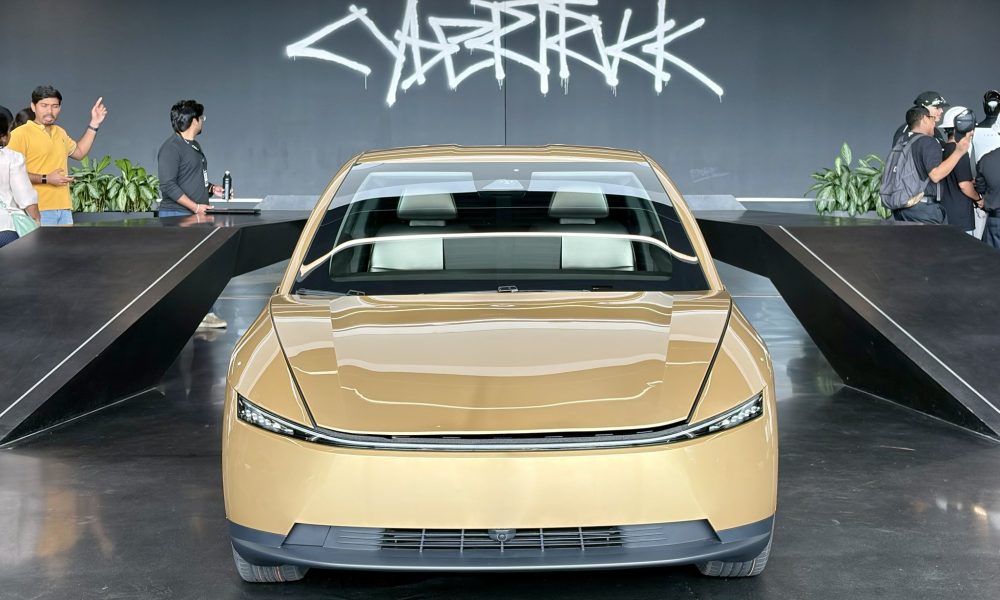
- The first production unit, ‘VIN Zero,’ features a dramatic champagne gold, high-gloss exterior, departing from earlier matte prototypes.
- This new finish is achieved through a specialized clear coat process, not conventional paint, signaling a premium aesthetic.
- The production ramp-up follows the first unit in February 2026, with aims for hundreds of units weekly.
- The Cybercab is central to Tesla’s vision of an unsupervised Full Self-Driving (FSD) robotaxi network, promising significantly reduced ride costs.
- The vehicle’s design emphasizes full autonomy with no steering wheel or pedals, alongside practical features like an open frunk.
A significant milestone has been achieved at Tesla’s Giga Texas facility as the company officially initiates mass production of its highly anticipated Cybercab robotaxi. The commencement of volume manufacturing marks a pivotal step in Tesla’s ambition to revolutionize urban mobility with fully autonomous vehicles.

The first units to emerge from the production line are showcasing a notable aesthetic departure from earlier prototypes. This striking design evolution is already garnering considerable attention within the electric vehicle (EV) community, highlighting Tesla’s commitment to both innovative technology and sophisticated presentation.
A Striking Debut: The Cybercab’s New Aesthetic
The inaugural production Cybercab, designated ‘VIN Zero,’ has unveiled a visually stunning transformation. Instead of the utilitarian, flat, matte-wrapped prototypes displayed at the 2024 ‘We, Robot’ event, the new production model boasts a vibrant champagne gold exterior, meticulously finished with a high-gloss sheen.
This dramatic shift in appearance represents a considerable pivot for Tesla, a company that has historically maintained a more subdued approach to custom colors and finishes. The premium, mirror-like shine of the Cybercab signals a fresh direction, enhancing the compact two-seater’s futuristic presence and adding a layer of luxury not previously associated with its test mules.
Beyond the Gloss: Engineering and Design Refinements
The sophisticated high-gloss finish is not merely a coat of paint; it is the result of a specialized clear coat or process designed to deliver deep, reflective qualities without conventional painting methods. This innovative approach underscores Tesla’s engineering prowess, integrating aesthetic enhancement with advanced manufacturing techniques.
Photographs circulating from Giga Texas, shared by prominent Tesla community members such as TechOperator on X (formerly Twitter) on April 23, 2026, provide an insightful glimpse into ‘VIN Zero.’ These images reveal refined panel gaps, robust aero wheel covers, and an interior specifically optimized for full autonomy, conspicuously lacking a steering wheel or pedals.
The design further incorporates practical elements, with an open frunk (front trunk) visible in some images, indicating ample storage capacity for a vehicle of its size. The overall build quality and attention to detail appear significantly more polished in these production models compared to their earlier developmental versions, reinforcing Tesla’s readiness for widespread deployment.
From Prototype to Production: Scaling Tesla’s Robotaxi Vision
The transition to mass production at Giga Texas is a critical phase in Tesla’s long-term strategy for autonomous mobility. Following the assembly of the first individual unit in February 2026, the company has rapidly escalated its efforts towards volume manufacturing.
Reports confirm that dozens of Cybercab units have already been observed in outbound lots, indicating a swift and efficient production ramp-up. CEO Elon Musk and his team have publicly articulated an ambitious goal: to produce hundreds of Cybercabs per week, setting the stage for the widespread implementation of unsupervised Full Self-Driving (FSD) robotaxi networks.
Tesla’s Grand Ambition: Unsupervised Autonomy and Ride-Hailing
At its core, the Tesla Cybercab embodies the company’s grand ambitions to operate a full-service ride-hailing system entirely devoid of human drivers. This vision aims to dramatically reduce the cost of transportation, potentially slashing ride expenses to mere pennies per mile, thereby making personal mobility more accessible and affordable.
While the complete realization of full autonomy remains an ongoing challenge for the automotive industry, Tesla has consistently advanced its Full Self-Driving suite through continuous over-the-air (OTA) software updates. These iterative improvements are central to gradually achieving the level of reliability and safety required for unsupervised robotaxi operations.
The development of the Cybercab underscores Tesla’s belief that true autonomy, coupled with purpose-built vehicles, is the key to unlocking a new era of transportation. This approach focuses on integrating hardware and software to create a seamless, efficient, and cost-effective personal transport solution.
The Future of Urban Mobility: Implications of Tesla Cybercab
The introduction of the Tesla Cybercab into mass production holds profound implications for the future of urban mobility and the broader transportation landscape. By targeting the development of a fully autonomous robotaxi network, Tesla is challenging conventional models of car ownership and public transit.
The potential for a fleet of self-driving electric vehicles to operate around the clock could significantly enhance operational efficiency, reduce traffic congestion, and lower carbon emissions in metropolitan areas. This next-generation transport solution promises not only convenience for consumers but also a more sustainable and optimized urban environment.
As Tesla continues its production ramp and refines its FSD technology, the Cybercab is poised to become a central player in the evolving ecosystem of autonomous electric vehicles. Its mass deployment could redefine personal transportation, fostering greater accessibility and contributing to a future where ride-hailing services are both ubiquitous and economically viable without the need for human intervention.
Frequently Asked Questions (FAQ)
What is the Tesla Cybercab?
The Tesla Cybercab is an upcoming autonomous robotaxi designed by Tesla. It is envisioned as a fully self-driving vehicle with no steering wheel or pedals, intended to operate within Tesla’s planned ride-hailing network to provide cost-effective, driverless transportation services.
Where is the Tesla Cybercab being mass-produced?
Mass production of the Tesla Cybercab has officially commenced at Tesla’s Giga Texas manufacturing facility. This marks a significant step in the company’s efforts to scale the production of its dedicated autonomous vehicle fleet for future deployment.
What is ‘VIN Zero’ in the context of Cybercab production?
‘VIN Zero’ refers to the very first production-ready unit of the Tesla Cybercab. Its unveiling signifies the completion of the vehicle’s development phase and the transition into full-scale manufacturing, showcasing the final design and production quality.
What is the new aesthetic change for the production Cybercab?
The production Cybercab features a dramatic aesthetic change from its prototypes. It now boasts a vibrant champagne gold exterior with a high-gloss finish, achieved through a specialized clear coat process rather than conventional painting, giving it a more luxurious and futuristic appearance.
What is Tesla’s goal for Cybercab production volume?
Tesla’s CEO Elon Musk and the company aim to achieve a production rate of hundreds of Cybercab units per week. This aggressive production ramp-up is crucial for building a substantial fleet necessary to launch and sustain a wide-ranging, unsupervised robotaxi service.
How does the Cybercab align with Tesla’s Full Self-Driving (FSD) ambitions?
The Cybercab is central to Tesla’s vision of an unsupervised FSD robotaxi network. It is designed from the ground up to be fully autonomous, relying on Tesla’s FSD software, which receives continuous over-the-air updates, to navigate and operate without human drivers, ultimately aiming to reduce ride costs significantly.
What are the key design features of the Cybercab’s interior?
The Cybercab’s interior is optimized for full autonomy, notably featuring no steering wheel and no pedals. This design emphasizes passenger space and experience, while also showcasing refined panel gaps, large aero wheel covers, and an open frunk for practical storage.