
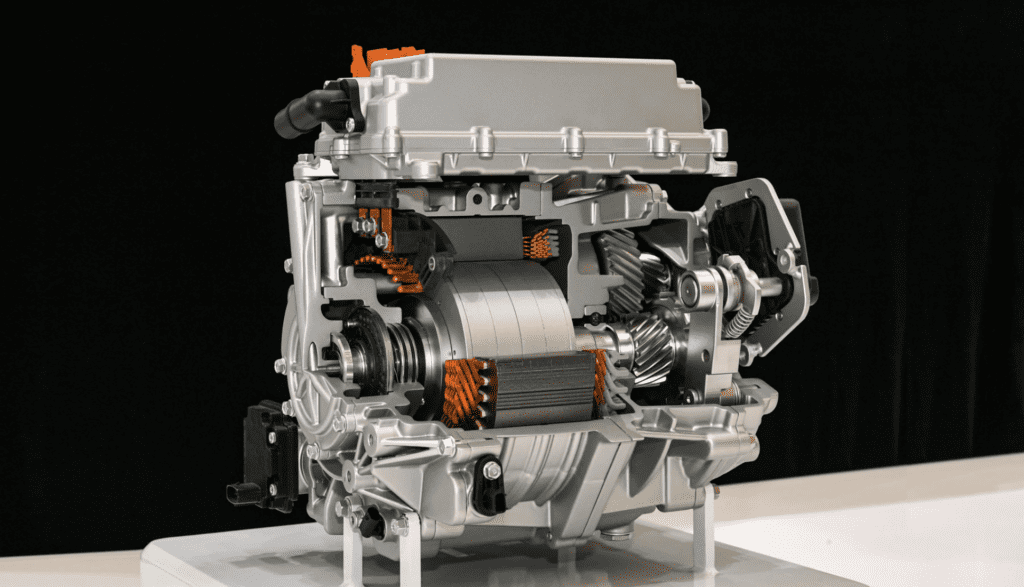
Key Takeaways: Hyundai Mobis has successfully developed a 160 kW Power Electric (PE) system designed as a universal platform for global EV manufacturers. This integrated unit, combining motor, inverter, and reduction gear, boasts a 16% improvement in specific power and a nearly 20% reduction in volume compared to previous designs. Achieved through modularity and standardized components, this innovation offers significant advantages in efficiency, compactness, and development flexibility for a wide range of electric vehicles, from compact models to high-performance segments. The company’s strategic roadmap includes a 250 kW high-performance system already completed and a 120 kW model targeting compact vehicles by mid-2026, positioning Hyundai Mobis as a key player in the evolving EV powertrain landscape.
Pioneering a Universal Electric Drivetrain Platform
SEO Keyword: EV drive system innovation

Hyundai Mobis, a leading global automotive supplier, has announced the successful development of a 160 kW Power Electric (PE) system, marking a significant step in electric vehicle (EV) powertrain technology. This new system is engineered not for a singular vehicle program but as a universal platform model, signaling a strategic shift towards standardized, versatile solutions for the rapidly expanding global EV market.
This innovative PE system integrates three crucial components—the electric motor, inverter, and reduction gear—into a single, compact unit. Such integration simplifies the powertrain architecture, reduces complexity, and optimizes performance, offering substantial benefits for original equipment manufacturers (OEMs) worldwide looking to streamline their EV development cycles and reduce manufacturing costs.
The 160 kW system is capable of delivering up to 215 horsepower, a power output that Hyundai Mobis confidently states is more than sufficient for the majority of electric vehicles currently in mass production. This positions the new drive system as a highly practical and broadly applicable solution for mainstream EV models, addressing the growing demand for efficient and reliable e-mobility components.
Advancing Efficiency and Compactness Through Smart Engineering
The newly developed PE system represents a notable leap in engineering efficiency. Compared to Hyundai Mobis’s prior approaches, the specific power—a critical metric measuring output per unit of weight—has improved by approximately 16%. This enhancement translates directly into lighter, more powerful vehicles, contributing to better range and overall performance.
Furthermore, the entire system’s volume has seen a remarkable reduction of nearly 20%. This compactness is a critical advantage for vehicle designers, allowing for greater flexibility in chassis design, optimized battery packaging, and increased interior space. These gains are primarily attributed to a sophisticated modular design, the implementation of standardized components, and a newly engineered motor cooling structure that enhances thermal management and operational efficiency.
The flexibility of this EV drive system innovation is further highlighted by its scalability. When two of these units are deployed—one on the front axle and one on the rear—the combined output effectively doubles to 320 kW, offering robust power for larger or performance-oriented electric vehicles. At the heart of this advanced system lies a power module built on high-efficiency power semiconductors, components vital for minimizing energy loss and maximizing the system’s overall electrical efficiency.
The Power of Standardization in EV Powertrains
A key enabler of these significant improvements is the standardization of three core components across the Hyundai Mobis PE system lineup: the drive motor stator, the inverter, and the power module. This platform approach allows the same fundamental architecture to be scaled and adapted across various vehicle classes without necessitating a complete powertrain redesign for each new program.
This methodology fundamentally diverges from how global automakers have traditionally co-developed component-specific systems in close collaboration with individual suppliers. By offering a standardized, universal platform, Hyundai Mobis aims to provide OEMs with off-the-shelf, high-performance solutions, accelerating their time-to-market and fostering greater innovation across the entire electric vehicle ecosystem.
A Comprehensive Portfolio for Diverse EV Segments
The 160 kW system is a pivotal addition to Hyundai Mobis’s expanding portfolio of electric powertrains. The company’s strategic roadmap for EV drive system innovation is clearly defined, addressing a wide spectrum of market needs.
Last year, Hyundai Mobis successfully completed a high-performance 250 kW PE system, catering to the demands of more powerful and premium electric vehicles. Looking ahead, a 120 kW model is slated for completion in the first half of 2026. This smaller, lighter, and more cost-effective system is specifically designed to target compact vehicles and emerging markets, where affordability and efficiency are paramount.
With the integration of the new 160 kW platform, Hyundai Mobis’s PE system lineup will comprehensively span small mobility solutions through to high-performance electric vehicles. This strategic breadth underscores the company’s commitment to supporting the global transition to electric mobility across all vehicle segments.
Global Market Interest and Future Outlook
The introduction of this advanced 160 kW EV drive system innovation has already garnered significant attention from the international automotive community. Hyundai Mobis has reported that overseas customers have expressed substantial interest in their latest PE system, indicating strong market validation for their universal platform approach and technological advancements.
This interest from global OEMs highlights the critical need for flexible, efficient, and cost-effective electric powertrain solutions that can be rapidly integrated into diverse vehicle architectures. Hyundai Mobis, as a key Tier-1 supplier, is strategically positioning itself to become a preferred partner for automakers navigating the complexities of EV development and production.
The company’s focus on modularity and standardization promises to streamline the supply chain, reduce development lead times, and ultimately contribute to the broader adoption of electric vehicles worldwide. As the EV market continues its rapid expansion, advancements in integrated and adaptable drive systems like those from Hyundai Mobis will be crucial for accelerating the transition to a sustainable transportation future.
Hyundai Mobis’s Vision for Future Mobility
This development is intrinsically linked to Hyundai Motor Group’s overarching commitment to leadership in the electric vehicle revolution. As the group’s component manufacturing arm, Hyundai Mobis plays a vital role in pioneering the core technologies that underpin the next generation of electric mobility. By focusing on robust research and development, particularly in areas like power electronics, integrated drive systems, and thermal management, Hyundai Mobis is reinforcing its position at the forefront of automotive innovation.
The continuous evolution of their PE systems, encompassing a range of power outputs and designed with universal applicability, demonstrates a clear vision for shaping the future of electric powertrains. This proactive approach ensures that Hyundai Mobis remains a critical enabler for global automakers striving to deliver high-performance, efficient, and environmentally friendly electric vehicles to consumers around the world.
FAQ Section
What is the key innovation of Hyundai Mobis’s new PE system?
The core innovation lies in developing a 160 kW Power Electric (PE) system as a universal platform model, meaning it’s standardized for various global OEM customers rather than being built for a specific vehicle. This modular approach integrates the motor, inverter, and reduction gear into a single unit, enhancing flexibility and efficiency for EV development.
What are the primary performance improvements of this new EV drive system?
The 160 kW system delivers up to 215 horsepower. It boasts a 16% improvement in specific power (output per unit weight) and a nearly 20% reduction in overall system volume compared to previous designs. These gains are achieved through modular design, standardized components, and an advanced motor cooling structure.
How does Hyundai Mobis’s platform approach differ from traditional OEM-supplier collaboration?
Traditionally, automakers co-developed component-specific systems with individual suppliers for each vehicle program. Hyundai Mobis’s platform approach, by standardizing core components like the drive motor stator, inverter, and power module, allows the same architecture to scale across various vehicle classes without requiring a full powertrain redesign per program.
What other PE systems are part of Hyundai Mobis’s product roadmap?
Beyond the new 160 kW system, Hyundai Mobis completed a 250 kW high-performance PE system last year. Additionally, a 120 kW model, specifically designed for compact vehicles and emerging markets with minimized size, weight, and cost, is planned for completion in the first half of 2026. This comprehensive lineup spans various EV segments.
What benefits does this modular EV drive system innovation offer to global automakers?
This modular and standardized PE system offers several benefits to global automakers, including reduced development time and costs, greater design flexibility due to its compact size, and a reliable, high-efficiency solution. Its universal platform nature allows for easier integration into diverse vehicle programs, accelerating the rollout of new EV models.