
Key Takeaways:
- DC-America offers prefabricated, skid-mounted EV charging platforms designed to expedite deployment and reduce installation costs for commercial fleets and public charging networks.
- These modular EV charging solutions integrate all necessary electrical components, including transformers and switchgear, and are factory-commissioned before shipment, drastically cutting on-site work to under four hours in many cases.
- The inherent flexibility of these platforms allows for easy relocation and upgrades, future-proofing investments against evolving technology and changing operational needs, crucial for fleet electrification strategies.
- Beyond rapid deployment, the systems support various charger types, enable smart power management for oversubscribed sites, and can integrate battery energy storage and other microgrid components.
- The company advocates for adaptable infrastructure strategies, particularly in the context of programs like NEVI, moving away from a one-size-fits-all approach to better suit diverse geographical and utilization demands.
The widespread adoption of commercial electric vehicles (EVs) hinges critically on robust and efficient charging infrastructure. While advancements in EV supply equipment (EVSE) hardware and sophisticated management software continue, a significant bottleneck persists: the costly, time-consuming, and often inflexible installation process of charging stations. Traditional site preparation, extensive trenching, and complex field commissioning often lead to delays and substantial capital outlays, posing a challenge for businesses navigating a rapidly evolving technological and operational landscape.

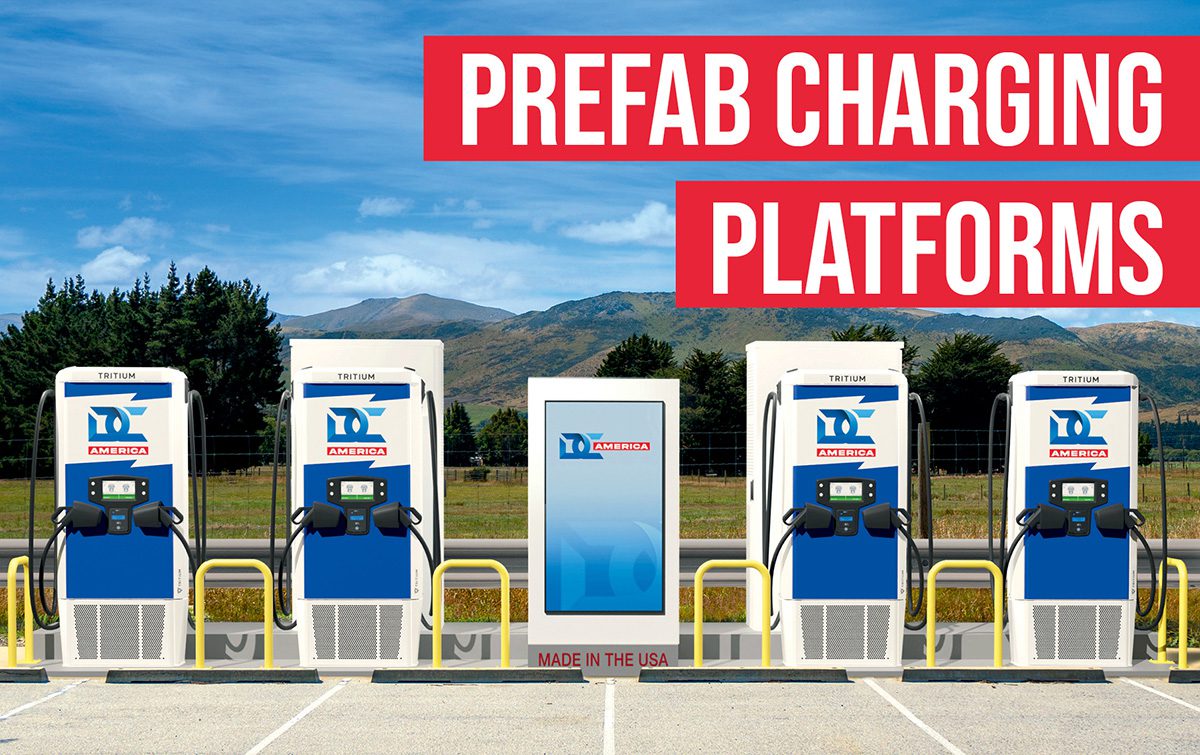
In response to these pervasive industry challenges, DC-America has pioneered an innovative approach: prefabricated, skid-mounted charging platforms. These turnkey solutions consolidate all essential electrical components—from transformers and switchgear to power cabinets and dispensers—onto a single metal skid. All welding, assembly, and crucial commissioning are completed at the company’s Huntington, West Virginia facility, drastically simplifying on-site deployment.
Tackling the Core Challenge of EV Charging Installation
The journey to electrify commercial fleets and expand public charging access is fraught with infrastructure hurdles. Companies frequently face the dilemma of installing permanent, inflexible hardware in dynamic business environments where fleet sizes grow, use cases evolve, and charging demands shift. Adding to this complexity is the frantic pace of technological evolution, making the prospect of ripping and replacing functionally obsolete EVSE after only a few years a significant concern.
While some companies explore mobile charging solutions, such as trailer-mounted units or self-contained solar-powered stalls, DC-America provides a solution that offers the permanence of traditional installations with unparalleled flexibility. By prefabricating complete charging stations on skids, the company effectively mitigates the common pain points associated with conventional installations.

The DC-America Advantage: Modular EV Charging Solutions
DC-America’s approach is rooted in applying proven industrial prefabrication techniques to the EV charging sector. Nathan Bowen, President of DC-America, explains the genesis of this innovation: “I was building prefabricated skids for the energy industry—natural gas compressor stations, or stuff that would go at a power plant. My background’s in the electrical field, so my aspect of it was doing the wiring, commissioning, pre-wiring sensors.”
The company leveraged this expertise when NEVI funding emerged around 2021, recognizing a critical need in the nascent EV market. Their prefabricated charging platforms encapsulate virtually any component found on a charging site, including electrical switchgear, panel boards, transformers, and combinations of Level 2 and DC fast chargers.
These skids can also integrate ancillary electrical components such as light poles and cameras. A key benefit is the significant reduction in trenching required on-site. Bowen highlights the remarkable speed of deployment: “We can deploy these in less than four hours in most cases.” This rapid installation capability offers substantial time and cost savings for operators.
After a couple of years refining their product and market strategy, the modular EV charging solutions have gained considerable traction, particularly in the “fleet behind-the-fence” space and among Charge Point Operators (CPOs) seeking efficient public charging station deployments. This innovative methodology directly addresses the industry’s need for faster, more economical infrastructure rollout.
Enhanced Flexibility and Future-Proofing for Evolving Needs
One of the paramount advantages of DC-America’s prefabricated charging platforms is their inherent flexibility, offering a robust future-proofing mechanism for EV infrastructure investments. Businesses often lease their operating spaces or anticipate future changes in their operational footprint, making permanent, in-ground infrastructure a risky long-term commitment.
Bowen explains the strategic benefit: “There are many advantages to it: quick deployment obviously, but in a lot of cases, especially in fleet behind-the-fence, what we see is either that folks are leasing their space, or they’re potentially interested in redeployment. Things change, and they want to have the ability to move infrastructure to where they need it without losing all that underground infrastructure investment. As quickly as we can put it in the ground, we can disconnect it, put it on a truck, and send it down the road.” This capability is vital for businesses requiring adaptability.
The solutions span a spectrum from permanent installations to truly mobile units. While many are intended for long-term deployment, smaller platforms can be designed for full mobility, suitable for rapid relocation in a pickup truck with quick connections. This versatility underscores DC-America’s commitment to meeting diverse customer needs.
Customization is also a cornerstone of their service. DC-America works with any charger manufacturer, allowing customers to provide their own hardware or select from the company’s established relationships. They also undertake custom designs, such as creating mobile units that convert single-phase power into the three-phase 480 VAC required by DC fast chargers, addressing specific utility constraints.
Furthermore, the integration of battery energy storage systems (BESS) is becoming increasingly relevant, especially for public charging. BESS can buffer demand fees, but their optimal impact can vary by location and utilization rates. The ability to redeploy charging infrastructure, including BESS, allows operators to optimize these investments over time. Bowen notes, “This skidded infrastructure gives you a good base for keeping up with technology advances because you can change hardware after the fact.” The open raceway system within the skid allows for easy swapping of components, facilitating upgrades from all-in-one chargers to more advanced distributed DC systems without costly civil work.
Comprehensive Integration: Components and Customization
DC-America’s prefabricated charging platforms are designed to integrate a wide array of components, offering a truly comprehensive solution. Beyond the core chargers, dispensers, power cabinets, transformers, and panel boards, customers can specify the inclusion of battery storage, emergency shutdown (ESD) buttons, multiple power sources, canopies, bollards, and even amenities like tire filling stations and vacuum cleaners. This modularity means that a complete, functional charging ecosystem can be delivered and installed with minimal on-site complexity.
While the company prioritizes standardization to achieve cost efficiencies and production scalability—with standard skid sizes designed to accommodate 80% of typical equipment footprints and parking stall widths—they also excel in handling unique requirements. “We can handle the non-standard stuff, but it’s a big advantage to prefabricated infrastructure to try to replicate it and build it over and over the same way,” Bowen explains. This flexibility allows for modifications to navigate site-specific challenges like wide parking spots for large trucks, shrubbery, or tight turns, ensuring a tailored fit for every deployment.
Strategic Partnerships and In-House Commissioning Expertise
DC-America’s business model is primarily focused on manufacturing and supporting major players in the EV charging ecosystem rather than directly competing with them. Roughly 90% of their business caters to companies offering ‘charging as a service,’ ‘trucks as a service,’ and CPOs. While they occasionally provide turnkey solutions for local initiatives, such as school districts or turnpike authorities in West Virginia, their core mission is to empower charging providers with efficient infrastructure.
A critical aspect of their offering is the pre-commissioning of chargers at their facility. This process involves meticulous attention to detail, starting with the panel board settings. For higher-amperage breakers, this includes configuring overcurrent protection, LSIG (an advanced system for overload, short circuits, and ground faults), and arc flash remediation based on the utility’s specific circuit. The wiring is rigorously tested, insulation breakdown is checked, and point-to-point communication (CAT5 or CAN bus) is verified.
The commissioning also encompasses the firing up of chargers, configuring SIM cards for communication, and in some cases, coordinating with charge management software and payment terminals. Bowen emphasizes the immense value of this pre-delivery process: “I think it’s a huge selling point to have the chargers pre-commissioned. When I roll out there, I’m charging a vehicle within a few hours, I’ve already worked out all the bugs.” This meticulous preparation ensures a smooth and rapid on-site activation, enhancing trust and efficiency for the site host.
Navigating Key Technical Discussions in EV Charging
Distributed vs. Standalone Charging
The debate between distributed and standalone charging units remains prominent. Bowen highlights the advantage of distributed systems, particularly when ‘oversubscribing’ a site. Oversubscription occurs when the cumulative nameplate power capacity of installed chargers exceeds the input power available from the utility (e.g., 1,800 amps of charger capacity on a 1,000-amp service). In such scenarios, dynamic, distributed systems leverage software to intelligently reallocate power based on vehicle state of charge, maintaining optimal charging rates across multiple vehicles. While all-in-one chargers are simpler to install, dynamic distributed systems, especially when paired with an open raceway system like DC-America’s, offer superior power management for high-utilization or constrained sites.
Onsite vs. Cloud-Based Processing
For energy management and other critical functions, Bowen expresses a preference for onsite hardware over purely cloud-based processing. He argues that hardwired, onsite controllers provide more granular, real-time information and greater resilience. “Especially if you’re wanting granular information, there’s nothing like having a hardwired input into a controller rather than going up to a cloud and coming back down and getting delayed information,” he states. This approach also ensures system operation even if 5G connectivity is lost, a crucial consideration for reliable infrastructure.
Credit Card Readers and Microgrids
Integrating credit card readers into public charging stations presents its own set of challenges, particularly regarding security and robust outdoor functionality, despite their ubiquitous presence at gas stations. On the microgrid front, DC-America can integrate various components, including solar panels, battery energy storage, and even propane generators, for off-grid or enhanced resilience applications. While large-scale solar canopies may not fully power DC fast charging due to scale, their integration into broader energy management strategies is possible. Vehicle-to-Grid (V2G) technology, particularly for school buses, is seen as an ideal application, offering benefits beyond just grid support, potentially extending battery life through intelligent discharge cycles.
Challenges and Adaptations in the NEVI Program
The National Electric Vehicle Infrastructure (NEVI) program, designed to build out a nationwide EV charging network, has faced implementation complexities. Bowen, observing from a rural state like West Virginia, notes the infrequency of non-Tesla infrastructure and the incompatibility issues with many existing Tesla Superchargers. While DC-America has contributed to crucial installations on the West Virginia Turnpike, meeting NEVI’s mandate of four 150-kilowatt chargers every 50 miles presents significant challenges in underutilized rural areas.
“It’s very difficult in a rural state like this to put in what NEVI was speccing out: four 150-kilowatt chargers, every 50 miles. Some people are going to disagree with me on this, but it’s difficult for that to make sense in every location. There’s just not enough utilization. It’s not going to make money,” Bowen explains. He advocates for greater state latitude in program implementation, emphasizing the importance of sizing infrastructure for future growth rather than imposing a rigid, one-size-fits-all solution.
This perspective strongly aligns with DC-America’s product philosophy, which enables operators to install smaller, initial setups and easily expand them as demand grows, minimizing upfront investment risk and maximizing long-term viability. Such adaptable strategies are vital for ensuring the success of public charging initiatives across diverse geographic and economic landscapes.
Conclusion
The deployment of robust and adaptable EV charging infrastructure is paramount for the acceleration of electric vehicle adoption. DC-America’s prefabricated charging platforms offer a compelling solution to the industry’s most pressing challenges: the high cost and complexity of installation, and the need for future-proofed, flexible systems. By delivering factory-assembled, pre-commissioned modular EV charging solutions that can be rapidly deployed and easily relocated or upgraded, the company is enabling faster, more efficient, and more resilient fleet electrification and public charging network expansion.
As the EV ecosystem continues its rapid evolution, innovative approaches like those offered by DC-America will be critical in creating a sustainable and accessible charging landscape, ensuring that infrastructure keeps pace with the growing demands of electric mobility.
Frequently Asked Questions (FAQs)
What is DC-America’s modular charging platform?
DC-America’s modular charging platform is a prefabricated, turnkey EV charging station where all necessary electrical components, such as chargers, transformers, and switchgear, are mounted on a single metal skid. These units are assembled and pre-commissioned at their facility, significantly reducing on-site installation time and complexity for various EV charging applications.
How do these prefabricated platforms save time and money?
These platforms save time and money by minimizing on-site civil work like trenching and complex wiring. With factory assembly and pre-commissioning, deployment can often be completed in less than four hours. This approach reduces labor costs, accelerates project timelines, and avoids expensive disruptions commonly associated with traditional, stick-built installations.
Are DC-America’s modular solutions truly mobile?
DC-America offers a range of flexibility, from permanent installations with redeployment capabilities to truly mobile units. Some smaller platforms are designed with quick connections and can be easily transported by a pickup truck, specifically intended for temporary or frequently changing charging needs. This spectrum covers both semi-permanent and fully mobile requirements.
Can existing chargers be integrated into these platforms?
Yes, DC-America’s prefabricated charging platforms are designed for flexibility. They can integrate chargers provided by the customer, or they can supply chargers from their relationships with major manufacturers. This allows operators to leverage existing hardware investments or select preferred brands, ensuring compatibility and maximizing utility for specific fleet or public charging requirements.
How does DC-America’s approach address future technology changes?
The skidded infrastructure is inherently future-proof. Its open raceway system allows components to be swapped out as technology evolves, such as upgrading from all-in-one chargers to distributed DC systems. This prevents the need for extensive civil work during upgrades, protecting initial infrastructure investments and allowing for adaptability to new charging standards and hardware.
What role does commissioning play in the solution?
Commissioning is a crucial pre-deployment step performed at DC-America’s facility. It involves setting up breaker protection, testing wiring, checking insulation, verifying communication connections (CAT5/CAN bus), and integrating charge management software and payment terminals. This rigorous process ensures the system is fully functional and debugged before arrival, enabling rapid, trouble-free activation on site.
How do modular platforms help with NEVI program challenges?
Modular platforms align with the need for flexible infrastructure, particularly in the context of NEVI program challenges in rural areas. Instead of forcing a large, potentially underutilized station, modular solutions allow for smaller initial deployments that can easily expand. This adaptability helps states meet charging needs more economically and efficiently, addressing utilization concerns and advocating against a one-size-fits-all approach.