
Key Takeaways
- Modern EV architectures demand advanced validation for high-bandwidth networks like 10GBASE-T1 Automotive Ethernet, crucial for ADAS and autonomous driving.
- Traditional road testing is often insufficient, costly, and lacks repeatability for complex connectivity fault scenarios.
- Automated MEMS-based fault insertion emerges as a superior laboratory solution for simulating real-world network errors with precision.
- This innovative approach significantly enhances test repeatability, safeguards signal integrity, and accelerates Hardware-in-the-Loop (HIL) validation processes.
- By moving testing to controlled lab environments, engineers can build greater confidence in the reliability and performance of high-speed automotive networks.
As the automotive industry accelerates towards an electrified and autonomous future, the complexity of in-vehicle communication networks is growing exponentially. Electric Vehicle (EV) architectures, now brimming with sophisticated Advanced Driver-Assistance Systems (ADAS) and foundational components for fully autonomous capabilities, necessitate an unprecedented level of data transfer. This paradigm shift demands robust and reliable high-bandwidth connectivity, making multi-gig automotive ethernet validation a critical frontier for test engineers worldwide.
The traditional network infrastructures once prevalent in vehicles are no longer sufficient to handle the vast streams of data generated by an array of sensors, cameras, and processing units. The transition to advanced Ethernet standards, particularly 10GBASE-T1, represents a significant leap in meeting these formidable demands. However, validating these high-speed links presents a unique set of challenges that traditional testing methodologies struggle to address effectively.

The Imperative for High-Speed Automotive Ethernet
The evolution of modern vehicles, particularly Electric Vehicles, is inextricably linked to advancements in their internal data backbone. Features like advanced infotainment systems, real-time sensor data fusion for environmental perception, and vehicle-to-everything (V2X) communication require networks capable of transmitting data at multi-gigabit speeds. Automotive Ethernet, with its scalability and robust design, has emerged as the de facto standard to support these burgeoning requirements.
Specifically, the 10GBASE-T1 standard provides the necessary bandwidth to support high-resolution cameras, LiDAR, radar, and ultra-fast communication between numerous Electronic Control Units (ECUs). This transition from slower, point-to-point connections to a high-speed, switched Ethernet architecture enhances both performance and scalability. However, with increased speed comes increased sensitivity to signal integrity issues and potential connectivity faults, underscoring the vital role of comprehensive multi-gig automotive ethernet validation.
Why Traditional Testing Falls Short
Historically, much of the validation for in-vehicle networks relied on extensive road testing. While crucial for real-world environmental exposure, this method is inherently time-consuming, expensive, and often struggles with repeatability. Simulating specific, intermittent fault conditions that might occur once in a thousand hours of driving is nearly impossible in an uncontrolled environment. This unpredictability makes precise fault diagnosis and resolution incredibly challenging for test engineers.

Moreover, the sheer volume of potential fault scenarios, from cable degradation and connector issues to electromagnetic interference (EMI) and power fluctuations, makes exhaustive road testing impractical for high-speed networks. The safety-critical nature of ADAS and autonomous driving systems further amplifies the need for highly reliable and exhaustively tested network performance, pushing the boundaries of conventional validation techniques.
Pioneering Validation with MEMS Fault Insertion
To overcome the limitations of traditional methods, the automotive industry is increasingly turning to sophisticated laboratory-based solutions. Automated MEMS (Micro-Electro-Mechanical Systems)-based fault insertion technology stands at the forefront of this innovation, offering a precise and repeatable method for multi-gig automotive ethernet validation. This approach allows test engineers to meticulously simulate a wide array of real-world connectivity faults within a controlled lab environment.
MEMS switches, known for their compact size, high reliability, and rapid actuation, enable the injection of specific fault conditions directly into the Ethernet link. These faults can range from open circuits and short circuits to impedance mismatches and intermittent disconnections, mimicking the stresses and failures networks might encounter over a vehicle’s lifespan. The precision of MEMS technology ensures that these faults are applied consistently, allowing for highly repeatable testing and accurate data collection.
Simulating Real-World Scenarios with Precision
The core advantage of MEMS-based fault insertion lies in its ability to replicate complex, transient network anomalies that are otherwise difficult to capture. By controlling the exact timing, duration, and nature of a fault, engineers can methodically test the network’s resilience, error handling capabilities, and recovery mechanisms. This includes evaluating how different ECUs react to signal degradation or momentary loss of communication, which is paramount for functional safety in ADAS and autonomous systems.
Such controlled simulation moves beyond merely identifying a fault; it facilitates understanding the root cause and verifying the effectiveness of mitigation strategies. This level of insight is indispensable for developing robust and fail-safe automotive network designs, ensuring that vehicles can maintain critical functions even when confronted with unexpected communication disruptions.
Unlocking Key Benefits for Automotive Network Testing
The adoption of automated MEMS-based fault insertion for multi-gig automotive ethernet validation brings several transformative benefits to the testing landscape:
Enhanced Repeatability and Test Efficiency
One of the most significant advantages is the dramatic improvement in test repeatability. Unlike road testing, where environmental variables and driving conditions are difficult to replicate precisely, a lab-based MEMS system can execute the exact same fault scenario multiple times. This consistency is vital for debugging, regression testing, and ensuring that software and hardware updates do not inadvertently introduce new vulnerabilities. It allows engineers to iterate quickly on design improvements, significantly reducing development cycles and costs.
Protecting Signal Integrity at High Speeds
For 10GBASE-T1 Ethernet, maintaining signal integrity is paramount. Even minor disruptions can lead to data corruption or complete communication failure. MEMS-based fault insertion systems are designed to introduce faults with minimal impact on the underlying signal characteristics when no fault is active. This ensures that when a fault is deliberately introduced, its impact is isolated and attributable, providing clear insights into the network’s performance under stress. The ability to precisely control the fault ensures that the integrity of the test signal itself is not compromised, leading to more accurate and reliable test results.
Accelerating Hardware-in-the-Loop (HIL) Validation
Hardware-in-the-Loop (HIL) simulation is a cornerstone of modern automotive validation, allowing engineers to test ECUs and other hardware components within a realistic, simulated environment. Integrating MEMS-based fault insertion into HIL setups dramatically enhances their capabilities. Engineers can inject various network faults directly into the communication paths of the hardware under test, observing how the physical components react in real-time. This accelerates the validation process by enabling comprehensive testing of system responses to network anomalies long before full vehicle prototypes are available, leading to earlier detection and resolution of critical issues in multi-gig automotive ethernet validation.
Building Greater Confidence in Network Performance
Ultimately, the rigorous and repeatable testing afforded by automated MEMS fault insertion builds unprecedented confidence in the performance and reliability of high-speed automotive networks. By thoroughly testing resilience against a wide spectrum of connectivity faults, manufacturers can ensure that ADAS and autonomous driving features operate flawlessly under diverse and challenging conditions. This heightened assurance is crucial for vehicle safety, customer trust, and compliance with increasingly stringent industry regulations.
The Future Landscape of Automotive Network Testing
As EV architectures continue to evolve, incorporating even higher data rates and more complex network topologies, the demand for sophisticated multi-gig automotive ethernet validation tools will only intensify. Future advancements may include integrating AI and machine learning into fault insertion systems to predict potential failure modes based on vehicle usage data, or to automatically generate and execute optimal test sequences for emerging standards.
The ongoing partnership between test equipment developers and automotive engineers will be critical in pushing the boundaries of what is possible in network validation. By embracing technologies like MEMS-based fault insertion, the industry can ensure that the promise of advanced EVs, with their intelligent and interconnected systems, is fully realized through unparalleled reliability and safety.
Further Insights into Multi-Gig Automotive Ethernet Validation
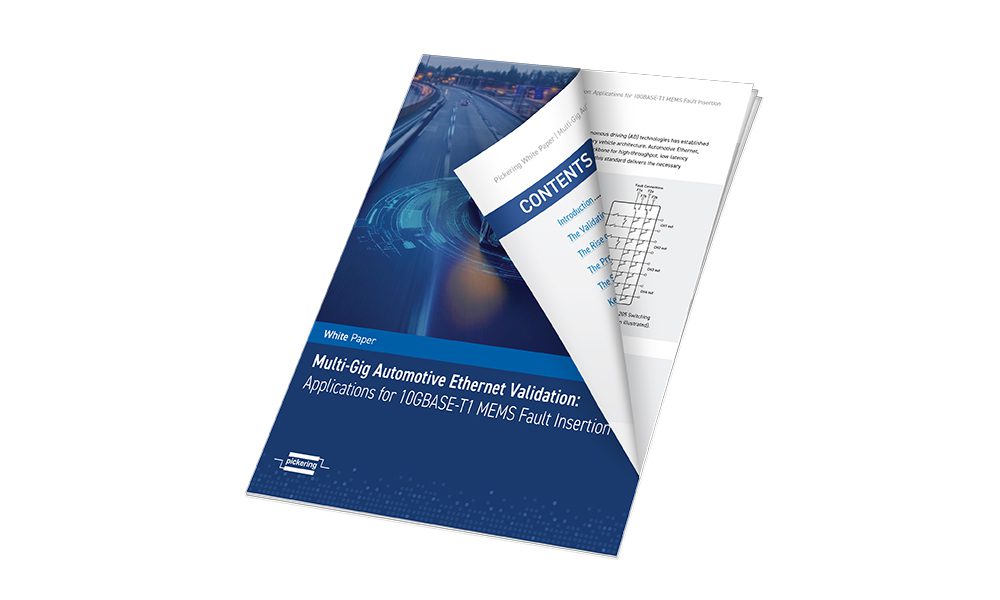
For test engineers and automotive professionals seeking to delve deeper into the practical applications and technical specifics of this transformative technology, a comprehensive guide is available. This white paper provides invaluable insights into how automated MEMS-based fault insertion can elevate testing strategies, detailing practical approaches for improving repeatability, safeguarding signal integrity, accelerating HIL validation, and instilling greater confidence in high-speed automotive network performance. Exploring these detailed methodologies can significantly enhance understanding and implementation strategies in this rapidly evolving field.
Frequently Asked Questions About Automotive Ethernet Validation
What is multi-gig Automotive Ethernet validation?
Multi-gig Automotive Ethernet validation involves rigorous testing of high-speed in-vehicle networks, such as 10GBASE-T1, to ensure their reliability, performance, and compliance with industry standards. It’s crucial for supporting data-intensive applications like ADAS, autonomous driving, and advanced infotainment systems in modern EVs.
Why is 10GBASE-T1 critical for modern EVs?
10GBASE-T1 provides the necessary high bandwidth to handle the immense data streams from multiple sensors, cameras, and processing units in modern EVs. It enables real-time data fusion, supports complex autonomous driving algorithms, and facilitates rapid communication between vital Electronic Control Units (ECUs), enhancing overall vehicle intelligence and safety.
What are the limitations of traditional road testing for network validation?
Traditional road testing is costly, time-consuming, and often lacks the repeatability needed for comprehensive network validation. It’s challenging to consistently recreate specific, intermittent connectivity faults or precisely control environmental variables, making it difficult to diagnose and resolve complex network issues efficiently for high-speed systems.
How does MEMS-based fault insertion improve testing?
MEMS-based fault insertion uses micro-electromechanical systems to precisely and repeatedly inject specific connectivity faults (e.g., opens, shorts, impedance mismatches) into an Ethernet link within a controlled lab environment. This allows engineers to systematically test network resilience, error handling, and recovery mechanisms with high accuracy and consistency.
What benefits does automated fault insertion offer for HIL validation?
Automated fault insertion significantly accelerates Hardware-in-the-Loop (HIL) validation by enabling the precise injection of network faults directly into the communication paths of physical ECUs under test. This allows for early and comprehensive testing of how hardware components react to network anomalies, identifying and resolving critical issues long before full vehicle integration.
How does this technology enhance signal integrity protection?
MEMS-based fault insertion systems are designed to introduce faults with minimal impact on the baseline signal integrity when inactive. This precision ensures that when a fault is deliberately applied, its effect is isolated and measurable, providing clear insights into the network’s performance under stress without compromising the quality of the test signal itself, which is vital for high-speed data transmission.
Why is repeatability so important in automotive network testing?
Repeatability is crucial in automotive network testing because it allows engineers to consistently reproduce specific fault conditions and observe system responses. This consistency is essential for accurate debugging, validating software updates, performing regression tests, and ensuring that design improvements effectively address identified vulnerabilities, ultimately leading to more reliable vehicle systems.