
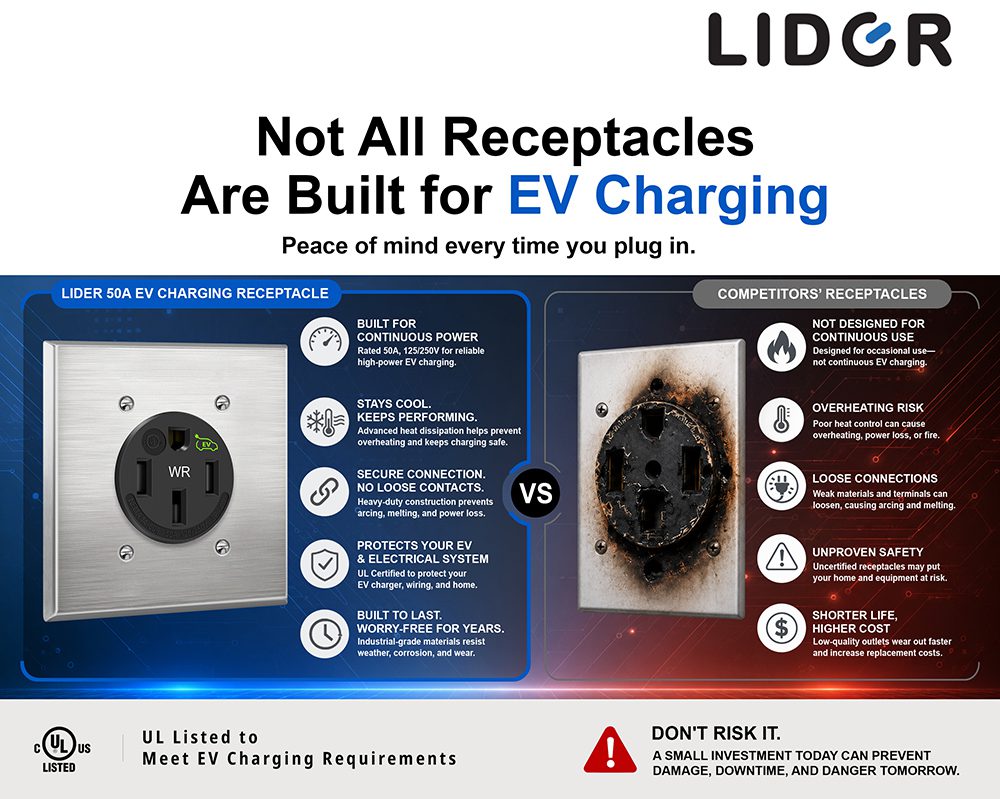
Key Takeaways (TL;DR):
- EV charging reliability extends beyond the charger and vehicle, with the receptacle serving as a crucial, often overlooked, connection point.
- Standard receptacles are not always designed for the sustained electrical load and repeated use inherent in daily Level 2 EV charging.
- Lider Electric’s LN-1450RH and LN-1450RHW NEMA 14-50 receptacles with Electric Vehicle Marking are purpose-built for EV applications.
- These receptacles feature UL certification specifically identifying them for EV-related use, providing installers and consumers with documented assurance.
- Advanced engineering, including fortified enclosures, silver-plated brass contacts, and secure wiring clamps, ensures long-term performance and heat management.
- The Electric Vehicle Marking clarifies product suitability, differentiating certified devices from generic alternatives in a rapidly expanding market.
As electric vehicle (EV) adoption accelerates globally, discussions surrounding charging infrastructure often focus on high-level components such as charger output, vehicle compatibility, software integration, and utility grid capacity. While these system-level elements are undoubtedly critical, a foundational yet frequently overlooked physical component plays an indispensable role in the long-term reliability of residential and light commercial EV charging setups: the electrical receptacle.

Specifically, for plug-in Level 2 charging, the NEMA 14-50 receptacle acts as the vital interface where a building’s electrical system meets the charging equipment. It is at this precise connection point that wiring integrity, contact pressure, mechanical fit, heat dissipation, repetitive use cycles, and overall installation quality converge to dictate charging performance. From an outward perspective, it might resemble a standard wiring device, but in the context of daily EV charging, it transforms into an integral part of the essential charging infrastructure.
This critical connection point is the focal point of Lider Electric’s LN-1450RH and LN-1450RHW NEMA 14-50 receptacles. These models have achieved the latest UL certification documentation, which now identifies them with Electric Vehicle Marking. This marking offers installers, inspectors, and end-users a clear and unambiguous method to recognise their specific certification status for EV applications. This combination of robust certification, distinct marking, and meticulous product design underscores Lider Electric’s steadfast commitment to safety-conscious product development, unparalleled connection reliability, and consistent long-term charging performance.
Why EV Charging Demands Specialised Receptacle Design
Unlike many household electrical events, EV charging is not a transient power draw. For a significant number of drivers, it represents a recurring duty cycle: plugging in, charging for several hours, unplugging, and repeating this sequence daily. This consistent pattern imposes a sustained and demanding electrical load on the entire pathway, particularly within residential garages, private driveways, workshops, multi-family residences, and light commercial environments.

Within this rigorous operational context, the selection of electrical components, especially the receptacle, must transcend basic plug configuration and mere price considerations. A receptacle designated for EV-related applications necessitates a thorough evaluation that accounts for continuous daily usage, prolonged sustained electrical loads, the ability to maintain secure wiring connections, efficient heat management capabilities, and exceptional long-term durability. These factors are paramount for ensuring a safe and reliable charging experience over the lifespan of the vehicle and the charging setup.
It is important to acknowledge that the receptacle does not function in isolation. Its performance is intrinsically linked to other elements of the electrical system, including appropriate breaker selection, accurate wire sizing, effective grounding, proper enclosure selection, correct terminal torque, adherence to local code compliance, and professional, qualified installation. However, the receptacle remains the point where electrical performance translates into direct physical contact, making it a foundational and influential component within the overarching EV charging infrastructure.
Engineering for Sustained EV Charging Use
Lider Electric’s systematic approach to NEMA 14-50 receptacle design is fundamentally rooted in a deep understanding of how EV charging is practically utilised. The products are meticulously engineered to accommodate repeated charging sessions, handle sustained electrical demand consistently, and deliver reliable connection performance over extended periods. This user-centric design philosophy directly addresses the unique challenges posed by electric vehicle charging.
The LN-1450RH and LN-1450RHW models are rated for 50A, 125/250V, and are specifically engineered for EV-related installations where consistent, long-duration charging performance is a critical requirement. Their core design priorities encompass ensuring reliable power delivery at the critical connection point, incorporating heavy-duty NEMA 14-50 construction for robust physical integrity, maintaining secure connection performance even under prolonged electrical loads, utilising contacts specifically designed to resist heat during extended operation, and providing clear product identification through the prominent Electric Vehicle Marking.
This meticulous attention to detail is particularly significant in a market where numerous products may superficially appear similar in online listings. While two receptacles might share the identical plug configuration, they can diverge considerably in their internal construction, contact design, material selection, terminal strength, and, crucially, their certification status. For both professional installers and discerning buyers, these often-hidden internal details can profoundly influence the confidence with which a product is selected for an essential EV-ready electrical upgrade. This makes the clarity provided by features like Electric Vehicle Marking invaluable.
Lider Electric’s stance on this issue is clear and unequivocal: for the demands of daily EV charging, product selection should never be based solely on price or simple plug configuration. The company dedicates its efforts to superior engineering, selection of advanced materials, rigorous safety-conscious product development, and ensuring dependable performance. This commitment empowers EV owners and trade professionals to make more informed and confident decisions at the critical connection point, prioritising long-term safety and reliability.
Inside the Engineering: Core Components for Reliability
The innovative EV charging receptacle design from Lider Electric places a strong emphasis on internal components engineered to support stable connection performance, even under sustained and demanding use. Key design specifications and material selections underscore this commitment to durability and reliability:
- Fortified nylon enclosure: Reinforced with glass fibers, this enclosure enhances overall durability, significantly improves heat resistance, and provides superior wear resistance, crucial for longevity.
- Silver-plated solid H65 brass contacts: These contacts are specifically designed for optimal conductivity and offer robust resistance to oxidation, ensuring efficient and stable electrical flow over time.
- V-shaped high-purity ETP copper clamp: Fabricated from copper with a purity of ≥ 99.9%, this clamp is expertly designed to securely hold both stranded and solid wires, preventing loosening and ensuring consistent electrical contact.
- Max 75 lb-in torque hexagon terminal screws: Engineered to support secure installation when applied according to all applicable requirements and established professional practices, these screws provide robust terminal connections.
- Self-grounding design: This feature helps establish a reliable ground path, significantly enhancing safety when the receptacle is properly installed.
- Electric Vehicle Marking: This clear and distinct marking provides unambiguous product identification, specifically for EV-related applications, facilitating correct product selection.
These precise engineering choices consistently reinforce the fundamental principle guiding the broader product design: that reliable EV charging performance originates directly from the superior quality of the physical electrical connection itself.
The Indispensable Value of UL Certification and EV Marking
The burgeoning EV charging market is replete with products that often claim to adhere to applicable safety standards. However, a crucial distinction exists between a self-declared claim and a product that has undergone and successfully completed a stringent, third-party certification process. In practical terms, formal certification is vital because it provides installers, inspectors, and customers with a documented, independent basis for product evaluation, assuming the certification reference accurately corresponds to the authorised UL Mark and its defined scope.
For homeowners investing in EV infrastructure, commercial users managing charging stations, professional electricians, contractors, builders, and specialist EV installation professionals, this distinction is profoundly significant. UL certification offers a clear and verifiable reference point when assessing products for both residential and commercial EV-ready projects. It effectively elevates the purchasing decision beyond mere marketing claims and redirects it toward verifiable, documented certification that attests to safety and performance standards.
In the case of Lider Electric’s LN-1450RH and LN-1450RHW, the most recent certification documentation explicitly identifies these NEMA 14-50 receptacles with Electric Vehicle Marking. This specific marking helps unequivocally identify receptacles that have been thoroughly evaluated under UL certification requirements tailored for EV-related use. For all stakeholders – installers, regulatory inspectors, and end-customers – this is far more than just a simple label; it serves as an essential and practical product identification tool in a category where clarity, safety, and reliability are increasingly paramount.
According to the official UL Certificate of Compliance, representative samples of Lider Electric’s LN-1450RH-** and LN-1450RHW-** models have been rigorously evaluated by UL in strict accordance with the Standard(s) referenced on the Certificate. For the U.S. Listing, the certificate explicitly references “UL 498 – Attachment Plugs and Receptacles.” The Models section further specifies “LN-1450RH-** Electric Vehicle Marking – Suitable for USL only” and “LN-1450RHW-** Electric Vehicle Marking – Suitable for USL only.” These precise designations provide unambiguous confirmation of their suitability for EV charging applications.
Lider Electric has provided additional context and detailed background information through their UL certification announcement and their dedicated EV Marking Article. These resources elucidate how such comprehensive certification documentation actively supports clearer product identification for all EV-related applications, ensuring transparency and informed decision-making.
Practical Implications for Various Stakeholders
The clear product identification provided by NEMA 14-50 receptacles with Electric Vehicle Marking carries significant practical benefits for a diverse range of professionals and consumers within the EV ecosystem.
For skilled electricians and dedicated EV installation professionals, clear product identification translates directly into more consistent and accurate specification and selection processes. When a receptacle is both clearly marked and thoroughly documented for specific EV-related use, it furnishes installers with an additional, reliable reference point when meticulously planning and executing a charging setup. This eliminates guesswork and enhances installation quality.
For property developers and diligent property managers, achieving EV readiness is rapidly evolving into a fundamental component of long-term property planning and valuation. By conscientiously selecting components that are purpose-built and rigorously designed around actual, demanding EV charging behaviour, these professionals can ensure the implementation of more robust, future-ready electrical projects that cater to the increasing demand for electric vehicles.
For EV owners, the overarching takeaway is straightforward and highly pertinent: dependable and safe charging commences long before the vehicle is physically plugged in. It originates with the integrity of the underlying electrical pathway, the uncompromised quality of the installation, and, critically, the proven reliability of the receptacle positioned at the vital connection point. Investing in certified and purpose-built components ensures peace of mind and consistent charging performance.
Building a Resilient EV Charging Future
As the adoption of electric vehicles continues its impressive growth trajectory, the expectations placed upon supporting charging infrastructure must evolve in tandem. While charging speed and convenience will undoubtedly remain important drivers for consumers, the underlying quality and enduring reliability of the components situated behind the wall will assume even greater significance. The receptacle, although physically small in comparison to the charger itself or the vehicle, wields a considerable influence in upholding and supporting daily charging performance and overall system longevity.
Lider Electric’s NEMA 14-50 receptacles with Electric Vehicle Marking embody this forward-thinking approach. The LN-1450RH and LN-1450RHW models are meticulously designed for demanding EV charging environments where connection reliability, unequivocal product identification, secure installation practices, and consistent long-term performance are not merely desirable, but absolutely essential requirements for a sustainable EV future.
For readers diligently evaluating NEMA receptacle options for their prospective EV-ready projects, Lider Electric offers a comprehensive overview through their expansive LIDER NEMA receptacle collection. Those requiring specific model details can thoroughly review the dedicated LN-1450RH product page or the LN-1450RHW product page. For customers who prefer the convenience of marketplace purchasing, the LN-1450RHW is also available on Amazon.
Ultimately, reliable electrical power begins at the connection point. For Lider Electric, this fundamental principle serves as the very genesis of thoughtful and enduring EV charging design, ensuring safety and performance for years to come.
Frequently Asked Questions About EV Charging Receptacles
What is a NEMA 14-50 receptacle and why is it important for EV charging?
A NEMA 14-50 receptacle is a 50-amp, 240-volt electrical outlet commonly used for high-power appliances. For EV charging, it’s the standard for plug-in Level 2 chargers, providing a sustained power connection crucial for faster home charging. Its robust design is essential for handling the continuous electrical load that EV charging demands over many hours.
What is ‘Electric Vehicle Marking’ on a NEMA 14-50 receptacle?
Electric Vehicle Marking is a UL certification designation that specifically identifies a NEMA 14-50 receptacle as having been evaluated and deemed suitable for EV-related use. This marking differentiates purpose-built receptacles from generic ones, providing installers and users with clear identification of its tested reliability for the unique demands of EV charging.
How does UL certification benefit EV owners and installers?
UL certification provides independent, third-party verification that a product meets rigorous safety and performance standards. For EV owners, it offers peace of mind regarding the safety and durability of their charging setup. For installers, it simplifies product selection, ensuring they use components that are proven to handle the sustained loads and repeated use associated with EV charging, thereby enhancing installation integrity.
Why are standard NEMA 14-50 receptacles not always suitable for EV charging?
While a standard NEMA 14-50 receptacle may fit an EV charger plug, many are not designed for the continuous, hours-long high electrical load and repeated plugging/unplugging cycles typical of EV charging. This can lead to issues like excessive heat generation, premature wear, or unreliable connections over time. Specialised NEMA 14-50 receptacles with Electric Vehicle Marking address these specific challenges.
What key features should I look for in an EV charging receptacle?
Beyond plug configuration, look for features like heavy-duty construction, robust contact materials (e.g., silver-plated brass for conductivity and oxidation resistance), secure wire clamping mechanisms, high heat resistance, and UL certification with Electric Vehicle Marking. These elements contribute significantly to connection reliability, safety, and long-term performance under the demanding conditions of daily EV charging.
Is professional installation required for EV charging receptacles?
Yes, professional installation by a qualified electrician is strongly recommended, and often legally required, for NEMA 14-50 receptacles used in EV charging. Correct wire sizing, proper grounding, accurate terminal torque, and adherence to local electrical codes are critical for safety and optimal performance. A professional ensures the entire electrical pathway, from the breaker to the receptacle, meets all necessary standards.