
Key Takeaways / TL;DR:
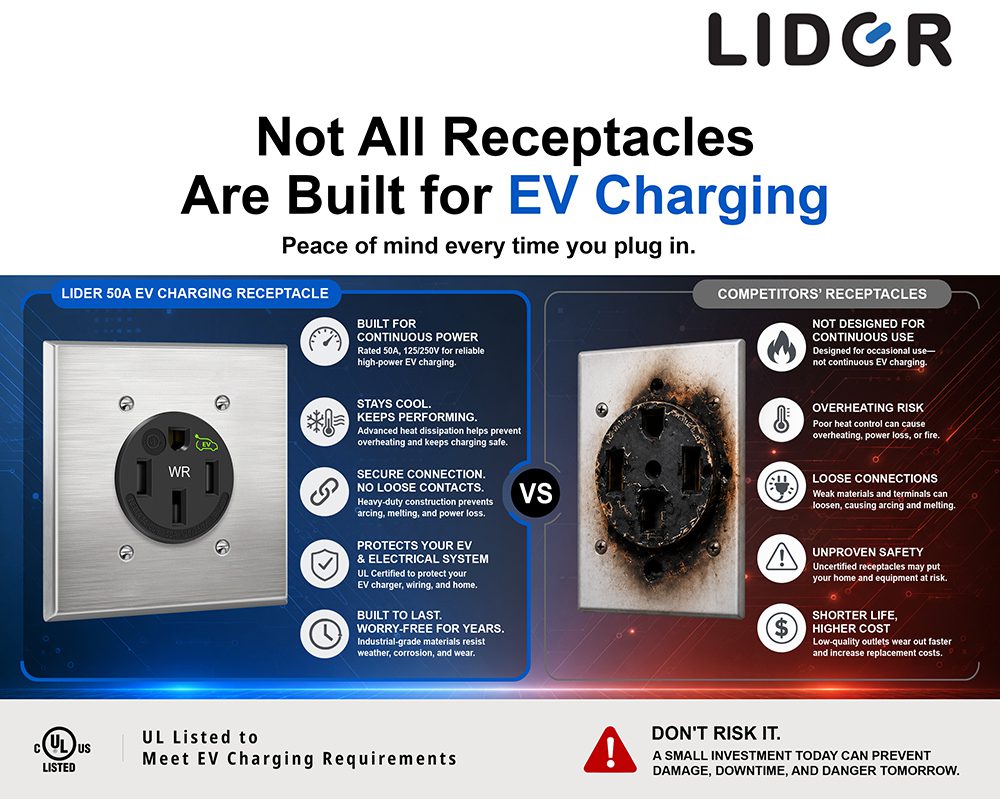
Electric Vehicle (EV) charging demands a robust electrical connection, often overlooking the critical role of the NEMA 14-50 receptacle. Unlike standard outlets, EV charging subjects these receptacles to sustained electrical loads and repeated use, necessitating purpose-built designs. Lider Electric addresses this by offering NEMA 14-50 receptacles (LN-1450RH and LN-1450RHW) with Electric Vehicle Marking and UL certification. These products feature fortified construction, silver-plated brass contacts, and secure wiring clamps, ensuring enhanced heat resistance, durability, and ultimately, superior EV charging reliability. This clear product identification and certification provide crucial assurance for installers and consumers, moving beyond mere claims to verified performance in the evolving EV landscape.

The Unsung Hero of the Charging Point: Ensuring Robust EV Charging Reliability
As the electric vehicle (EV) revolution gains momentum across India and globally, discussions around charging infrastructure often revolve around advanced chargers, vehicle compatibility, and grid capacity. While these system-level factors are undoubtedly crucial for seamless EV adoption, a fundamental yet often overlooked component plays an equally vital role in ensuring consistent and safe charging: the humble electrical receptacle.
For millions of EV owners relying on Level 2 plug-in charging at home or in light commercial settings, the NEMA 14-50 receptacle serves as the essential connection point. It is here that the building’s intricate electrical wiring system physically interfaces with the charging equipment. This seemingly simple component becomes the nexus where critical factors like contact pressure, mechanical fit, heat generation, repeated insertion and removal, and installation quality converge, directly impacting overall EV charging reliability.
Recognising this critical interface, Lider Electric has introduced its LN-1450RH and LN-1450RHW NEMA 14-50 receptacles. These models stand out with their distinctive Electric Vehicle Marking, backed by the latest UL certification documentation. This unique identification, coupled with a purpose-built design, underscores Lider Electric’s commitment to safety, connection reliability, and long-term performance specifically tailored for the demanding environment of daily EV charging.
The Unique Demands of Electric Vehicle Charging
Beyond Standard Use: Why EV Charging Redefines Receptacle Expectations
Unlike typical household appliances that draw intermittent power, electric vehicle charging is not a one-time electrical event. For a vast majority of EV drivers, it constitutes a sustained, repetitive duty cycle: plugging in for several hours, drawing a continuous, high electrical load, unplugging, and then repeating the process daily. This pattern imposes unparalleled and sustained demand on the electrical pathway, especially in common charging environments such as residential garages, driveways, workshops, multi-family properties, and various light commercial premises.
Within this rigorous operational context, the selection of an electrical product extends far beyond basic considerations like plug configuration or initial purchase price. Any receptacle intended for EV-related applications must be meticulously evaluated against a stringent set of criteria. These include its ability to withstand daily, prolonged use, manage sustained electrical loads effectively, ensure secure wiring connections over time, dissipate heat efficiently, and demonstrate exceptional long-term durability.
It is also crucial to understand that the receptacle does not function in isolation. Its performance is intrinsically linked to a broader electrical ecosystem, encompassing appropriate breaker selection, accurate wire sizing, robust grounding mechanisms, suitable enclosure selection, precise terminal torque, strict adherence to local building codes, and, critically, qualified professional installation. However, the receptacle remains the tangible point where electrical performance translates into physical contact, cementing its status as an indispensable component within the holistic EV charging setup.
Lider Electric’s Engineered Approach to EV Charging Reliability
Lider Electric’s philosophy for NEMA 14-50 receptacle design is deeply rooted in a comprehensive understanding of real-world EV charging usage patterns. The LN-1450RH and LN-1450RHW models are specifically engineered to accommodate repeated charging sessions, endure sustained electrical demand, and consistently deliver reliable connection performance over extended periods.
Rated for 50A and 125/250V, these receptacles are purpose-built for installations where consistent, long-duration charging performance is paramount for maintaining optimal EV charging reliability. Their design priorities are meticulously focused on several key aspects:
- Reliable Power Delivery: Ensuring a stable and consistent power supply at the critical connection point.
- Heavy-Duty Construction: Utilising robust NEMA 14-50 construction to withstand the rigours of daily use.
- Secure Connections: Designing for unwavering connection performance even under prolonged electrical loads.
- Enhanced Heat Resistance: Incorporating contacts specifically engineered to manage and resist heat buildup during extended operational periods.
- Clear Product Identification: Featuring distinctive Electric Vehicle Marking for unambiguous recognition of their specialised application.
This meticulous attention to detail becomes particularly vital in a market saturated with products that may appear superficially similar in online listings. While two receptacles might share an identical configuration, their internal construction, contact design, material composition, terminal strength, and crucially, their certification status, can vary significantly. For both professional installers and discerning buyers, these often-hidden distinctions profoundly influence the confidence with which a product is selected for an EV-ready electrical upgrade, directly impacting long-term EV charging reliability.
Lider Electric maintains a clear and unambiguous stance: for daily EV charging applications, product selection must transcend mere price points and plug configurations. The company’s unwavering focus on precision engineering, superior material science, safety-conscious product development, and consistently dependable performance empowers both EV owners and trade professionals to make more informed and responsible decisions regarding this critical connection point.
Inside the Engineering: Components for Sustained Performance
The core of Lider Electric’s EV charging receptacle design lies in its internal components, specifically chosen and engineered to ensure stable connection performance under continuous, high-demand usage. Key design specifications and material selections underscore this commitment to superior EV charging reliability:
- Fortified Nylon Enclosure: The receptacle features a robust nylon enclosure, expertly reinforced with glass fibers. This structural enhancement significantly boosts durability, improves heat resistance, and offers superior wear resistance, crucial for longevity in demanding environments.
- Silver-Plated Solid H65 Brass Contacts: Internally, the contacts are crafted from solid H65 brass, meticulously silver-plated. This choice of material and plating ensures exceptional electrical conductivity while providing robust resistance to oxidation, guaranteeing efficient power transfer over time.
- V-Shaped High-Purity ETP Copper Clamp: The wiring clamp system incorporates a V-shaped design, made from high-purity ETP copper (Cu ≥ 99.9%). This design is engineered to securely hold both stranded and solid wires, preventing loosening and maintaining a reliable electrical path.
- Max 75 lb-in Torque Hexagon Terminal Screws: Terminal screws are designed to accept a maximum torque of 75 lb-in, facilitating an exceptionally secure installation. This ensures optimal electrical contact when installed according to applicable requirements and established professional practices.
- Self-Grounding Design: An integrated self-grounding feature helps establish a reliable ground path, significantly enhancing safety when the receptacle is properly installed.
- Electric Vehicle Marking: The clear and prominent Electric Vehicle Marking provides instant identification, signaling that the product has been specifically evaluated and certified for EV-related applications.
These sophisticated engineering choices collectively embody the fundamental principle guiding Lider Electric’s broader product design: that unwavering EV charging reliability originates from the uncompromising quality and integrity of the physical electrical connection.
The Imperative of Certification: Beyond Claims
Understanding UL Certification and Electric Vehicle Marking
In the rapidly expanding electric vehicle charging market, numerous products often carry self-declared claims of meeting applicable industry standards. However, it is paramount to distinguish between such unsubstantiated assertions and products that have rigorously completed a comprehensive and independent certification process. In practical terms, formal certification holds significant weight because it furnishes installers, inspectors, and end-users with a documented, third-party verified basis for product evaluation, provided the certification reference precisely aligns with the authorised UL Mark and its defined scope.
For a diverse range of stakeholders—including homeowners, commercial property owners, licensed electricians, contractors, builders, and specialist EV installation professionals—this distinction is not merely semantic; it is fundamentally critical. UL certification offers an unambiguous and reliable reference point when assessing components for EV-ready residential and commercial installations. It effectively elevates the purchasing decision beyond persuasive marketing rhetoric, grounding it firmly in verifiable and documented certification, thereby bolstering confidence in long-term EV charging reliability.
Specifically for Lider Electric’s LN-1450RH and LN-1450RHW, the most recent certification documentation confirms a NEMA 14-50 receptacle platform adorned with Electric Vehicle Marking. This distinctive marking is instrumental in identifying receptacles that have undergone thorough evaluation under UL certification requirements tailored explicitly for EV-related applications. For all involved parties—installers, regulatory inspectors, and the end customer—this is far more than a simple label; it represents a pragmatic and essential product identification tool within a category where clarity and verified performance are increasingly indispensable.
According to the official UL Certificate of Compliance, representative samples of Lider Electric’s LN-1450RH-** and LN-1450RHW-** models have been meticulously evaluated by UL. This evaluation strictly adhered to the Standard(s) referenced on the Certificate. For the U.S. Listing, the certificate explicitly cites “UL 498 – Attachment Plugs and Receptacles.” The Models section further clarifies: “LN-1450RH-** Electric Vehicle Marking – Suitable for USL only” and “LN-1450RHW-** Electric Vehicle Marking – Suitable for USL only.” Lider Electric has proactively shared additional context regarding its UL certification announcement and its EV Marking Article, detailing how this certification documentation significantly contributes to clearer product identification for all EV-related applications.
Impact in the Field: Benefits for Stakeholders
Ensuring Future-Ready EV Infrastructure
The implications of such specialised engineering and clear certification extend significantly across the entire ecosystem of electric vehicle infrastructure. For electricians and dedicated EV installation professionals, the availability of clearly marked and documented products specifically designed for EV-related use facilitates more consistent specification and selection processes. When a receptacle explicitly carries marking and documentation for EV applications, it provides installers with an additional, invaluable reference point, streamlining the planning and execution of a reliable charging setup.
For property developers and managers, the concept of EV readiness is rapidly integrating into long-term property planning and valuation strategies. The strategic selection of electrical components specifically engineered to accommodate real-world EV charging behaviours can play a pivotal role in creating more future-proof and resilient electrical projects, enhancing property value and occupant satisfaction.
For the growing number of EV owners, the fundamental takeaway is straightforward yet critical: dependable charging commences well before the charging cable is even plugged into the vehicle. It originates from the integrity of the underlying electrical pathway, the uncompromising quality of the installation itself, and, fundamentally, the inherent reliability of the receptacle at the critical connection point, all contributing to superior EV charging reliability.
Building for a More Demanding Charging Future
As the global adoption of electric vehicles continues its accelerating trajectory, the expectations placed upon supporting charging infrastructure must evolve commensurately. While the convenience and speed of charging will undoubtedly remain crucial factors for consumers, the underlying quality and robustness of the components installed behind the wall will assume an increasingly paramount importance. The electrical receptacle, though physically small when compared to the charger unit or the vehicle itself, performs a deeply meaningful and indispensable role in consistently supporting daily charging performance and overall EV charging reliability.
Lider Electric’s NEMA 14-50 receptacles, featuring their distinctive Electric Vehicle Marking, are a testament to this forward-thinking approach. The LN-1450RH and LN-1450RHW models are meticulously designed for the rigorous demands of modern EV charging environments, prioritising connection reliability, clear product identification, secure installation practices, and unwavering long-term performance.
For trade professionals and consumers meticulously evaluating NEMA receptacle options for their EV-ready projects, Lider Electric offers comprehensive resources. A broader overview is available through the LIDER NEMA receptacle collection. For those seeking model-specific details, information can be reviewed on the LN-1450RH product page or the LN-1450RHW product page. Additionally, for convenience, customers preferring marketplace purchasing can view the LN-1450RHW on Amazon.
Ultimately, robust and reliable power fundamentally begins at the connection point. For Lider Electric, this critical interface is precisely where thoughtful and resilient EV charging design truly commences.
Frequently Asked Questions (FAQ)
What makes an EV charging receptacle different from a standard receptacle?
EV charging receptacles are designed for sustained, high-current electrical loads over many hours, often daily. Unlike standard outlets used intermittently, they require enhanced heat resistance, more secure wiring connections, and greater durability to maintain long-term EV charging reliability and safety under continuous demand.
What is “Electric Vehicle Marking” on Lider Electric NEMA 14-50 receptacles?
Electric Vehicle Marking is a UL-backed identification feature on Lider Electric’s LN-1450RH and LN-1450RHW NEMA 14-50 receptacles. It clearly signifies that these products have been specifically evaluated and certified under UL requirements for EV-related applications, providing assurance of their suitability and performance for EV charging reliability.
Why is UL certification important for EV charging receptacles?
UL certification provides independent, third-party verification that a product meets rigorous safety and performance standards. For EV charging receptacles, it assures installers and consumers that the product has been tested for sustained electrical loads, heat management, and durability, moving beyond manufacturer claims to documented reliability and compliance.
What are the key engineering features of Lider Electric’s EV charging receptacles?
Lider Electric’s LN-1450RH and LN-1450RHW receptacles incorporate a fortified nylon enclosure, silver-plated solid H65 brass contacts for conductivity and oxidation resistance, and V-shaped high-purity ETP copper clamps for secure wire connections. These features are designed to support stable performance, heat resistance, and enhance EV charging reliability.
How does proper receptacle selection impact long-term EV charging reliability?
Selecting a purpose-built, certified receptacle directly impacts the long-term EV charging reliability and safety of a charging setup. A high-quality receptacle designed for sustained use minimises risks of overheating, loose connections, and premature failure, ensuring consistent power delivery and protecting both the vehicle and the electrical system.
Can any NEMA 14-50 receptacle be used for EV charging?
While any NEMA 14-50 receptacle can physically accept an EV charging plug, not all are designed for the continuous, high-current demands of EV charging. Using a standard, uncertified receptacle may lead to overheating, premature wear, and compromised EV charging reliability, making purpose-built, certified options like Lider Electric’s preferable for safety and performance.