
KEY TAKEAWAYS
- Tesla has introduced its innovative ‘Folding Unit’ V4 Supercharger in Europe, beginning a strategic rollout aimed at major motorway rest stops in Q3 2026.
- This marks a significant shift in infrastructure expansion, focusing on engineering logistics for faster, more cost-effective deployment.
- The pre-assembled V4 stations, featuring telescopic light poles, allow for 33% more stalls per delivery truck, halve installation time, and reduce costs by over 20%.
- V4 cabinets deliver up to 500 kW for passenger vehicles and 1.2 MW for Tesla Semi, supporting twice the stalls and three times the power density of previous versions.
- Longer cables ensure immediate compatibility for non-Tesla EVs, including Ford, GM, Rivian, Hyundai, and Stellantis, enhancing accessibility across the continent.
- The move signifies Tesla’s full pivot to V4 production, which concluded V3 manufacturing at Gigafactory New York in March 2026.
Tesla has officially commenced the deployment of its groundbreaking ‘Folding Unit’ Supercharger technology across Europe, signaling a strategic evolution in the expansion of electric vehicle (EV) charging infrastructure. The company has announced plans for a broader rollout targeting major motorway rest stops throughout the European continent in the third quarter of 2026.

This initiative represents a pivotal shift in Tesla’s approach to network growth, moving beyond mere hardware performance to strategically engineer the entire logistics chain. The innovative design promises to accelerate the availability of high-speed charging, addressing key bottlenecks in EV adoption.
A New Era of EV Charging Infrastructure in Europe
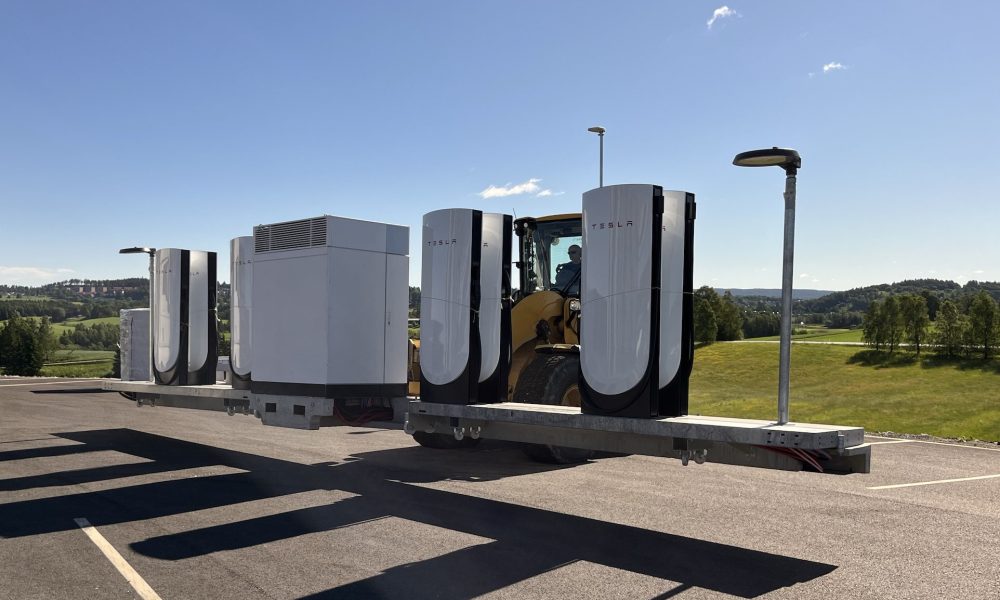
The arrival of Tesla’s folding Supercharger in Europe is poised to redefine rapid charging expansion. While the precise location of the initial European installation remains undisclosed by Tesla, a recent photo shared on X (formerly Twitter) strongly indicates Norway as the likely launchpad.
Historically, Norway has served as a designated testbed for Tesla’s new infrastructure architectures in Europe. This is largely due to the nation’s unparalleled electric vehicle adoption rates and its robust, supportive EV ecosystem, making it an ideal environment for pioneering deployments.

The strategic focus on motorway rest stops is critical for enhancing long-distance electric travel. By placing these advanced V4 Superchargers at key transit points, Tesla aims to significantly reduce range anxiety and facilitate seamless cross-border journeys for EV owners across Europe.
Engineering Innovation: The “Folding Unit” Explained
The ‘Folding Unit’ represents a significant leap in charging station design and deployment. Introduced in March 2026, this technology features a factory-pre-assembled V4 charging station built upon an industrial hinge system, all mounted to a heavy-duty concrete base.
This innovative pre-assembly means that the entire unit arrives on-site ready to unfold and connect, dramatically simplifying the installation process. The comprehensive design addresses the complexities traditionally associated with setting up large-scale charging infrastructure.
A key feature of these units is the inclusion of telescopic light poles, specifically engineered for easy transportation and rapid on-site deployment. This detail underscores the meticulous planning that has gone into optimizing the logistics chain in conjunction with the hardware itself.
Unprecedented Deployment Efficiency
The engineering behind the Folding Unit delivers substantial logistical and financial advantages. Tesla confirms that this design allows for the transportation of 33% more charging stalls per delivery truck, significantly increasing efficiency in transit.
Furthermore, the streamlined installation process cuts the typical deployment time roughly in half compared to conventional methods. This reduction in labor and equipment needs contributes to an overall decrease in deployment costs by more than 20%.
The telescopic light poles are particularly impactful in this regard. Traditional Supercharger installations often require fixed-height poles that are cumbersome to ship, slow to position, and frequently demand separate crews and specialized equipment. By engineering poles that compress for transit and extend upon arrival, Tesla has eliminated a previously quiet yet persistent bottleneck in the physical deployment process.
Every hour saved on light pole installation translates into accelerated progress toward energizing charging stalls. When scaled across dozens of new sites per quarter, these cumulative time savings represent a meaningful acceleration in how quickly a location transitions from permit approval to serving its first EV customer, enhancing the overall EV charging network.
Enhanced Power and Universal Compatibility
Each Folding Unit integrates a single V4 power cabinet with eight charging posts, representing a robust and efficient power delivery system. The V4 cabinet is capable of delivering up to 500 kW per stall for passenger vehicles, ensuring ultra-fast charging times for the latest EV models.
Moreover, the V4 technology is designed to support the formidable power requirements of the Tesla Semi, delivering up to 1.2 MW. This dual-capability ensures that the Supercharger network can cater to a wide array of electric vehicles, from personal cars to heavy-duty trucks.
The V4 generation supports twice the number of stalls per cabinet and boasts three times the power density of its predecessor, the V3. This advancement translates into more efficient use of space and greater charging capacity at each location.
Crucially, the new V4 Superchargers feature longer cables, making every new station immediately usable by non-Tesla vehicles. This is a clear priority for the company as it continues to open its extensive charging network to a broader range of electric vehicles, including those from Ford, General Motors, Rivian, Hyundai, and Stellantis.
Global Shift to V4 Production
The European arrival of the Folding Unit marks a significant milestone in Tesla’s global manufacturing strategy. As previously reported by Teslarati, Tesla’s Gigafactory New York concluded production of its V3 Supercharger cabinet in March 2026.
This event, following more than seven years of V3 production and over 15,000 units, signifies a complete pivot to V4 production. The introduction of the folding design in Europe is the logical next chapter in this technological and manufacturing transition.
Strategic Implications for EV Adoption Across Europe
The advantages of faster and cheaper deployment inherent in the Folding Unit design are profound. They enable Tesla to justify building charging infrastructure in markets and along corridors that were previously deemed too expensive or logistically challenging to serve.
By filling these critical coverage gaps, Tesla is directly addressing one of the primary obstacles to widespread EV adoption outside of major urban centers. This expanded accessibility will empower more consumers to transition to electric vehicles, confident in the availability of reliable, high-speed charging.
The enhanced efficiency and reduced costs associated with V4 Supercharger deployment are expected to accelerate the overall growth of the EV ecosystem in Europe. This will not only benefit Tesla owners but also contribute significantly to the broader decarbonization efforts across the continent.
First Folding Unit Superchargers in Europe 🇪🇺 https://t.co/KNfYWJukkL pic.twitter.com/YR1udIpH1i
— Tesla Charging (@TeslaCharging) June 10, 2026
Frequently Asked Questions (FAQs)
What is Tesla’s Folding Unit Supercharger?
The Folding Unit Supercharger is Tesla’s latest V4 charging station, designed for rapid deployment. It arrives factory pre-assembled on a concrete base with an industrial hinge system, allowing it to unfold quickly on-site. This innovative design significantly streamlines the installation process for EV charging infrastructure.
Where is the first European Folding Supercharger installed?
While Tesla has not officially disclosed the exact location, a photo shared on X by Tesla Charging strongly suggests the first European Folding Supercharger has been installed in Norway. Norway is often chosen for new infrastructure rollouts due to its high EV adoption rates and supportive environment.
What are the key benefits of the Folding Unit design?
The Folding Unit offers several significant benefits, including 33% more charging stalls per delivery truck, roughly half the installation time, and over 20% reduction in overall deployment costs compared to traditional Supercharger installations. It also features telescopic light poles for easier transport and setup.
How powerful are the new V4 Superchargers?
The new V4 Superchargers are highly powerful, delivering up to 500 kW per stall for passenger electric vehicles. For the Tesla Semi, the V4 cabinet can provide an impressive 1.2 MW. This capacity ensures extremely fast charging, catering to both personal EVs and commercial electric trucks.
Are the new V4 Superchargers compatible with non-Tesla vehicles?
Yes, a key feature of the V4 Superchargers is their universal compatibility. They come equipped with longer cables, making them immediately usable by a wide range of non-Tesla electric vehicles. This includes popular brands such as Ford, General Motors, Rivian, Hyundai, and Stellantis, expanding accessibility for all EV drivers.
Why is Tesla focusing on motorway rest stops for this rollout?
Tesla is prioritizing motorway rest stops to enhance long-distance electric travel. By strategically placing these advanced rapid chargers at key transit points, the company aims to reduce range anxiety for EV drivers and facilitate seamless, efficient journeys across European borders. This supports broader EV adoption and convenience.
When did Tesla transition to V4 Supercharger production?
Tesla’s Gigafactory New York completed its final V3 Supercharger cabinet production in March 2026, after more than seven years of manufacturing. This marked a complete pivot to V4 production, with the European deployment of the folding design representing the next phase in this technological transition.