
Key Takeaways
- Tesla provided initial details on its long-anticipated robotaxi service during its first-quarter earnings call.
- The service is envisioned as a hybrid model, combining a company-operated fleet with participation from individual Tesla owners.
- Owners will have control over when and by whom their vehicles can be used for ride-hailing, described as a “combination of Airbnb and Uber.”
- The automaker confirmed its continued investment in a “vision-only architecture with end-to-end neural networks” for achieving full autonomy.
- This strategic pivot comes amidst reports of deferred plans for a more affordable consumer vehicle, prioritizing autonomous ride-hailing development.
- Skepticism remains due to CEO Elon Musk’s past ambitious timelines for full self-driving capabilities and the current limitations of the Full Self-Driving (FSD) feature.
Tesla has officially provided its most concrete details yet regarding its ambitious plans for a self-driving robotaxi service. During its first-quarter earnings call on Tuesday, April 23, 2024, the electric vehicle giant outlined a hybrid operational model that seeks to integrate a company-run autonomous fleet with privately owned Tesla vehicles, allowing owners to generate income from their cars.
This revelation comes after a period of intense speculation among analysts, investors, and enthusiasts, particularly concerning the exact nature and timeline of Tesla’s pivot towards the robotaxi business. The automaker had been under scrutiny following reports suggesting a shift in focus from a more affordable consumer vehicle to accelerating its autonomous ride-hailing project.
Tesla’s Vision for Autonomous Ride-Hailing
Tesla CEO Elon Musk elaborated on the company’s ride-hailing strategy during the conference call, painting a picture of a flexible and user-centric platform. He emphasized that Tesla intends to operate a significant portion of the autonomous taxi fleet directly.
Beyond its own operations, a cornerstone of the Tesla robotaxi vision involves leveraging its existing customer base. Musk clarified that individual Tesla owners would be empowered to participate in the network, likening the model to a fusion of established sharing economy platforms. He stated, “think of it like a combination of Airbnb and Uber.”
Integrating Owners into the Robotaxi Network
The proposed system would grant unprecedented control to Tesla owners. According to Musk, owners would be able to “add or subtract their cars from the fleet whenever they want.” This flexibility extends to user preferences, as owners “can decide if they want to only let the car be used by friends and family, or only by five-star users or by anyone.”
Such a model could potentially offer a new revenue stream for Tesla owners while expanding the reach and availability of the robotaxi service without requiring massive upfront capital expenditure solely from the company for fleet acquisition.
Technological Foundation and Strategy
Further insights into the technological backbone supporting this initiative were provided in Tesla’s first-quarter earnings report. The document explicitly noted that Tesla is “currently working on ride-hailing functionality that will be available in the future.”
The company underscored its sustained commitment to achieving full autonomy, stating, “We have been investing in the hardware and software ecosystems necessary to achieve vehicle autonomy and a ride-hailing service.” A key aspect of their strategy is a “vision-only architecture with end-to-end neural networks, trained on billions of miles of real-world data.” This approach relies exclusively on camera data and artificial intelligence to navigate and perceive environments, eschewing supplementary sensors like lidar.
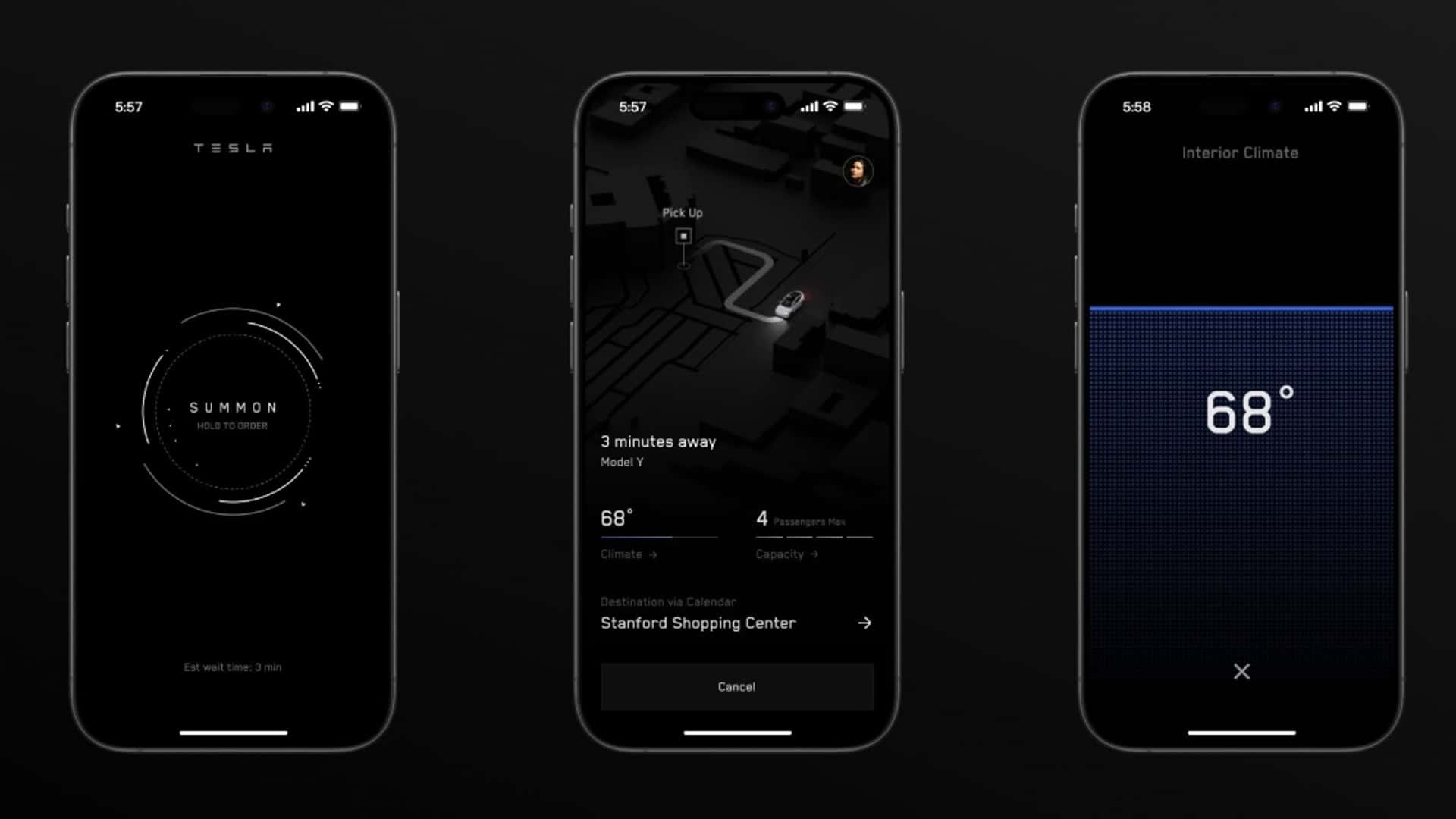
To give a glimpse into the future user experience, Tesla also released a preview of what the integrated ride-hailing functionality might look like within the Tesla app. Renderings displayed a “Summon” button, presumably for requesting an autonomous vehicle. One screen within the app also indicated a temperature setting of 68 degrees, suggesting potential customer control over cabin climate prior to entry, though specific details remain sparse.
Context: The Shift from Affordable EVs
The renewed emphasis on the Tesla robotaxi project gained considerable traction after a *Reuters* report earlier this year indicated that Tesla had reportedly shelved plans for a more affordable consumer vehicle. This report triggered widespread debate and investor concern about the company’s strategic direction and its ability to compete in a rapidly evolving EV market.
During the recent earnings call, Tesla aimed to address these concerns by stating it is accelerating the launch timing of “new vehicles, including more affordable models.” However, it simultaneously indicated that a dedicated robotaxi would arrive at a later stage, suggesting a phased approach where existing or upcoming vehicle platforms might initially serve the autonomous ride-hailing function before a purpose-built robotaxi is introduced.
The explicit mention of a ride-hailing business in the earnings report and call appears to be a concerted effort by Tesla to reassure investors. The company aims to demonstrate that a clear, albeit long-term, plan is in place to capitalize on its autonomous driving technology, irrespective of the timelines for its other vehicle segments.
Challenges and Past Promises
Despite the new details, the successful implementation of Tesla’s robotaxi vision hinges entirely on the company’s ability to achieve true full self-driving capabilities. This remains a significant hurdle, as Tesla’s current Full Self-Driving (FSD) feature, despite its name and high cost, requires active driver supervision and has been documented to make errors.
Skepticism is further fueled by CEO Elon Musk’s past optimistic forecasts. Most notably, Musk famously declared in 2019 that Tesla would have 1 million robotaxis operating on the road by 2020. This ambitious target was not met, and the timeline for achieving Level 5 autonomy, where a vehicle can operate completely without human intervention under all conditions, has consistently been pushed back by the industry as a whole.
The technical and regulatory complexities of deploying widespread autonomous vehicle fleets are immense. From navigating unpredictable urban environments to securing regulatory approvals across diverse jurisdictions, the path to a fully operational Tesla robotaxi service is fraught with challenges. While the concept of a Tesla taxi business is intriguing and potentially revolutionary, its realization will depend on overcoming these significant technological and practical obstacles.
Investor Sentiment and Future Outlook
The detailed announcement about the Tesla robotaxi strategy during the earnings call was critical for investor sentiment. With growing competition in the EV market and challenges in meeting production targets, showcasing a clear, high-potential growth avenue like autonomous ride-hailing is vital for maintaining investor confidence.
The vision of a scalable and profitable autonomy business, driven by a “vision-only architecture” and vast real-world data, represents a foundational pillar of Tesla’s long-term value proposition. However, the market will undoubtedly continue to scrutinize the progress of Tesla’s self-driving technology and the tangible steps taken towards launching its robotaxi service.
The integration of individual car owners into the robotaxi network could offer a unique advantage, potentially creating a distributed, adaptable fleet. This approach distinguishes Tesla from competitors who might rely solely on company-owned autonomous vehicles. The coming years will be crucial in determining whether Tesla can convert its ambitious robotaxi vision into a widespread, reliable, and profitable reality.
Frequently Asked Questions (FAQs)
What is Tesla’s robotaxi plan?
Tesla plans a ride-hailing service that combines a company-operated fleet of self-driving taxis with individual Tesla owners’ vehicles. Owners can choose when and how their cars participate, allowing them to earn income. This hybrid model is described as a “combination of Airbnb and Uber” for autonomous transport.
When will Tesla’s robotaxi service be available?
Tesla has indicated that ride-hailing functionality will be available in the future and that a dedicated robotaxi vehicle would arrive later. While no specific launch date was provided during the Q1 earnings call, the company affirmed it is accelerating its efforts in this area.
How will Tesla owners be involved in the robotaxi fleet?
Tesla owners will have the option to add or remove their cars from the autonomous fleet at will. They can also set preferences, such as allowing only friends and family, five-star users, or any user to operate their car for ride-hailing services, giving them significant control.
What technology is powering Tesla’s robotaxis?
Tesla is investing in a “vision-only architecture with end-to-end neural networks.” This system relies exclusively on cameras and advanced artificial intelligence, trained on billions of miles of real-world driving data, to achieve full vehicle autonomy without needing lidar or radar sensors.
What are the main challenges for Tesla’s robotaxi initiative?
The primary challenge is achieving true full self-driving capabilities, as Tesla’s current FSD feature requires driver supervision. Other hurdles include regulatory approvals for autonomous vehicles across different regions and scaling the technology to safely handle diverse real-world driving scenarios. CEO Elon Musk’s past unfulfilled promises also contribute to skepticism.
Does this mean Tesla is no longer making affordable cars?
No. While *Reuters* reported a pivot to robotaxis at the expense of cheaper consumer vehicles, Tesla stated during its earnings call that it is accelerating the launch timing of “new vehicles, including more affordable models.” The robotaxi service is intended to complement, rather than entirely replace, other vehicle development plans.