
Key Takeaways:
- During its first-quarter earnings call, Tesla provided new insights into its long-anticipated Tesla robotaxi fleet project, confirming plans for a proprietary ride-hailing service.
- CEO Elon Musk described the model as a blend of ‘Airbnb and Uber,’ allowing Tesla owners to integrate their personal vehicles into the autonomous fleet while maintaining control over usage parameters.
- The company reiterated its commitment to a ‘vision-only architecture with end-to-end neural networks’ for achieving full vehicle autonomy, a key component for the future ride-hailing functionality.
- This announcement comes amidst reports of a strategic pivot away from a cheaper consumer car, with Tesla clarifying it is accelerating ‘new vehicles, including more affordable models,’ while the robotaxi launch is set for a later date.
- The success of this ambitious venture hinges on Tesla’s ability to overcome long-standing challenges in delivering truly full self-driving capabilities, a goal that has seen numerous past projections from the company.
During its closely watched first-quarter earnings call, electric vehicle giant Tesla offered its clearest outline yet for its ambitious foray into the autonomous ride-hailing sector. The company detailed plans to deploy a proprietary Tesla robotaxi fleet, a significant strategic move that could reshape the future of urban transportation and vehicle ownership.
This revelation comes at a pivotal moment for the automaker, as investors and analysts sought clarity on its future trajectory, particularly concerning reports of a strategic reorientation towards autonomous mobility solutions. The details, though still preliminary, provide a more defined vision of how Tesla intends to operationalise its long-promised self-driving technology.
Tesla’s Dual-Layered Autonomous Mobility Vision
Elon Musk, Tesla’s Chief Executive Officer, shed light on the operational framework of the forthcoming service during the investor conference call. He indicated that Tesla intends to operate a substantial portion of its own self-driving taxi fleet, establishing a direct presence in the burgeoning autonomous ride-hailing market.
Crucially, Musk also revealed a unique hybrid model, inviting existing Tesla owners to participate. He stated that owners would be able to “add or subtract their cars from the fleet whenever they want.” This flexibility extends further, as owners can choose the terms of engagement: “they can decide if they want to only let the car be used by friends and family, or only by five-star users or by anyone.”
Musk encapsulated this innovative approach by likening it to a “combination of Airbnb and Uber.” This analogy suggests a platform where Tesla, as the central operator, manages a core fleet while simultaneously enabling private owners to monetise their autonomous vehicles by offering them for ride-hailing services. The model aims to leverage the existing Tesla ecosystem and community, potentially creating a highly scalable and distributed network of autonomous vehicles.
Such a system would not only augment Tesla’s own operational robotaxi fleet but also offer a novel income stream for vehicle owners, transforming the concept of car ownership from a depreciating asset into a revenue-generating one, albeit with the caveat of fully autonomous functionality.
The Technological Foundation: Vision-Only Autonomy
The first-quarter earnings report elaborated on the technological backbone supporting this ambitious venture. Tesla confirmed that it is “currently working on ride-hailing functionality that will be available in the future,” underscoring the ongoing development efforts in this critical area.
The report highlighted the company’s significant investment in the necessary infrastructure. “We have been investing in the hardware and software ecosystems necessary to achieve vehicle autonomy and a ride-hailing service,” the company stated. This commitment encompasses both the in-car computing power and the sophisticated software algorithms required for safe and reliable autonomous operation.
Central to Tesla’s strategy for achieving vehicle autonomy is its steadfast belief in a “vision-only architecture with end-to-end neural networks, trained on billions of miles of real-world data.” This approach relies exclusively on cameras and advanced artificial intelligence to perceive the environment and navigate, diverging from many competitors who utilise a combination of sensors like lidar and radar.
The reliance on vast datasets of real-world driving scenarios is paramount for training these neural networks, allowing them to learn and adapt to diverse and complex driving conditions. This data-driven methodology is what Tesla believes will ultimately enable a “scalable and profitable autonomy business.”
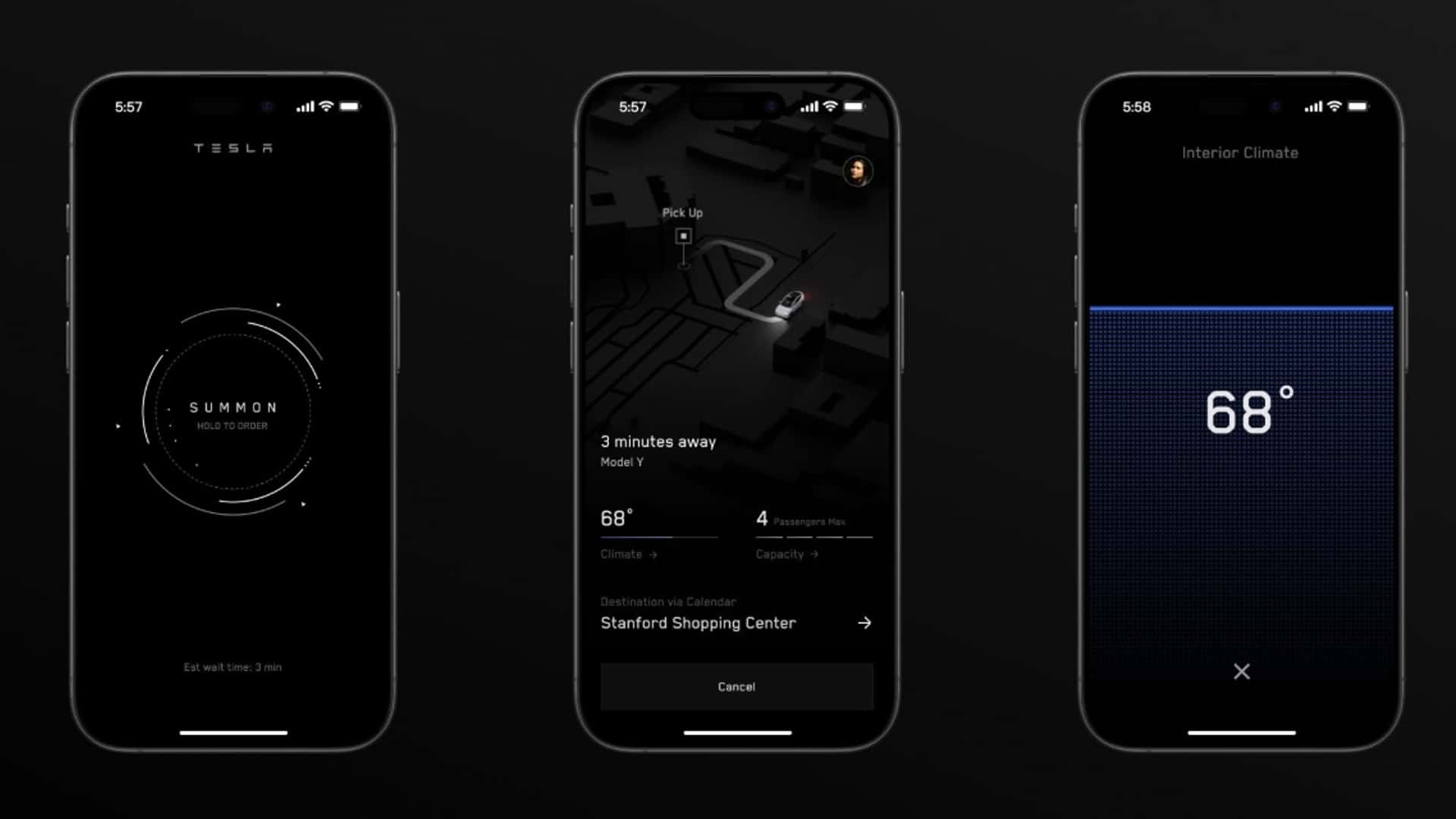
Further visual insights were offered through a preview of what the ride-hailing functionality might look like within the existing Tesla app. Renderings displayed a ‘Summon’ button, implying a seamless interface for users to hail an autonomous taxi. One screen even showed a temperature setting of 68 degrees, hinting at potential in-app climate control customisation for future passengers, enhancing the personalised experience of the Tesla robotaxi fleet.
Navigating Strategic Shifts and Investor Confidence
The announcements regarding the Tesla robotaxi fleet arrive in the wake of considerable speculation and investor apprehension. Earlier reports from Reuters suggested that Tesla had redirected its focus, reportedly scrapping plans for a more affordable consumer vehicle in favour of prioritising the robotaxi project.
This potential strategic shift had fueled uncertainty among stakeholders, prompting questions about the company’s product roadmap and market positioning. In response, Tesla’s earnings call sought to address these concerns directly.
The company clarified its stance, indicating that it is “accelerating the launch timing of ‘new vehicles, including more affordable models,'” while simultaneously suggesting that the standalone robotaxi would arrive at a later stage. This statement aimed to reassure investors that the development of more accessible electric vehicles remains a part of the long-term strategy, even as autonomous ride-hailing gains prominence.
The detailed mention of a concrete ride-hailing business plan served as a critical mechanism to bolster investor confidence, painting a clearer picture of the potential revenue streams and market opportunities that the Tesla robotaxi fleet could unlock in the future. It underscored a deliberate strategy to demonstrate a viable path forward for the company’s autonomous driving investments.
The Roadblocks to Full Autonomy: Past Promises and Future Hurdles
Despite the optimistic outlook presented during the earnings call, the realisation of a fully operational Tesla robotaxi fleet faces significant technological and regulatory hurdles. Tesla’s journey towards achieving true self-driving capabilities has been marked by a series of ambitious projections that have yet to fully materialise.
A primary challenge remains the development of a Full Self-Driving (FSD) system that genuinely operates without human intervention. The current iteration of Tesla’s FSD feature, which comes at a substantial cost, still requires constant driver supervision and has been documented to “regularly make mistakes.” This necessitates that human drivers remain attentive and ready to take control, a requirement that fundamentally contradicts the concept of an autonomous robotaxi.
Critics and observers often recall past predictions from Elon Musk, notably his 2019 proclamation that Tesla would have “1 million robotaxis on the road by 2020.” This bold assertion, like many others concerning the timeline for full autonomy, ultimately went unfulfilled, contributing to a degree of scepticism surrounding new timelines and grand statements.
Therefore, while the idea of a comprehensive Tesla taxi business is compelling, it is prudent to consider past experiences and the inherent complexity of autonomous vehicle technology. The path to widespread deployment of a truly self-driving Tesla robotaxi fleet demands not only technological perfection but also robust regulatory frameworks and broad public acceptance, elements that are still very much in development globally.
Broader Implications for the Future of Urban Mobility
Should Tesla successfully deploy its envisioned Tesla robotaxi fleet and integrated owner network, the implications for urban mobility and the broader automotive industry would be profound. The ‘Airbnb and Uber’ hybrid model introduces a unique approach to ride-hailing technology, potentially offering greater flexibility and efficiency than current platforms.
For cities, this could mean a reduction in privately owned vehicles, decreased traffic congestion, and a more efficient utilisation of transport infrastructure. For consumers, it promises convenient, on-demand transportation that is potentially more affordable than traditional taxi services, particularly if a significant portion of the fleet is owned and operated by private individuals participating in the network.
The concept of monetising one’s personal electric vehicle through an autonomous network could also drive further adoption of EVs, linking the environmental benefits of electric cars with significant economic incentives for owners. This symbiotic relationship between vehicle autonomy, electric mobility, and flexible ownership models could set a new paradigm for how people interact with transportation.
However, the transition to such a future would require addressing complex questions around liability, insurance, data privacy, and the socio-economic impacts on traditional ride-hailing drivers. The vision is clear, but the implementation is a multifaceted challenge.
A Vision in Progress: Tesla’s Autonomous Future
Tesla’s latest disclosures mark a significant step in articulating its future strategy for autonomous driving and ride-hailing. The commitment to a proprietary Tesla robotaxi fleet, complemented by a novel owner-participation model, signals a comprehensive and ambitious approach to urban mobility.
While the company has provided a clearer roadmap for its intentions, many critical details regarding deployment timelines, regulatory approvals, and the practicalities of achieving widespread, unsupervised full self-driving capabilities remain under wraps or subject to ongoing development. The success of this venture will ultimately depend on Tesla’s ability to translate its bold vision into a tangible, safe, and reliable service that delivers on its long-standing promises of autonomy.
As the electric vehicle and autonomous technology landscapes continue to evolve rapidly, all eyes will remain on Tesla’s progress in bringing its “Airbnb and Uber” for cars to fruition, fundamentally altering the fabric of personal and public transportation.
Frequently Asked Questions (FAQ)
Q1: What did Tesla announce regarding its robotaxi plans?
Tesla announced its intent to launch a dedicated ride-hailing service, operating its own fleet of autonomous taxis. This plan also includes a hybrid model where private Tesla owners can integrate their vehicles into the network for shared use.
Q2: How will Tesla owners participate in the robotaxi fleet?
Tesla owners will have the option to add or remove their vehicles from the autonomous fleet at will. They can also set specific parameters for use, such as restricting access to friends and family, five-star users, or opening it to all passengers, similar to Airbnb or Uber.
Q3: What technology underpins Tesla’s autonomous driving for robotaxis?
Tesla is developing its robotaxi system using a ‘vision-only architecture,’ relying solely on cameras and advanced end-to-end neural networks. These AI systems are trained on billions of miles of real-world driving data to achieve full vehicle autonomy.
Q4: How does this robotaxi announcement relate to earlier reports about a cheaper Tesla car?
Reports suggested Tesla prioritised robotaxis over a cheaper consumer car. Tesla clarified it is accelerating the launch of ‘new vehicles, including more affordable models,’ indicating these would precede the standalone robotaxi launch. The robotaxi announcement aims to reassure investors of a clear future strategy.
Q5: What challenges does Tesla face in deploying its robotaxi fleet?
The primary challenge is achieving true, unsupervised full self-driving capability, as the current FSD system still requires driver supervision and makes mistakes. Overcoming technological hurdles and gaining regulatory approval are critical steps for widespread deployment.
Q6: When is Tesla’s robotaxi service expected to launch?
While Tesla confirmed it is actively working on ride-hailing functionality, a definitive launch timeline for the robotaxi service was not provided. The company indicated it would arrive after the accelerated launch of new, more affordable vehicle models.
Q7: What is the significance of the ‘Airbnb and Uber’ analogy for the Tesla robotaxi fleet?
This analogy highlights a dual-sided marketplace: Tesla operating a core fleet, much like Uber, combined with private owners listing their autonomous vehicles for hire, similar to Airbnb. This aims for a scalable, flexible, and potentially more profitable mobility service.