
Key Takeaways:
- Tesla confirmed plans to launch a proprietary ride-hailing service, combining company-owned autonomous vehicles with a unique program allowing private Tesla owners to integrate their cars into the network.
- CEO Elon Musk described the model as a “combination of Airbnb and Uber,” offering owners flexibility to control when and how their vehicles participate, including options for friend/family use or specific user ratings.
- The automaker is heavily investing in a “vision-only architecture with end-to-end neural networks” for achieving full autonomy, trained on billions of miles of real-world data.
- This strategic pivot towards a Tesla robotaxi service aims to bolster investor confidence, following earlier reports of a potential shift away from developing more affordable consumer vehicles, a claim the company later clarified by reiterating commitment to new, more affordable models alongside robotaxis.
- Despite ambitious timelines, the realization of this service hinges on Tesla achieving true Level 4/5 self-driving capabilities, a goal that remains a significant technological and regulatory challenge given the current state of its Full Self-Driving (FSD) feature.
During its first-quarter earnings call on Tuesday, Tesla offered significant new insights into its long-anticipated plans for a robotaxi service, addressing pressing questions from analysts and investors. The electric vehicle giant confirmed its intent to establish a ride-hailing network, a move that clarifies its strategic direction amid broader market uncertainties.
The company outlined a two-pronged approach that blends a corporate-operated fleet with a novel system for private vehicle owners. This innovative model, described by CEO Elon Musk as a fusion of the peer-to-peer lodging platform Airbnb and the ubiquitous ride-sharing service Uber, aims to redefine personal mobility and vehicle ownership.
Defining the Tesla Robotaxi Service Model
Elon Musk elucidated the operational framework of the forthcoming Tesla robotaxi service during the investor call. He stated that Tesla plans to directly manage a substantial portion of its own self-driving taxi fleet, ensuring service quality and operational control.
Complementing this, a groundbreaking feature will allow individual Tesla owners to integrate their personal vehicles into the autonomous ride-hailing network. Musk elaborated, saying, “they can decide if they want to only let the car be used by friends and family, or only by five-star users or by anyone.”
This flexibility extends to participation, as owners will be able to “add or subtract their cars from the fleet whenever they want.” Such a model positions Tesla at the intersection of traditional ride-hailing and a decentralized, owner-driven economy, potentially creating a new revenue stream for vehicle owners and expanding the reach of the Tesla robotaxi service.
Technological Foundation for Autonomy
The success of the Tesla robotaxi service is intrinsically linked to the company’s progress in autonomous driving technology. Tesla’s first-quarter earnings report highlighted its continued investment in the foundational elements required for such an ambitious undertaking.
The report specified, “We have been investing in the hardware and software ecosystems necessary to achieve vehicle autonomy and a ride-hailing service.” This commitment underscores Tesla’s belief in its proprietary technology stack as the cornerstone of its future mobility services.
Central to Tesla’s strategy is a “vision-only architecture with end-to-end neural networks, trained on billions of miles of real-world data.” This approach relies exclusively on cameras and advanced artificial intelligence to perceive and navigate the environment, a contrasting method to rivals who often integrate radar and lidar sensors.
The accumulation of vast datasets from its global fleet is critical to training these neural networks, allowing the vehicles to learn and adapt to diverse driving conditions and scenarios. This robust training regimen is seen as pivotal for realizing a “scalable and profitable autonomy business,” as stated by the company.
Anticipated App Functionality
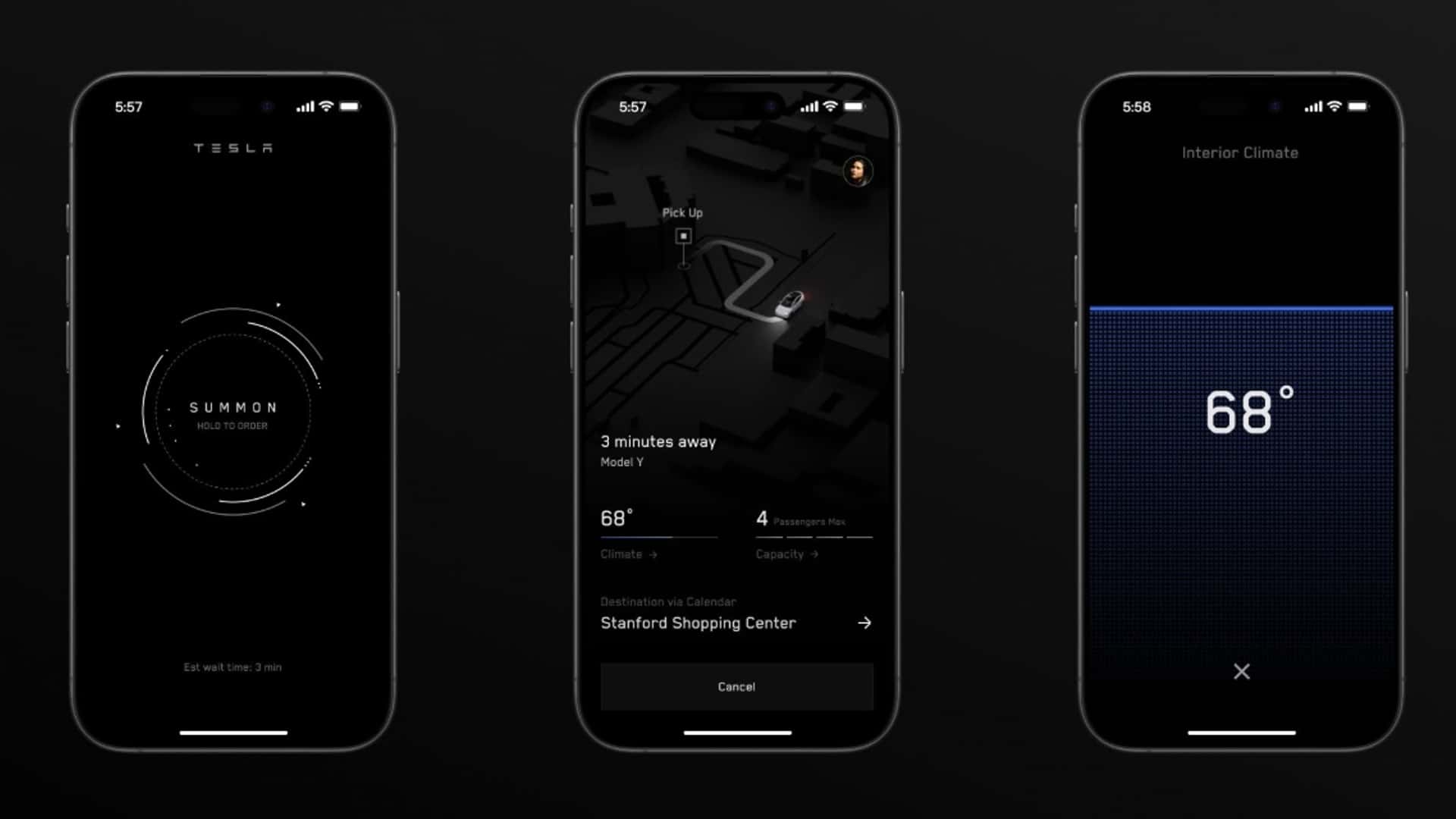
Tesla also provided an early glimpse into the user interface for its ride-hailing functionality, which will be integrated directly into the existing Tesla app. Renderings displayed during the announcement revealed a prominent “Summon” button, presumably the primary interface for requesting an autonomous taxi.
One particular screen in the preview showed a temperature setting of 68 degrees, sparking speculation about potential in-app climate control features. This suggests that future users of the Tesla robotaxi service might have the convenience of pre-setting cabin conditions before their ride arrives, enhancing the overall passenger experience.
While specific details remain scant, these previews signal Tesla’s focus on a seamless and user-friendly experience, consistent with its approach to its electric vehicle ecosystem.
Strategic Clarity and Investor Relations
The detailed announcement regarding the Tesla robotaxi service comes at a critical juncture for the automaker. Recent reports from Reuters had indicated a pivot away from the development of a more affordable consumer vehicle, sparking considerable speculation and some investor apprehension.
During the earnings call, Tesla addressed these concerns by stating it is “accelerating the launch timing of ‘new vehicles, including more affordable models,’ and indicated that a robotaxi would arrive later on.” This clarification aims to reassure stakeholders that the company’s long-term vision encompasses both a broader consumer market and the advanced mobility services of its robotaxi fleet.
The explicit mention of a ride-hailing business serves as a strategic move to provide greater clarity and a tangible roadmap for investors. It suggests a diversified growth strategy, where autonomous services are projected to become a significant revenue driver alongside vehicle sales, thereby bolstering confidence in Tesla’s future financial performance following a challenging first quarter.
Challenges on the Road to Full Autonomy
Despite the ambitious vision for the Tesla robotaxi service, its ultimate success hinges on overcoming substantial technological hurdles. Tesla’s Full Self-Driving (FSD) feature, a key precursor to its autonomous taxi ambitions, currently requires constant driver supervision and has, on occasions, exhibited errors.
Achieving true Level 4 or Level 5 autonomy—where vehicles can operate without human intervention under specific conditions or all conditions, respectively—is a complex engineering and regulatory challenge. The transition from advanced driver-assistance systems (ADAS) to fully autonomous operation demands unparalleled reliability, safety, and regulatory approval across diverse jurisdictions.
It is important to recall that CEO Elon Musk famously projected one million robotaxis on the road by 2020. While significant progress has been made in autonomous technology, this earlier timeline underscores the inherent difficulties and unpredictable nature of developing such cutting-edge systems. Consequently, observers often approach Musk’s grand pronouncements with a degree of measured optimism, acknowledging both Tesla’s innovative prowess and the formidable scale of the task ahead.
The Future of Urban Mobility
The introduction of a comprehensive Tesla robotaxi service has the potential to profoundly reshape urban mobility, challenging traditional vehicle ownership models and existing ride-hailing paradigms. By offering a hybrid ownership and service model, Tesla could tap into both segments of the market simultaneously.
While the full rollout of such a service remains “far down the line,” the foundational investments in hardware, software, and artificial intelligence underscore Tesla’s long-term commitment. The realization of this vision could usher in a new era of convenient, efficient, and potentially more sustainable transportation options.
FAQ
What is the core concept of Tesla’s robotaxi service?
Tesla plans a dual-model ride-hailing service. It will operate its own fleet of autonomous vehicles while also allowing private Tesla owners to add their cars to the network. This creates a flexible system where owners can earn revenue by letting their self-driving Teslas serve as taxis when not in personal use, similar to a blend of Airbnb and Uber.
When is the Tesla robotaxi service expected to launch?
While Tesla has confirmed its plans and outlined its strategy, a definitive launch date for the robotaxi service has not been provided. The company indicated that the service would arrive “later on,” suggesting it is still a significant distance away, contingent upon further advancements in its autonomous driving technology and regulatory approvals.
How will private Tesla owners participate in the robotaxi fleet?
Private owners will be able to opt their vehicles into the Tesla robotaxi service using the Tesla app. They will have control over their vehicle’s availability, being able to “add or subtract their cars from the fleet whenever they want.” Owners can also specify usage parameters, such as allowing use only by friends and family, five-star users, or the general public.
What technology underpins Tesla’s autonomous driving efforts for robotaxis?
Tesla is investing in a “vision-only architecture with end-to-end neural networks.” This technology relies exclusively on cameras to perceive the environment, with artificial intelligence algorithms trained on billions of miles of real-world driving data. The goal is to achieve full vehicle autonomy without requiring supplementary sensors like lidar or radar.
What challenges does Tesla face in deploying its robotaxi service?
The primary challenge is achieving true Level 4 or Level 5 self-driving capabilities, which involves ensuring the vehicles can navigate complex environments reliably and safely without human intervention. Regulatory approvals across different regions also pose a significant hurdle. Furthermore, managing and maintaining a vast fleet of autonomous vehicles will present operational complexities.
How does this robotaxi plan relate to earlier reports about cheaper Tesla vehicles?
Earlier reports suggested Tesla might prioritize robotaxis over a more affordable consumer vehicle. However, during its Q1 earnings call, Tesla clarified that it is “accelerating the launch timing of ‘new vehicles, including more affordable models,’” alongside the robotaxi project. This indicates a dual strategy, aiming to expand its market reach while simultaneously developing advanced mobility services.