
Key Takeaways (TL;DR):
- Ionna, backed by eight major automakers, and retail giant Walmart are aggressively expanding their respective EV fast charging networks across North America.
- Both companies are introducing electric vehicle charging options at prices significantly lower than established networks such as Tesla Superchargers and Electrify America.
- This strategic pricing, coupled with rapid deployment, signals a potential price war within the electric vehicle charging industry, aiming to attract a broader base of EV drivers.
- Ionna currently offers the lowest average price per kWh at $0.37, while Walmart ranks fourth cheapest at $0.43 per kWh, according to Chargenomics data.
- The increased competition promises improved affordability and accessibility, marking a new phase for the EV fast charging landscape beneficial to consumers.
The landscape of electric vehicle charging is undergoing a significant transformation, moving beyond mere availability to focus sharply on affordability. At the forefront of this shift are Ionna and Walmart, whose aggressive expansion strategies and competitive pricing suggest the nascent stages of an EV fast charging price war. Their combined efforts are poised to disrupt long-standing networks and fundamentally reshape consumer expectations for electric vehicle charging infrastructure.
For years, the primary objective for the EV ecosystem was to establish widespread charging options, addressing the pervasive concern of range anxiety. With growing saturation in major markets, the industry’s focus is now evolving towards making EV fast charging more accessible and economically attractive. Ionna and Walmart are leveraging this paradigm shift by not only expanding their networks but also by undercutting the pricing of established players.
Ionna’s Ambitious Network Expansion and Pricing Strategy
Ionna, a formidable joint venture backed by a consortium of eight global automakers—BMW, General Motors, Honda, Hyundai, Kia, Mercedes-Benz, Stellantis, and Toyota—has declared ambitious plans. The consortium’s primary goal is to mitigate charging availability concerns for electric vehicle customers, thereby stimulating EV adoption.
To achieve this, Ionna has committed to deploying an impressive 30,000 EV fast charging ports across the United States and Canada by 2030. Many of these stations are designed to offer amenities akin to traditional gas stations, including convenience stores and restrooms, enhancing the overall charging experience. The network supports both NACS and CCS plugs, ensuring broad compatibility for EV drivers. Ionna’s rapid deployment efforts have seen a substantial number of stations installed recently.
Crucially, Ionna has positioned itself as a price leader in the EV fast charging market. According to data compiled by Paren and cited by Loren McDonald, CEO and chief analyst at Chargenomics, Ionna charges an average of $0.37 per kilowatt-hour (kWh) for electricity. This rate places it as the lowest among 17 analyzed networks, demonstrating a clear intent to attract new customers through aggressive pricing.
McDonald highlighted the need for such aggressive tactics. “They’re the new kid on the block. You and me and the everybody on LinkedIn in the EV industry know who Ionna is. But your average new driver who goes down to the Hyundai dealer or Ford dealer and gets an EV, they have no idea what an ‘Ionna’ is. They’ve heard of Tesla. They’ve probably heard of Electrify America, maybe EVGo,” he explained. McDonald also pointed out Ionna’s strategy of offering significant holiday and new-station discounts, sometimes pushing prices as low as $0.20 per kWh for limited periods, a rate often cheaper than residential electricity.
Walmart’s Strategic Entry into the EV Charging Market
Walmart, a retail behemoth, initially ventured into the EV charging space through a partnership with Electrify America, installing charging stations in many of its store parking lots. Observing the positive impact on store traffic and customer loyalty, the company has since embarked on establishing its own proprietary electric vehicle charging network.
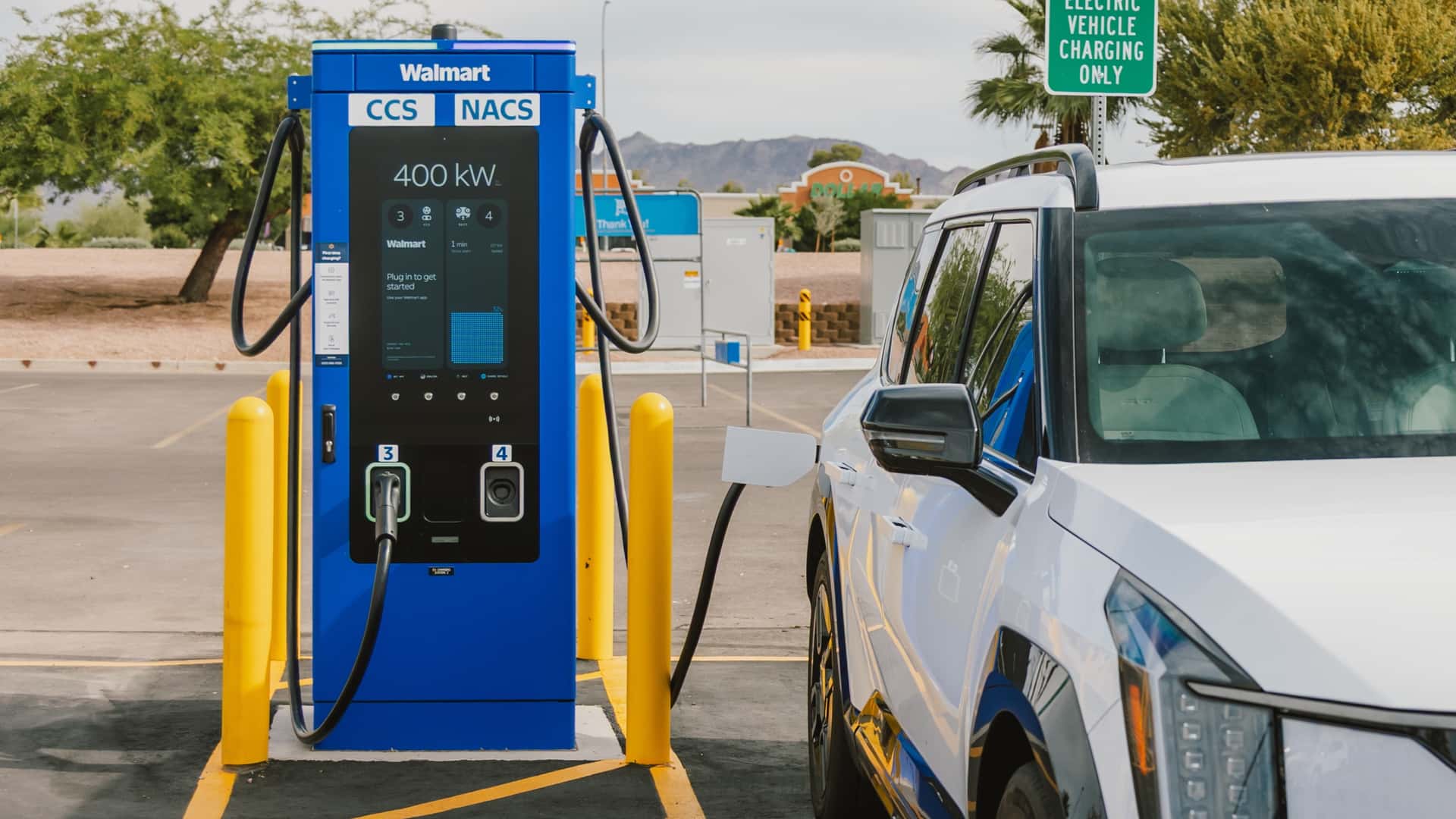
Walmart’s new stations are equipped with 400-kW Alpitronic chargers, featuring both NACS and CCS plugs. A significant incentive for its customer base is a 10% discount offered to Walmart+ subscribers. The retail giant has also demonstrated an aggressive rollout, with hundreds of chargers becoming operational in recent months, significantly boosting its presence in the EV fast charging sector.
Walmart’s pricing strategy is similarly competitive. According to Paren, Walmart offers an average price of $0.43 per kWh, making it the fourth cheapest among the analyzed networks, trailing only Shell Recharge and Rocky Mountain Power. This competitive pricing is underpinned by several strategic advantages inherent to Walmart’s business model.
McDonald elaborated on Walmart’s distinct motivations: “Walmart, obviously, is in the business for a very different reason.” He noted the company’s vast network of thousands of stores across the U.S., which provides effectively free real estate for charger installations. This scale allows Walmart to negotiate favorable terms with equipment suppliers and utility providers, significantly reducing installation and operational costs. Crucially, the chargers serve a dual purpose beyond direct revenue generation.
“The stereotypical demographic and psychographic of EV drivers is not like, Walmart customers, right? So they can attract a new customer base and then, the key for them obviously is getting people inside the store for 40 minutes, spending $50 or $100, not just the $22 out front,” McDonald explained. This strategy positions EV charging as a powerful tool for driving foot traffic and increasing in-store sales, leveraging the company’s existing infrastructure to expand its customer base.
Comparing Prices with Established Networks
The aggressive pricing from Ionna and Walmart stands in stark contrast to the rates offered by established EV fast charging networks. Tesla and Electrify America, for instance, charge an average of $0.56 per kWh. This means an EV driver utilizing Ionna’s network could realize savings of approximately 40% compared to charging at an Electrify America station.
This substantial price difference is a critical factor in swaying consumer habits. Many EV owners might have their vehicles’ navigation systems pre-programmed with EA or Tesla stations, or they might be accustomed to Tesla’s seamless plug-and-charge functionality. Some may have even received free charging credits upon purchasing their electric vehicle. To overcome this ingrained inertia, new entrants must offer compelling incentives, and price is undoubtedly a primary motivator.
The Evolving Landscape of EV Fast Charging Costs
For a considerable period, the focus of the EV fast charging industry was on rapid network deployment to address range anxiety. This phase often meant that operators could command higher prices, particularly in areas with limited charging options, as scale and availability took precedence over cost competitiveness. The build-out of such extensive infrastructure is inherently expensive, as are the utility demand charges associated with high-power fast chargers, contributing to elevated per-kWh rates.
For context, completely charging a 2024 Chevy Blazer EV (with 279 miles EPA range) at $0.56 per kWh would cost $47.60. To cover the same distance, a gas-powered 2024 Chevy Blazer AWD would consume 12.68 gallons, costing $51.61 at the U.S. average of $4.07 per gallon. While the EV remains slightly cheaper in this scenario, the margin narrows considerably with fast charging rates.
At the most expensive Tesla Supercharger, a brutal $0.74 per kWh could mean a full charge costs $62.90, illustrating the wide variability in pricing. While home charging remains significantly cheaper, averaging $0.18 per kWh in the U.S., public DC fast charging has historically been a premium service. However, this dynamic is changing as the market matures and competition intensifies.
The current phase marks a pivot where competition is forcing providers to offer more value, be it through lower prices, enhanced amenities, or a superior user experience. This shift signals a promising future for EV owners, who can anticipate more affordable and convenient electric vehicle charging options as the industry continues to evolve.
Diverse Strategies in a Competitive Market
The entry of Ionna and Walmart is just one facet of the burgeoning competition in the EV fast charging sector. Other players are also carving out their niches with distinct strategies:
- Mercedes-Benz High Power Charging is prioritizing a premium experience, focusing on high-quality amenities and reservation systems.
- BP is targeting the development of large-scale charging hubs, aiming for convenience and comprehensive service.
- Newcomers like Rove are emerging as premium providers, striving to attract customers with a superior charging experience coupled with attached markets.
- Tesla, Electrify America, and EVGo continue to grow their networks, also pushing membership programs to foster customer loyalty.
- Companies like Pilot, General Motors, and EVGo are expanding charging options at key rest stops, addressing long-distance travel needs.
The convergence of these diverse strategies—from price leadership to premium services and strategic location partnerships—underscores a pivotal moment for the EV charging industry. While the ultimate winners remain to be seen, the clear beneficiary of this intensified competition will be the EV owner, who can look forward to a future with more choices, better services, and more competitive EV fast charging prices.
FAQ Section
What is driving the EV fast charging price competition?
The competition is driven by new entrants like Ionna and Walmart aggressively expanding their networks and employing lower pricing strategies to attract a broad customer base. As the EV market grows and charging availability improves, companies are shifting focus from mere deployment to securing market share through competitive pricing and enhanced services, benefiting EV drivers.
How much cheaper are Ionna and Walmart compared to other networks?
According to Chargenomics, Ionna charges an average of $0.37 per kWh, making it the cheapest among 17 analyzed networks. Walmart charges $0.43 per kWh, ranking fourth. In comparison, established networks like Tesla and Electrify America average around $0.56 per kWh, meaning significant savings for consumers using the newer networks.
What are Ionna’s expansion plans?
Ionna, backed by eight major automakers (BMW, GM, Honda, Hyundai, Kia, Mercedes-Benz, Stellantis, Toyota), plans to install 30,000 EV fast charging ports across the U.S. and Canada by 2030. Their stations offer both NACS and CCS plugs, often including amenities like convenience stores and restrooms to enhance the charging experience.
Why is Walmart investing in its own EV charging network?
Walmart’s investment stems from a successful early partnership with Electrify America, which demonstrated the positive impact of charging stations on store traffic and loyalty. Leveraging its vast store network and parking lots, Walmart can reduce real estate costs and negotiate favorable rates, using EV fast charging as a means to attract new customers and drive in-store sales.
How does this competition benefit EV owners?
Increased competition in the EV fast charging market leads to several benefits for EV owners. These include lower charging prices, a wider array of charging options, improved reliability, and enhanced amenities at charging stations. This shift makes owning and operating an electric vehicle more convenient and cost-effective, addressing previous concerns about charging infrastructure and expense.