
Key Takeaways:
- Asahi Kasei has unveiled a pioneering lithium pre-doping technology designed for high-voltage lithium-ion batteries that utilize silicon-based anodes.
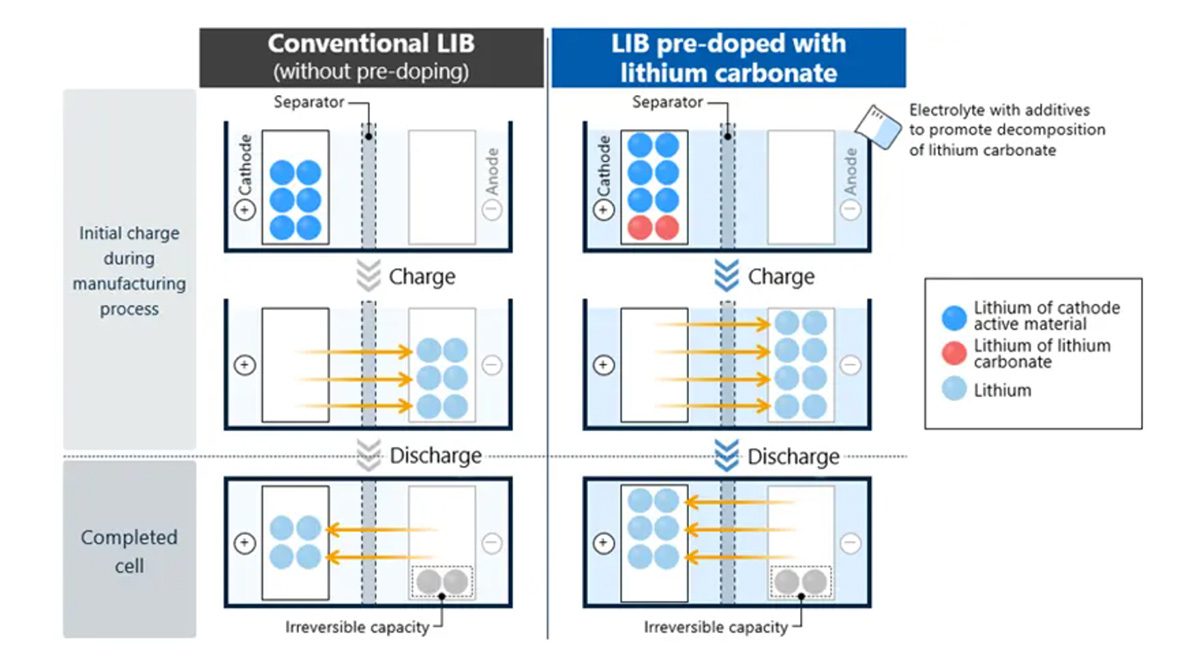
- The innovation addresses the critical issue of first-cycle capacity loss in silicon-rich cells by introducing lithium carbonate as an additional lithium source within the cathode.
- This proprietary approach enables the decomposition of lithium carbonate at standard operating voltages, a significant hurdle previously preventing its effective use for pre-doping.
- Internal tests by Asahi Kasei demonstrated a notable 10% increase in energy density when applied to an NMC cell featuring a 90% graphite and 10% silicon monoxide (SiO) anode.
- The technology promises enhanced cycle life and reduced cost per Wh, crucially without requiring substantial modifications to existing battery manufacturing lines, indicating broad applicability across various battery chemistries.
Revolutionising EV Battery Technology with Pre-Doping Innovation
Asahi Kasei, a global leader in materials science, has announced a significant advancement in lithium-ion battery technology. The company has developed a groundbreaking lithium pre-doping technology specifically engineered for high-voltage lithium-ion batteries that incorporate silicon-based anodes.

This innovative solution is poised to address one of the primary limitations of next-generation battery designs: the permanent capacity loss experienced by silicon-rich cells during their crucial first charge and discharge cycle. By integrating lithium carbonate into the cathode as an additional lithium source, Asahi Kasei’s pre-doping technology effectively compensates for this initial loss.
The Drive for Higher Energy Density in Electric Vehicles
The burgeoning electric vehicle (EV) market is a key driver for continuous innovation in battery technology. Automotive manufacturers and consumers alike demand higher energy density, enabling longer driving ranges and faster charging capabilities for EVs.
To meet these escalating requirements, battery developers have primarily focused on two strategic shifts: integrating silicon-based materials to partially replace traditional graphite in anodes and elevating the operating voltage of cathodes. While silicon offers immense potential, it introduces a unique set of challenges that Asahi Kasei’s pre-doping technology directly confronts.
Understanding the Silicon Anode Advantage and Its Challenges
Silicon stands out as a highly promising anode material due to its remarkable ability to store significantly more lithium per gram compared to graphite. This superior gravimetric energy density is the primary reason why cell manufacturers are increasingly blending silicon-based materials into predominantly graphite anodes.
However, the incorporation of silicon comes with a notable trade-off: a substantial and often irreversible capacity loss during the battery’s inaugural charge cycle. This inherent characteristic not only curtails the overall cycle life of the battery but also limits its practical energy density.
To counteract this, existing approaches often necessitate the loading of extra cathode active material, which consequently escalates material usage and manufacturing costs. Asahi Kasei’s pre-doping technology offers a more elegant and cost-effective solution to mitigate this fundamental hurdle.
Asahi Kasei’s Innovative Pre-Doping Mechanism Explained
The core of Asahi Kasei’s pre-doping technology lies in its novel approach to utilising lithium carbonate. While lithium carbonate is recognised for its relatively low cost and established history as a battery material, its high decomposition voltage has historically presented a significant barrier to its effective use in pre-doping applications.
Conventional lithium-ion cells operate within a nominal voltage range, typically below the decomposition threshold of lithium carbonate. This made it challenging to release its lithium content in a controlled and efficient manner during the initial charging phase.
Asahi Kasei’s breakthrough involves the incorporation of specialised additives within the electrolyte. These proprietary additives play a crucial role in facilitating the decomposition of lithium carbonate at cell voltages that are well within the standard operating parameters of typical lithium-ion batteries.
When pre-added to the cathode, the lithium carbonate undergoes decomposition during the cell’s initial charge cycle. This process effectively releases its lithium ions into the cell, thereby providing the necessary additional lithium source to compensate for the irreversible capacity loss associated with silicon-based anodes.
Performance Benefits and Industry Implications
The efficacy of Asahi Kasei’s pre-doping technology has been rigorously demonstrated through internal testing. In controlled experiments conducted on an NMC (Nickel Manganese Cobalt) cell, which featured an anode composed of 90% graphite and 10% silicon monoxide (SiO), the company reported impressive results.
These tests revealed a significant 10% increase in energy density, a critical metric for enhancing EV range and performance. Such an improvement is substantial in the highly competitive battery market and could translate into noticeable gains for electric vehicle applications.
Beyond the energy density boost, Asahi Kasei also highlights the technology’s potential to improve the overall cycle life of batteries. This enhancement in durability is coupled with a promise of a low cost per Wh, making it an economically attractive solution for mass production.
Crucially, the company asserts that this innovative pre-doping method can be integrated into existing battery manufacturing lines without necessitating significant modifications. This ease of integration is a key factor that could accelerate its adoption across the industry, minimising capital expenditure for battery producers.
Furthermore, the versatility of Asahi Kasei’s pre-doping technology is a compelling feature. It is expected to be applicable across a broad spectrum of cathode and anode material systems, suggesting its potential to become a widely adopted solution for various battery chemistries beyond the tested NMC/silicon-graphite combination.
Future Outlook and Commercialisation Pathway
With the successful validation of its technology, Asahi Kasei is now moving forward with the next critical phase: proof-of-concept evaluations with a diverse range of global customers. These collaborations are essential for demonstrating the technology’s real-world performance and adaptability across different battery designs and applications.
The company plans to implement licensing arrangements that will be phased according to each customer’s specific stage of development. This flexible approach aims to facilitate a smooth integration of Asahi Kasei’s pre-doping technology into various product development cycles, from research and development to full-scale commercial production.
This strategic rollout underscores Asahi Kasei’s commitment to advancing battery technology, positioning its pre-doping solution as a pivotal development for unlocking the full potential of silicon-rich anodes in the next generation of high-performance lithium-ion batteries, particularly for the demanding EV sector.
FAQs on Asahi Kasei’s Pre-Doping Technology
What is lithium pre-doping in batteries?
Lithium pre-doping is a technique used to compensate for irreversible lithium loss in new battery cells, particularly those with silicon-based anodes. It involves adding an extra source of lithium during manufacturing to ensure the cell has sufficient active lithium ions for optimal performance throughout its lifespan, mitigating initial capacity degradation.
Why is silicon used in battery anodes, and what are its drawbacks?
Silicon is favoured for its high theoretical capacity, meaning it can store significantly more lithium per gram than graphite, potentially increasing battery energy density. However, its primary drawback is large volume expansion during lithiation, leading to mechanical stress, electrolyte degradation, and a substantial irreversible capacity loss during the first charge cycle.
How does Asahi Kasei’s technology address first-cycle capacity loss?
Asahi Kasei’s pre-doping technology mitigates first-cycle capacity loss by incorporating lithium carbonate into the cathode. Special electrolyte additives enable this lithium carbonate to decompose at standard operating voltages during the initial charge. This process releases additional lithium ions, compensating for the irreversible capacity consumed by silicon anode side reactions.
What performance improvements does this technology offer?
Internal tests by Asahi Kasei demonstrated a 10% increase in energy density in NMC cells utilising a 90% graphite and 10% silicon monoxide (SiO) anode. The technology also promises improved cycle life and a lower cost per Wh. These benefits are critical for enhancing the performance and economic viability of next-generation batteries.
Can Asahi Kasei’s pre-doping technology be integrated into existing battery production?
Yes, a key advantage of Asahi Kasei’s pre-doping technology is its compatibility with current manufacturing processes. The company states that the technology can be applied without requiring significant modifications to existing battery production lines, which facilitates easier adoption and reduces the need for extensive re-tooling by battery manufacturers.
Is this technology limited to specific battery chemistries?
No, Asahi Kasei expects its pre-doping technology to be versatile and applicable across a broad spectrum of cathode and anode material systems. This wide compatibility suggests that the innovation can benefit various types of lithium-ion batteries, enhancing its potential impact across different applications and battery designs beyond the initial test configurations.
What are the next steps for commercialising Asahi Kasei’s innovation?
Following successful internal validation, Asahi Kasei is currently conducting proof-of-concept evaluations with global customers. The company plans to establish phased licensing arrangements tailored to each customer’s development stage. This strategic approach aims to ensure a smooth transition from development to market implementation for their pre-doping technology.