
Key Takeaways
- Asahi Kasei has developed a groundbreaking lithium pre-doping technology specifically for high-voltage lithium-ion batteries that utilize silicon-based anodes.
- The innovation addresses the significant first-cycle irreversible capacity loss inherent in silicon-rich cells, a key hurdle limiting their widespread adoption and performance.
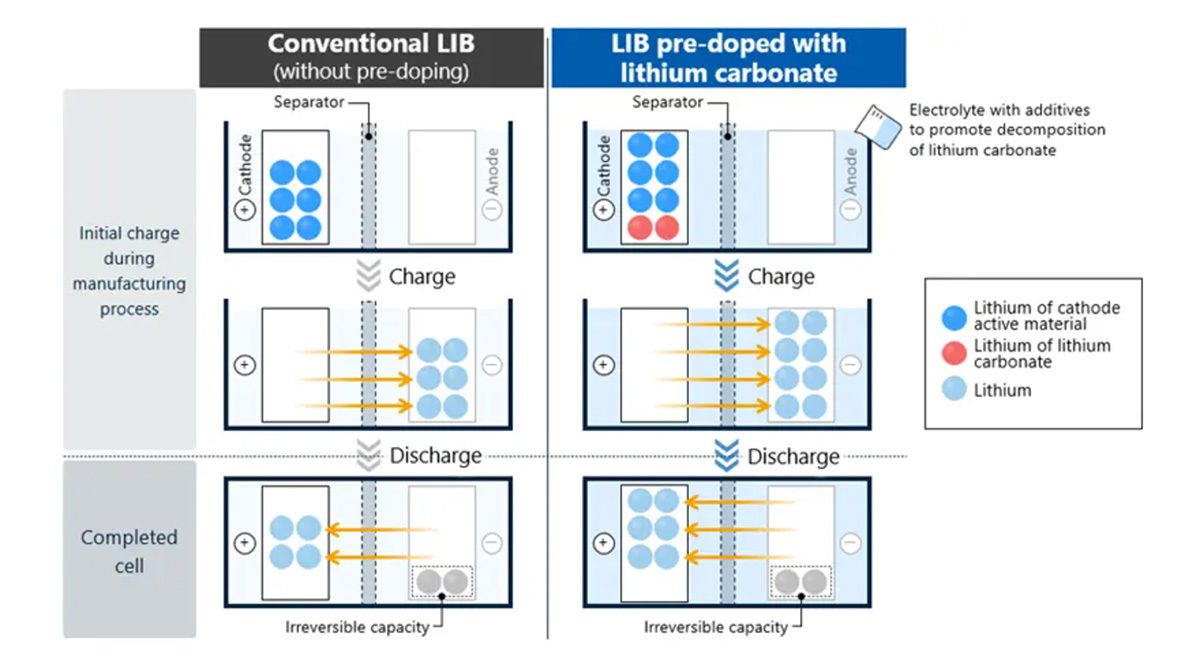
- By incorporating inexpensive lithium carbonate into the cathode and using special electrolyte additives, the technology ensures the carbonate decomposes at standard operating voltages, releasing critical lithium.
- Internal tests demonstrated a notable 10% increase in energy density for NMC cells with a 10% silicon monoxide anode, alongside improved cycle life and cost-efficiency.
- This development is poised to enhance electric vehicle (EV) range and battery longevity without requiring major modifications to existing manufacturing infrastructure.
In a significant advancement for electric vehicle (EV) battery technology, Asahi Kasei, a global leader in material science, has unveiled a novel lithium pre-doping technology. This innovation is specifically engineered to mitigate the notorious first-cycle capacity loss observed in high-voltage lithium-ion batteries that incorporate silicon-based anodes, paving the way for more efficient and durable power storage solutions.
The development marks a critical step forward in the ongoing quest to enhance battery energy density, a paramount requirement for extending EV range and improving overall performance. By tackling one of the core challenges associated with silicon-rich battery chemistries, Asahi Kasei’s solution promises to unlock the full potential of these next-generation anode materials.

The Imperative for Advanced EV Battery Solutions
The automotive industry’s rapid transition towards electrification has intensified the demand for lithium-ion batteries offering superior energy density and extended cycle life. Electric vehicles, in particular, necessitate batteries that can store more energy in a compact, lightweight package to achieve longer driving ranges and faster charging capabilities, all while maintaining competitive costs.
To meet these escalating requirements, battery manufacturers and material scientists have primarily focused on two strategic areas. The first involves the partial replacement of traditional graphite anodes with advanced silicon-based materials, renowned for their higher theoretical lithium storage capacity. The second strategy centers on elevating the operating voltage of cathode materials, which also contributes to increased energy density.
Addressing the Silicon Anode Challenge: First-Cycle Capacity Loss
While silicon boasts a significantly higher gravimetric energy density compared to graphite—holding substantially more lithium ions per gram—its integration into commercial battery anodes comes with inherent complexities. The most prominent challenge is a substantial and irreversible capacity loss that occurs during the battery’s very first charge and discharge cycle. This initial capacity fade is a critical impediment, as it directly limits both the overall energy density and the long-term cycle life of the cell.
This irreversible loss primarily stems from the formation of the Solid Electrolyte Interphase (SEI) layer, a crucial passivation layer that forms on the anode surface during the initial charging process. While essential for battery stability, the SEI formation consumes active lithium ions, effectively trapping them and preventing their subsequent participation in energy storage. Silicon’s tendency to undergo significant volume expansion and contraction during lithiation and delithiation cycles further exacerbates the SEI growth and breakdown, leading to continuous lithium consumption and accelerated capacity degradation.
To compensate for this initial lithium loss and maintain desired performance metrics, cell manufacturers have often resorted to incorporating additional cathode active material. While effective, this approach invariably increases material usage and, consequently, manufacturing costs, making it a less than ideal long-term solution for high-volume EV production.
Asahi Kasei’s Lithium Pre-Doping Technology Explained
Asahi Kasei’s innovative lithium pre-doping technology offers a direct and elegant solution to this critical challenge. The core of this method involves integrating lithium carbonate (Li₂CO₃) directly into the cathode as an additional source of lithium ions. This strategic placement ensures that a supplementary supply of lithium is available to offset the irreversible losses occurring at the silicon-rich anode during the first charge.
Lithium carbonate is an attractive choice for pre-doping due to its relative affordability and its well-established history as a safe and effective battery material. However, its practical application has historically been hindered by its high decomposition voltage, which typically sits far above the standard nominal operating range of conventional lithium-ion cells. This characteristic has made it challenging to efficiently release its lithium content within typical battery operational parameters.
Overcoming the Decomposition Hurdle with Electrolyte Additives
Asahi Kasei’s breakthrough lies in its development of specialized additives for the electrolyte system. These proprietary additives play a crucial role in enabling the decomposition of lithium carbonate at cell voltages that are well within the standard operating range of existing battery technologies. Essentially, these additives catalyze the decomposition process, allowing the pre-added lithium carbonate to release its stored lithium ions effectively during the initial charging cycle.
Once released, these supplementary lithium ions are then available to participate in the formation of the SEI layer on the silicon anode without drawing from the active lithium inventory supplied by the primary cathode material. This ensures that a greater proportion of the cathode’s lithium remains available for reversible cycling, directly addressing and compensating for the first-cycle irreversible capacity loss.
Demonstrated Performance and Key Advantages
The efficacy of Asahi Kasei’s lithium pre-doping technology has been rigorously evaluated through internal testing. In controlled experiments conducted on a Nickel-Manganese-Cobalt (NMC) cell featuring an anode composed of 90% graphite and 10% silicon monoxide (SiO), the company reported impressive results. A significant 10% increase in energy density was measured, indicating a substantial improvement in the cell’s ability to store charge.
Beyond the enhanced energy density, the technology also promises an improved cycle life. By effectively mitigating the initial lithium consumption, the battery can maintain its capacity over a greater number of charge-discharge cycles, thereby extending the overall lifespan of the battery pack. This enhanced durability contributes significantly to the long-term cost-efficiency of EV ownership.
A further compelling advantage highlighted by Asahi Kasei is the low cost per Wh achievable with this innovation. The use of relatively inexpensive lithium carbonate, combined with the technology’s ability to seamlessly integrate into existing battery manufacturing lines without requiring significant modifications, makes it a highly attractive and scalable solution for mass production. This compatibility ensures a smooth transition and rapid adoption across various cathode and anode material systems.
Strategic Path Forward: Global Collaboration and Licensing
With the successful validation of its lithium pre-doping technology, Asahi Kasei is now transitioning to the next phase of its commercialization strategy. The company is actively initiating proof-of-concept evaluations with a select group of global customers, underscoring its commitment to bringing this innovation to the market.
Accompanying these evaluations will be a phased licensing arrangement, meticulously tailored to align with each customer’s specific stage of development. This flexible approach is designed to facilitate broad adoption and accelerate the integration of this advanced battery enhancement into diverse product portfolios worldwide, solidifying its potential impact on the future of EV battery performance.
FAQ Section
What is lithium pre-doping technology?
Lithium pre-doping technology involves adding an extra source of lithium to a battery cell, typically during manufacturing. This supplementary lithium compensates for irreversible capacity losses that occur during the initial charge and discharge cycles, especially in advanced anode materials like silicon, thereby enhancing overall battery performance.
Why is this technology important for electric vehicles (EVs)?
This technology is crucial for EVs because it enables the effective use of silicon-based anodes, which can significantly boost battery energy density. Higher energy density translates to longer driving ranges for EVs, while improved cycle life contributes to battery longevity and reduces overall ownership costs.
How does Asahi Kasei’s pre-doping method work?
Asahi Kasei’s method integrates lithium carbonate into the cathode. Special electrolyte additives facilitate the decomposition of this lithium carbonate at standard battery operating voltages during the first charge, releasing lithium ions. These ions then compensate for the initial irreversible loss at the silicon anode, improving efficiency.
What is the benefit of using lithium carbonate?
Lithium carbonate is a cost-effective and well-established battery material. Its use in pre-doping, made possible by Asahi Kasei’s electrolyte additives, provides an economical way to supply the extra lithium needed. This helps keep manufacturing costs down while still achieving significant performance gains.
What performance improvements have been observed?
In internal tests, Asahi Kasei observed a 10% increase in energy density when their technology was applied to an NMC cell with a 10% silicon monoxide anode. The company also reported improvements in cycle life and emphasized the low cost per Wh, making it an efficient and practical solution.
Can this technology be integrated into existing battery production lines?
Yes, Asahi Kasei states that its lithium pre-doping technology can be applied without requiring significant modifications to existing battery manufacturing lines. This compatibility is a major advantage, promising easier and quicker adoption across various battery production facilities globally.