
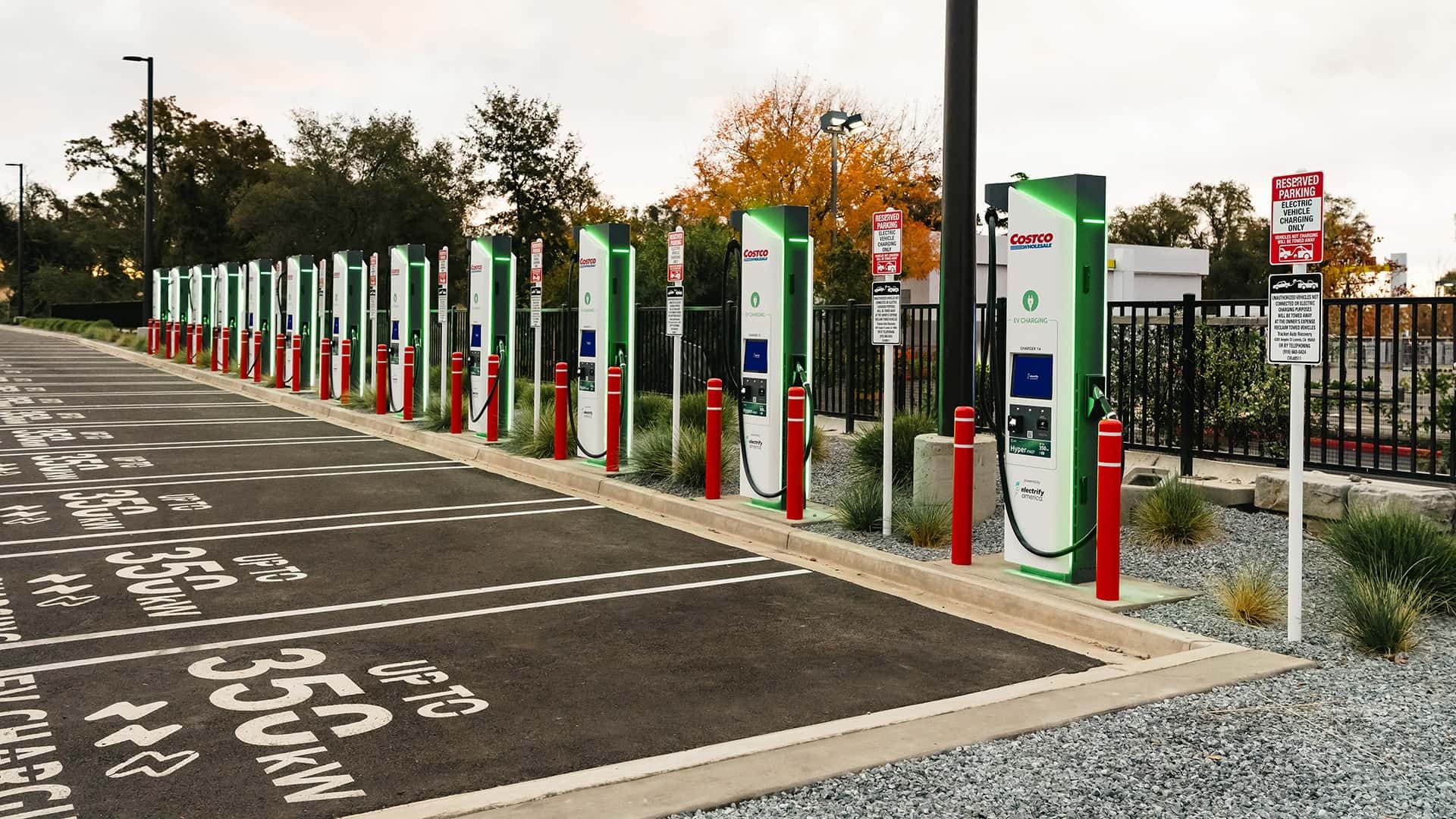
Key Takeaways: Optimising EV Charging Infrastructure
- Focusing solely on ultra-fast, high-powered EV chargers may not guarantee high utilisation or profitability for network operators.
- A white paper by Kempower reveals that increasing the number of charging plugs at a station significantly boosts utilisation rates and revenue, outperforming increases in total installed power.
- Sites with eight charging points demonstrate a utilisation rate nearly five times higher than two-plug stations and deliver more than double the energy of four-plug sites.
- The ideal average power output for maximizing station utilisation, considering most EVs’ real-world charging behaviour, is approximately 100 kW.
- Distributed power management systems, like those offered by Kempower, enhance scalability and cost-efficiency for EV charging infrastructure development.
The burgeoning electric vehicle (EV) market often highlights the allure of ultra-fast charging, promising rapid top-ups that can add hundreds of miles of range in mere minutes. While such advancements capture headlines and driver imagination, a recent analysis suggests that the sustainability and profitability of EV charging networks might hinge on a more fundamental metric: the sheer number of available charging plugs, rather than just raw power output.
A comprehensive white paper released by Kempower, a prominent Finnish provider of EV charging hardware and management software, challenges the conventional wisdom that higher power automatically translates to better business. The findings, derived from extensive North American charging data, indicate a significant paradigm shift for operators aiming to ensure financial viability and robust electric vehicle charging infrastructure.

Rethinking EV Charging Infrastructure Investment
Kempower’s study, leveraging data from its proprietary ChargEye analytics platform, posits that charging network operators will achieve greater financial success and a faster return on investment by prioritising the installation of more charging points at their stations. This strategy holds true even if these additional stalls offer comparatively less power than competing high-kilowatt locations.
The core assertion from the company is unequivocal: "Installed power barely moves the needle." Instead, the white paper concludes that "Charging site utilization climbs steadily as sites add charging points." This insight has profound implications for the strategic planning and deployment of future electric vehicle charging infrastructure.
The research underscores that while megawatt charging capabilities are technologically impressive, their economic impact on a network’s bottom line is less pronounced than the availability of multiple connection points. Drivers, it appears, are more inclined to use stations where the likelihood of an open charger is higher, even if the peak charging speed is not the absolute highest available.

The Multiplier Effect of More Plugs
Data compiled by Kempower illustrates a compelling correlation between the number of plugs at an electric vehicle charging station and its overall utilisation rate. This direct relationship translates into higher revenue streams and a quicker recoupment of initial investment for network operators.
The company’s analysis reveals a striking disparity: an EV charging station equipped with eight plugs can achieve a utilisation rate three times higher than a smaller station featuring fewer, albeit higher-powered, stalls. This suggests that the convenience and accessibility offered by multiple charging points are far more critical drivers of user engagement and profitability than the headline power figures.
Further quantifiable evidence from the white paper highlights this trend. Moving from a two-plug station to an eight-plug station dramatically increases the utilisation rate, jumping from approximately 2% to nearly 10%. In contrast, boosting station power from 100-kilowatt (kW) to 400-kW only saw utilisation rise from roughly 3% to just over 5%.
Moreover, sites with eight charging points demonstrate a substantial lead in energy delivery. On average, these larger stations dispense 128,342 kilowatt-hours (kWh) of energy, significantly more than the 61,453 kWh delivered by four-plug sites. This volume directly translates to greater income for the charging network operators.
Optimising Power Output for Real-World EV Charging
Kempower’s research also delves into the optimal power output for maximising the utilisation of an electric vehicle charging station when all connectors are actively in use. The paper suggests that an average output of approximately 100 kW represents an ideal balance for practical charging scenarios.
This recommendation stems from the observation that most, if not all, electric vehicles rarely sustain their advertised peak charging power throughout an entire charging session. Factors such as the vehicle’s battery management system, the current state of charge (SoC), ambient temperature, and the battery’s overall health dynamically modulate the actual power accepted by the EV.
Consequently, even if an EV manufacturer touts a peak charging rate of 300 kW, a typical 10% to 80% charging session often results in an average power input closer to 100 kW to 150 kW. Investing in substantially higher-powered chargers that rarely operate at their maximum capacity for extended periods can therefore lead to underutilised infrastructure and diminished returns on investment for EV charging network providers.
The Advantage of Distributed Power Systems
Kempower, established in Finland in 2017, is a specialist in developing EV charging stations that employ a distributed power architecture coupled with dynamic power management. This technological approach mirrors that of pioneering networks like Tesla’s Superchargers, which have long championed efficient power distribution.
The company advocates that adopting a distributed power strategy simplifies the future expansion and scalability of an EV charging station. This method allows operators to add more charging points incrementally without necessitating substantial, costly reinvestments in the core power infrastructure after the initial stalls have been energised.
In a distributed power system, a central power unit can allocate energy flexibly among multiple charging points based on real-time demand. This intelligent management ensures that the available power is optimally distributed across all active electric vehicle charging sessions, rather than being concentrated at a few high-powered, often underutilised, stalls.
Such an approach not only enhances operational efficiency but also provides a more consistent and reliable charging experience for consumers. By focusing on smart, scalable infrastructure rather than brute-force power, the industry can build a more robust and financially sustainable future for electric vehicle charging.
Implications for Future EV Charging Network Development
The findings presented by Kempower carry significant implications for stakeholders across the electric vehicle ecosystem, from charging network developers and investors to urban planners and EV manufacturers. As the global push towards electric mobility accelerates, understanding the true economics of EV charging infrastructure becomes paramount.
For network operators, the white paper provides a clear directive: strategic investment should lean towards expanding the number of charging points, thereby improving accessibility and reducing wait times for drivers. This customer-centric approach is directly linked to higher utilisation rates, which are fundamental to achieving profitability in a competitive market.
The emphasis on an average optimal power of 100 kW also suggests a need for a nuanced understanding of EV battery technology and charging behaviour. While headline-grabbing ultra-fast chargers have their place, a widespread deployment of moderately powerful, yet abundant, charging points could offer a more efficient and economically sound solution for the mass market.
Ultimately, the long-term success of the EV charging sector will depend not just on technological prowess but on smart, data-driven investment strategies. Kempower’s research serves as a crucial reminder that in the world of electric vehicle charging, sometimes more plugs, even with less individual power, can lead to significantly greater collective impact and a healthier bottom line for the industry.
Frequently Asked Questions About EV Charging Infrastructure
Q1: Why are more charging plugs better than higher power for EV charging stations?
A1: More plugs increase the likelihood of an available charging point, leading to higher station utilisation. Drivers prefer stations with less waiting time, which directly translates to greater revenue and a faster return on investment for operators, according to Kempower’s research.
Q2: What is the ideal power output for an EV charging station to maximise utilisation?
A2: Kempower’s data suggests that an average power output of approximately 100 kW per connector is ideal for maximising station utilisation. This accounts for the real-world charging behaviour of most EVs, which rarely sustain peak power throughout a session.
Q3: How does real-world EV charging differ from advertised peak charging rates?
A3: Electric vehicles rarely accept their advertised peak charging power for the entire duration of a session. Factors like battery state of charge, temperature, and battery management systems dynamically reduce the power input, resulting in a lower average charging rate, typically between 100 kW and 150 kW for a 10-80% charge.
Q4: What is ‘distributed power’ in EV charging infrastructure, and why is it beneficial?
A4: Distributed power involves a central power unit flexibly allocating energy across multiple charging points. This approach, similar to Tesla’s Superchargers, makes it easier and more cost-effective to scale a charging station by adding more plugs over time without significant infrastructure overhauls, improving efficiency and reliability.
Q5: What impact does high utilisation have on EV charging network operators?
A5: High utilisation directly leads to increased revenue and a quicker return on the initial investment for EV charging network operators. It signifies efficient asset deployment and greater customer satisfaction, contributing to the overall sustainability of the electric vehicle charging business model.
Q6: Does this mean ultra-fast chargers are unnecessary for electric vehicle charging?
A6: Not entirely. While more plugs are crucial for overall utilisation, ultra-fast chargers serve specific needs, like long-distance travel corridors or situations requiring very rapid charging. The research suggests that a balanced approach, with a focus on a higher number of moderately powerful plugs, is generally more profitable for widespread deployment.
Q7: What data source did Kempower use for their white paper findings?
A7: Kempower’s white paper findings are based on extensive North American charging data extracted from their proprietary ChargEye analytics platform, providing real-world insights into electric vehicle charging patterns and station performance.