
Key Takeaways: Toyota Motor North America has implemented an ‘Electrification 101’ training program for its employees, revealing a significant knowledge gap among staff regarding electric vehicles and hybrid technologies. This initiative, crucial for fostering internal advocacy, aims to educate diverse corporate personnel on the fundamentals, benefits, and future direction of electrification. While promoting Toyota’s multi-pathway strategy, the program emphasizes the efficiency of electric motors and seeks to galvanize employee support for the company’s long-term sustainability goals, transforming sceptics into proponents of the evolving automotive landscape.
As the automotive industry rapidly pivots towards electrification, a surprising revelation has emerged from within one of the world’s largest automakers. Toyota Motor North America recently hosted an ‘Electrification 101’ training program, designed to bring its diverse workforce up to speed on the intricacies of electric, hybrid, and fuel cell technologies. The experience highlighted a critical but often overlooked reality: not every employee, even at a leading car manufacturer, possesses an inherent understanding or passion for the nuances of vehicle electrification.

This realization, initially perceived as potentially discouraging, underscores the profound importance of internal education in driving a company’s strategic shift. For a global titan like Toyota, where the future of mobility is increasingly defined by sustainable powertrains, fostering a deeply informed and engaged workforce is not merely beneficial; it is imperative for the successful implementation of its comprehensive Toyota electrification strategy.
Understanding the Internal Knowledge Landscape
The traditional perception of an automaker’s employee base often assumes a universal enthusiasm for all things automotive. However, this is far from the complete picture, especially in large corporate environments. Many individuals join companies like Toyota for robust benefits, career stability, a respectful work culture, or the prestige associated with working for a world-renowned brand, rather than a deep-seated passion for vehicle mechanics or cutting-edge propulsion systems.
For roles such as corporate accountants, software developers, or human resources professionals, an in-depth understanding of battery chemistry or the nuances of hybrid systems is not typically a prerequisite. Even among employees with a general interest in cars, the rapid evolution of electrification presents a steep learning curve. The technical distinctions between NCM and LFP battery chemistries, for instance, can be esoteric even for seasoned automotive enthusiasts whose backgrounds might be rooted in traditional internal combustion engines.

Toyota’s Proactive Approach to Education
Recognizing this internal knowledge disparity, Toyota proactively developed its ‘Electrification 101’ program. This initiative marks the second such educational offering from the company, following an earlier broader ‘Introduction to Automotive’ class for employees. Such programs affirm that specialized knowledge about the minutiae of vehicle products is not uniformly distributed across its extensive workforce.
The program’s deliberate title, ‘Electrification 101’ rather than ‘EV 101,’ is highly indicative of Toyota’s broader strategic philosophy. The company is a prominent advocate of a ‘multi-pathway’ approach to reducing carbon emissions. This strategy champions a diverse portfolio of electrified vehicles, with a pronounced immediate focus on hybrid electric vehicles (HEVs), while simultaneously exploring the long-term potential of battery electric vehicles (BEVs) and hydrogen fuel cell electric vehicles (FCEVs).
Recent sales figures underscore this strategic emphasis: in the last quarter, a significant 56.8% of Toyota’s total vehicle sales were electrified. This category encompasses HEVs, BEVs, plug-in hybrid electric vehicles (PHEVs), and FCEVs. Notably, pure BEVs constituted only 1.7% of these electrified sales, highlighting the current dominance of hybrid technologies within Toyota’s immediate market offerings and their Toyota electrification strategy.
Inside the ‘Electrification 101’ Curriculum
The four-hour training course was predominantly conducted in a classroom setting, meticulously covering the fundamental principles of all electrified powertrain types. A crucial aspect involved clarifying the distinctions between standard hybrids and plug-in hybrids. Despite Toyota’s prevalent focus on hybrids, a substantial portion of the program was dedicated to dismantling common misconceptions surrounding battery electric vehicles.
The session commenced with a historical analogy, drawing parallels between the nascent gasoline car industry of the early 20th century and the current transition to electrification. Just as early automobiles faced challenges related to infrastructure, public education, servicing, and unclear regulations – making horse ownership seem simpler at the time – electric vehicles navigate similar hurdles today. The historical context underscored the idea that disruptive technologies, despite initial complexities, ultimately prevail.
The program then delved into the myriad advantages of electrification, particularly emphasizing enhanced efficiency and reduced environmental impact. It strongly advocated for the multi-pathway approach, presenting it not only as a means to offer customers diverse choices but also as the most effective method for optimizing the utilization of finite battery resources. This perspective, however, remains a point of considerable debate within the broader automotive and environmental communities, with much research suggesting that BEVs often represent the cleanest option over their lifecycle, even when considering energy generation sources.
Nuances in Presenting Powertrain Advantages
One section of the curriculum, focused on the relative benefits of each powertrain type, was noted as potentially less comprehensive in its impartiality. While discussing the limitations of BEVs, it did not equally highlight the additional maintenance demands or the inherent noise, vibration, and harshness (NVH) associated with gasoline-powered vehicles. Furthermore, the program adopted a characteristically optimistic stance on hydrogen fuel cell technology.
A slide, for instance, proclaimed that hydrogen “can reduce ‘range anxiety’ as number of stations grow,” noting the Toyota Mirai’s impressive range of up to 402 miles per tank. While such figures were compelling during the early stages of EV development, the current landscape has shifted considerably. Today, at least eight battery electric vehicles available in the U.S. market already surpass this driving range, with an increasing number of models poised to offer even greater distances, challenging the presented advantage of hydrogen in this specific context.
Beyond these specific points, the remainder of the in-classroom content was broadly informative and objective. It thoroughly covered the fundamentals of battery chemistries, distinguished between various charging types, elucidated core electrical concepts such as kilowatts and kilowatt-hours, and provided an overview of burgeoning battery recycling initiatives. This foundational knowledge is critical for understanding the mechanics of any advanced Toyota electrification strategy.
Interactive Learning for Deeper Understanding
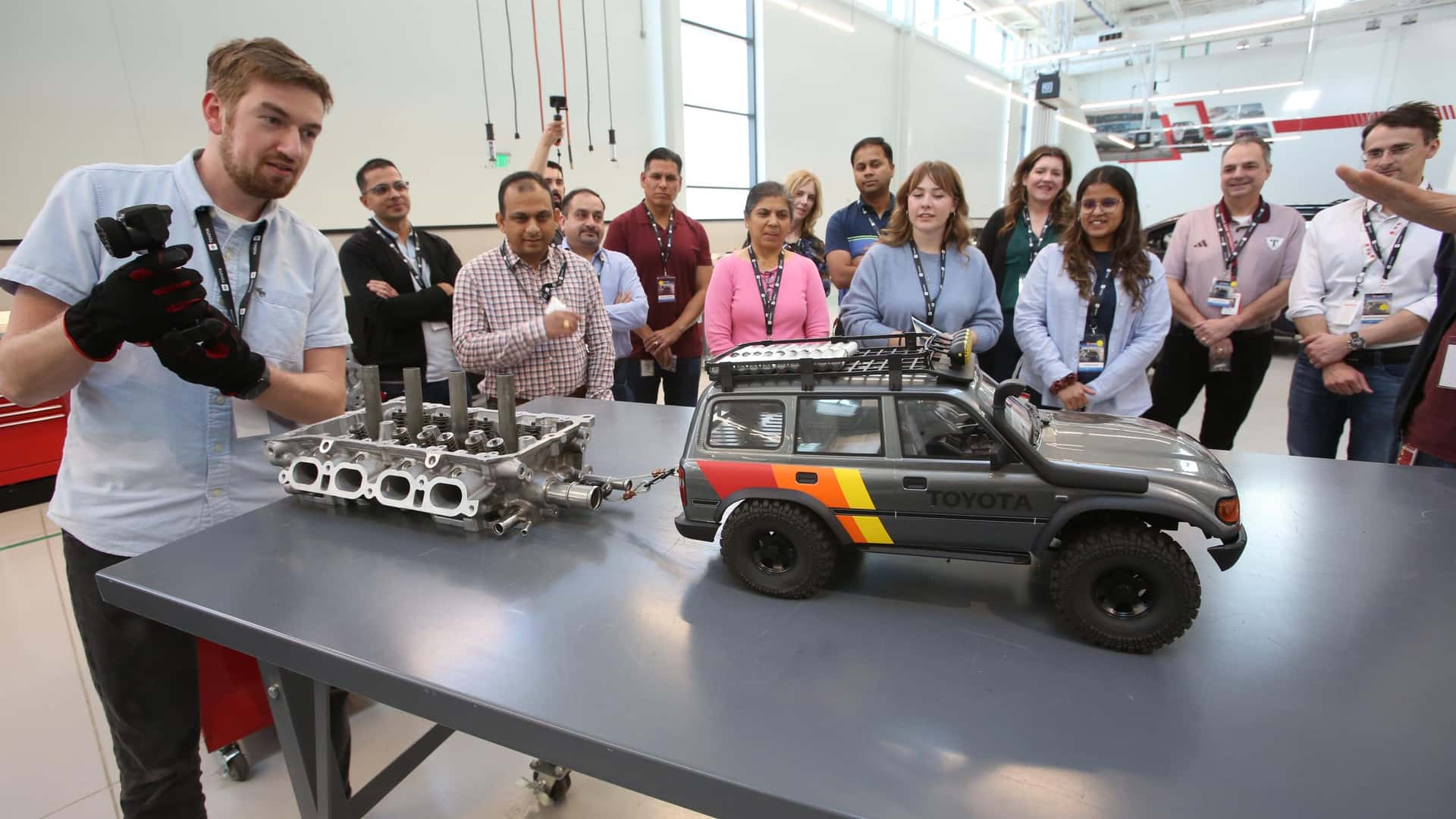
The most engaging segment of the program was its interactive, hands-on component. Participants were given the opportunity to construct a simple electric motor using basic materials: a screw, a magnet, a AA battery, and a piece of wire. They also assembled a rudimentary potato-based battery and observed different charging outputs in real-time. A compelling demonstration involved a tiny remote-controlled Land Cruiser effortlessly pulling a cylinder head weighing over 30 pounds, vividly showcasing the instant torque inherent to an EV motor.
The Core Lesson: Simplicity and Efficiency of Electric Propulsion
The central message conveyed by the training was unequivocal: electric motors represent an extraordinary technological advancement. Presenters contrasted a complex, stripped-out Toyota V-6 engine, replete with its numerous accessories and intricate components, with an equivalent electric motor. The electric counterpart demonstrated superior power output within a significantly smaller footprint and through a far simpler design.
Even when electric motors are integrated into a gasoline powertrain, as seen in Toyota’s sophisticated hybrid systems, they contribute to reduced mechanical complexity. For example, the inclusion of an electric motor can often eliminate the need for a finicky traditional transmission. This fundamental principle highlights that adding electric propulsion, regardless of the degree of electrification, consistently enhances efficiency with minimal compromises.
The deeper one progresses along the path of electrification, the simpler the powertrain architecture becomes. A true battery electric vehicle, devoid of an internal combustion engine, possesses considerably fewer moving parts and intricate systems, thereby reducing potential points of failure and simplifying maintenance. This inherent simplicity is a powerful argument for the long-term viability of an all-electric future, central to Toyota’s evolving Toyota electrification strategy.
Toyota representatives were clear that the company foresees substantial improvements needed in battery chemistry and charging infrastructure before BEVs become a universally adopted, ‘one-size-fits-all’ solution. However, the overarching impression from the training was a concerted effort by the company to generate genuine excitement among its employees for a predominantly electric future.
Cultivating Internal Advocacy for Electrification
The cultivation of an informed and enthusiastic internal workforce is critical for any large-scale corporate transformation. Without a clear understanding of the long-term benefits of electrification, employees in roles like corporate procurement might perceive only the immediate challenges: the added costs of new component designs or the complexities of onboarding novel suppliers. Such a narrow perspective often leads to resistance to change, a natural human tendency.
However, by igniting excitement and conviction, employees become willing to navigate short-term complexities in pursuit of overarching long-term objectives. They are empowered to advocate for these goals and influence their colleagues and external stakeholders. This internal momentum is vital for effectively implementing a progressive Toyota electrification strategy.
Brigette Armato, a Toyota employee who participated in the training, exemplifies this transformative impact. She openly admitted to knowing “nothing” about EVs and hybrids prior to the course. Yet, upon completion, she emerged as an ardent advocate. “I work with our lease experience team, so I’m actually working with the customers and the vehicles. This was extremely helpful because now I can have an educated conversation with them and maybe convince them to go for an electric vehicle, whereas before I don’t think I had that skill,” she shared after the session.
Her newfound conviction extends beyond customer interactions. Ms. Armato is now seriously considering an EV for her personal use, despite her current attachment to her Toyota 4Runner. She expressed a desire for a fully electric alternative, stating, “I wish we would gravitate more towards electric vehicles across the lineup.” This sentiment reflects a growing internal consensus that Toyota aims to foster.
With hundreds of employees attending these ‘Electrification 101’ classes and a substantial waitlist for upcoming sessions, Toyota’s North American headquarters is steadily cultivating a growing cadre of EV proponents. This shift is not about overcoming active resistance, but rather addressing a common lack of awareness. Much like many car buyers, a significant portion of the workforce simply hadn’t been fully informed about the compelling advantages of electrification, a crucial step in advancing Toyota’s long-term Toyota electrification strategy.
Frequently Asked Questions (FAQ)
What is Toyota’s ‘Electrification 101’ program?
Toyota’s ‘Electrification 101’ is an internal training initiative for its employees, designed to educate them on the basics of electrified vehicle powertrains, including hybrids, plug-in hybrids, battery electric vehicles, and hydrogen fuel cell vehicles. It aims to bridge knowledge gaps and foster a deeper understanding of the company’s future direction in sustainable mobility.
Why did Toyota implement this training?
Toyota recognized that many of its employees, particularly those not in product-specific roles, lacked comprehensive knowledge about electrification. The program was created to inform the workforce about the benefits and technologies of electrified vehicles, generate internal excitement, and empower employees to become advocates for Toyota’s evolving electrification strategy.
What is Toyota’s ‘multi-pathway’ approach to electrification?
Toyota’s ‘multi-pathway’ approach emphasizes offering a diverse range of electrified vehicles to meet various customer needs and market conditions. This strategy currently prioritizes hybrids, while also developing battery electric vehicles and hydrogen fuel cell vehicles. The company believes this balanced approach optimizes resource utilization and ensures customer choice.
What were some key takeaways from the ‘Electrification 101’ curriculum?
The program covered powertrain distinctions, dispelled EV myths, highlighted efficiency and cleanliness benefits, and explained battery chemistries and charging. A core lesson emphasized the inherent simplicity and efficiency of electric motors compared to complex internal combustion engines, even in hybrid applications, indicating a cleaner, more streamlined future for automotive propulsion.
How does employee education impact Toyota’s electrification strategy?
Educating employees creates internal champions who understand and advocate for electrification. This understanding helps overcome resistance to change, drives long-term strategic decisions, and fosters a unified vision across the company. Informed employees can better engage with customers and contribute to the successful implementation of Toyota’s sustainable mobility goals.