
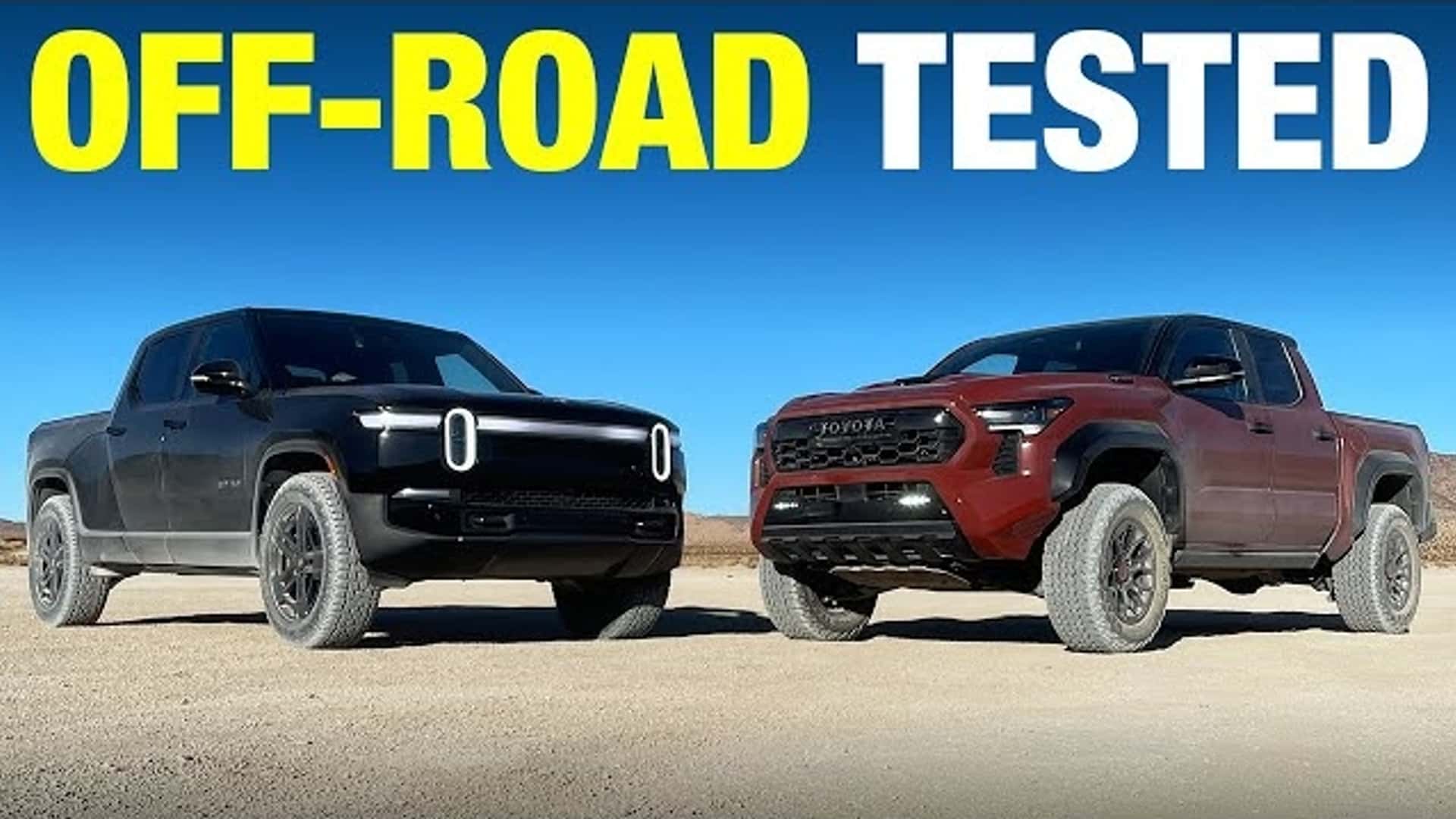
Johnson Valley, CA – A head-to-head comparison between the all-electric Rivian R1T and the hybrid Toyota Tacoma TRD Pro reveals distinct strengths and weaknesses when tackling challenging off-road terrain. While both vehicles are marketed for their adventure capabilities, their fundamentally different designs lead to varying performance outcomes.
Electric Sophistication vs. Mechanical Prowess
The Rivian R1T, described as a “computer on wheels,” features advanced technology such as adaptive dampers and dual electric motors producing over 800 pound-feet of torque. Its sophisticated traction system and adaptive air suspension are designed to handle various off-road conditions. In contrast, the Toyota Tacoma TRD Pro represents a more raw, mechanical approach, relying on its proven hybrid powertrain and robust construction for off-road dominance.

Performance in Diverse Terrains
During testing in Johnson Valley, Southern California, the Rivian R1T demonstrated its capabilities on sandy terrain, where its abundant power and torque proved advantageous. The unibody construction of the R1T also allowed it to absorb and dissipate harsh impacts more effectively at higher speeds, contributing to a smoother ride on uneven surfaces.
However, the R1T encountered difficulties on steep hill climbs. Despite its powerful electric motors and brake torque vectoring system, the vehicle struggled to maintain traction on the steepest sections. Brake torque vectoring, while helpful in limiting excessive wheelspin, does not redistribute lost torque to wheels with grip, proving insufficient for extreme inclines.
The hybrid Toyota Tacoma TRD Pro, on the other hand, excelled in these challenging scenarios. Its mechanical setup, including a locking rear differential, allowed both rear wheels to spin in unison, delivering consistent power to the ground on hill climbs. The Tacoma also proved superior in rock climbing and articulation tests, largely due to its disconnecting front sway bar, which enabled its front axle to better adapt to the terrain’s contours.

Powertrain and Construction Differences
The dual-motor Rivian R1T boasts 533 horsepower and over 800 lb-ft of torque, coupled with an adaptive air suspension and a hydraulic suspension system. Its design includes high approach and departure angles, off-road tires, and multiple drive modes for optimized traction and suspension settings.
The hybrid Tacoma is powered by a 2.4-liter, four-cylinder turbocharged engine delivering 326 horsepower and 465 lb-ft of torque. Critically, it utilizes a body-on-frame construction, a design generally favored for rugged off-road applications due to its inherent rigidity. The Tacoma is further equipped with a locking rear differential, a solid rear axle, a disconnecting front sway bar, and off-road-tuned Fox shocks.
On-Road Comfort vs. Off-Road Specialization
While the R1T’s unibody construction contributes to a more comfortable and smoother on-road experience, the Tacoma’s mechanical setup appears better suited for slow-speed maneuvers like hill climbs and rock crawls. The article notes that future comparisons might be more equitable with vehicles like the upcoming Scout Terra, which is slated to feature a solid rear axle and locking differentials, aiming for true off-road credentials.
The analysis suggests that for demanding low-speed off-road challenges, the traditional mechanical approach of the Tacoma TRD Pro currently holds an advantage over the electric sophistication of the Rivian R1T, despite the latter’s impressive power output and advanced technology.