
Key Takeaways
- BYD has introduced an innovative EV charging station in Abu Dhabi, integrating solar panels, battery storage, and a robotic arm for automated, hands-free charging.
- This cutting-edge BYD EV charging station is designed to operate independently of the main electricity grid, making high-speed charging accessible in remote or infrastructure-limited areas.
- Each T-shaped Flash Charger is equipped with two 185 kWh storage batteries, totalling 370 kWh, capable of delivering up to 1,500 kW of power.
- Compatible electric vehicles, such as those featuring BYD’s second-generation Blade battery, can achieve a 10% to 70% charge in just five minutes.
- BYD aims to establish 6,000 Flash Charging stations globally by the end of 2027, signalling a significant expansion of its advanced charging network.
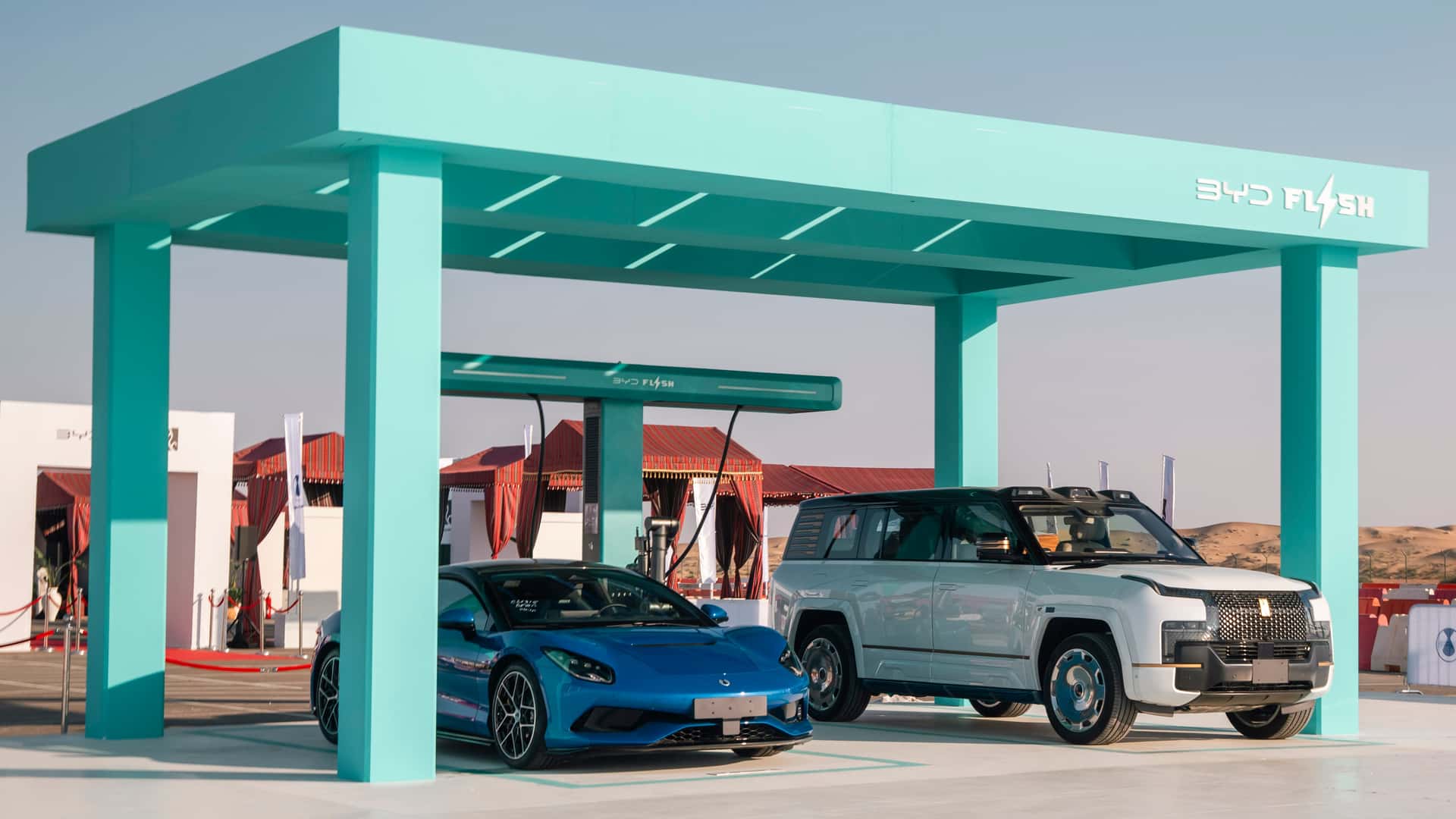
In a groundbreaking move set to redefine electric vehicle (EV) infrastructure, Chinese automotive giant BYD has unveiled a state-of-the-art EV charging station capable of operating entirely off the grid. Located in the challenging environment of the Abu Dhabi desert, this innovative facility seamlessly integrates solar power generation, robust battery energy storage, rapid Flash Charging technology, and an advanced robotic arm for automated vehicle connection. This development promises to extend high-speed charging capabilities to previously inaccessible remote locations worldwide.
Traditionally, establishing fast-charging infrastructure has been heavily reliant on strong grid connections, posing a significant hurdle for deployment in areas with underdeveloped electricity networks. BYD’s new approach addresses this core challenge by creating a self-sufficient ecosystem where sunshine is harnessed, energy is stored, and electric vehicles are charged with unprecedented efficiency and autonomy.
BYD’s Vision for Grid-Independent EV Charging
The core concept behind BYD’s latest innovation is elegantly simple yet profoundly impactful: solar panels capture solar energy, integrated batteries store this renewable electricity, and high-power chargers then deliver it to electric vehicles. This comprehensive system is engineered to function independently, liberating rapid EV charging from the constraints of existing grid infrastructure.
The strategic deployment of such a sophisticated BYD EV charging station in the Abu Dhabi desert serves as a powerful demonstration of its potential. This location, known for its abundant solar resources and often challenging infrastructure, provides an ideal testing ground for a system designed for resilience and self-sufficiency. The ability to deploy fast-charging solutions without a direct, robust grid connection opens new possibilities for EV adoption in diverse global geographies, from remote highways to emerging markets.
How the Integrated System Works
At the heart of this advanced BYD EV charging station are its T-shaped Flash Chargers, each paired with two substantial 185-kilowatt-hour (kWh) storage batteries. This configuration provides a combined on-site storage capacity of 370 kWh per charger. While these units are designed to draw power from the grid where available, at rates ranging from 100 to 560 kilowatts, their primary innovation lies in their capacity to operate autonomously, utilizing stored energy.

The system’s modular design ensures that the energy generated by the solar panels is directly fed into these storage batteries. From there, the chargers can supply power to electric vehicles at significantly higher rates than the incoming grid connection might allow. This dual functionality not only supports off-grid operation but also enables existing grid-connected stations to boost power delivery during peak demand, alleviating strain on local grids.
Robotics and Automation: The Future of Plugging In
A distinctive feature of this next-generation BYD EV charging station is the inclusion of a robotic arm that automatically plugs into the electric vehicle. This hands-free operation represents a significant step towards fully automated EV charging and parking experiences. While BYD has not yet provided extensive details on the robotic arm’s full capabilities, its integration hints at a future where charging becomes as effortless as parking a vehicle.
The robotic arm’s role is particularly crucial in off-grid deployments, where human intervention might be less feasible or desirable. Coupled with automated parking systems, this technology could streamline the charging process, enhance user convenience, and potentially enable autonomous vehicle fleets to manage their charging needs without human oversight. It underscores a broader industry trend towards intelligent, self-sufficient infrastructure.
High-Speed Charging Capabilities and Battery Technology
BYD’s Flash Charging technology is central to the station’s appeal, promising remarkably short charging times. With its latest 1,500 kW Flash Chargers, compatible electric vehicles equipped with BYD’s second-generation Blade battery can achieve a rapid charge from 10% to 70% in just five minutes. Furthermore, a near-full charge, reaching 97%, can be accomplished in approximately nine minutes.
This level of speed significantly addresses range anxiety and convenience concerns, making EV charging comparable to or even faster than traditional refuelling in some scenarios. The Blade battery, known for its safety, durability, and energy density, plays a critical role in enabling such high-power intake without compromising battery health or safety. The synergy between advanced battery chemistry and ultra-fast charging technology is what truly sets this BYD EV charging station apart.
Power Delivery and Efficiency
Each Flash Charger is engineered to deliver substantial power: up to 1,500 kW when using a single cable, or up to 1,000 kW when both available cables are simultaneously in use. This high output ensures that even multiple vehicles can be charged efficiently, though the exact number of cars the desert station can charge on solar power alone, or its precise solar output, remains undisclosed by BYD. This information would be crucial for a complete assessment of its off-grid autonomy and capacity.
The Global Expansion of BYD’s Charging Network
BYD’s ambitious plans extend far beyond the Abu Dhabi desert. The company has declared its intention to establish 6,000 Flash Charging stations worldwide by the end of 2027. While it has not specified how many of these will feature solar power, off-grid operation, or the robotic arm, this aggressive expansion signals BYD’s commitment to building a robust global EV charging infrastructure.
The rollout is already underway in Europe, with Flash Charging sites operational in key markets such as Italy, Germany, France, and the United Kingdom. Canada is also slated to receive these advanced charging facilities in the near future. This geographical spread highlights BYD’s strategy to support the global transition to electric mobility with cutting-edge charging solutions.
Vehicle Compatibility: The Denza Z9 GT Example
To fully leverage the capabilities of these high-power charging stations, compatible electric vehicles are essential. The Denza Z9 GT, an electric wagon, is one such vehicle currently sold in Europe that can fully utilise BYD’s Flash Charging power. During a recent demonstration, the Denza Z9 GT showcased impressive charging performance, achieving a 10% to 80% charge in six minutes and 32 seconds, and reaching 97% in nine minutes and 22 seconds.
This performance underscores the importance of an integrated ecosystem where vehicle battery technology and charging infrastructure evolve in tandem. As BYD expands its vehicle lineup and Flash Charging network, the adoption of compatible EVs will be key to unlocking the full potential of this advanced charging paradigm.
The Broader Trend of Battery-Backed Charging
BYD’s innovation aligns with a growing industry trend towards battery-backed charging solutions. Companies like Electric Era and Beam Global specialize in these systems, and even industry leader Tesla has incorporated solar panels and its Megapack batteries into its largest Supercharger site. The rationale is clear: on-site energy storage allows charging stations to deliver more power than their direct grid connection might provide, while also reducing peak demand on the grid, enhancing resilience, and optimizing energy costs.
This approach transforms charging stations into more flexible energy assets, capable of managing demand, integrating renewable sources, and providing a stable power supply even in fluctuating grid conditions. For a BYD EV charging station, this means greater reliability and the potential for a greener energy footprint, contributing to broader decarbonization efforts in the transportation sector.
Future Outlook and Challenges
While the prospect of off-grid, robotic Flash Charging is incredibly promising, specific technical details regarding the new desert installation’s solar output and total battery capacity for fully off-grid operation remain undisclosed. Clarifying these metrics would provide a clearer understanding of its sustained capacity and efficiency when detached from the grid, especially under varying environmental conditions.
Nevertheless, BYD’s latest development represents a significant leap forward in addressing critical challenges in EV adoption, particularly infrastructure availability and charging speed. As the global EV market continues its rapid growth, innovations like this BYD EV charging station will be pivotal in building a robust, accessible, and sustainable charging network that supports the widespread transition to electric mobility. The integration of renewable energy, advanced robotics, and ultra-fast charging promises a future where range anxiety and charging inconvenience become relics of the past.
Frequently Asked Questions (FAQs)
What makes BYD’s new EV charging station unique?
BYD’s new EV charging station is unique for its integration of solar panels, battery storage, and a robotic arm, enabling fully autonomous and off-grid high-speed charging. This allows deployment in remote areas without a strong grid connection, powered by renewable energy, and facilitates hands-free vehicle charging through automation.
How fast is BYD’s Flash Charging technology?
BYD’s Flash Charging technology is exceptionally fast. With the latest 1,500 kW chargers, compatible electric vehicles featuring BYD’s second-generation Blade battery can charge from 10% to 70% in just five minutes. A near-full charge, reaching 97%, can be achieved in approximately nine minutes, significantly reducing charging times.
Can the BYD EV charging station operate without a grid connection?
Yes, the new BYD EV charging station is designed to operate independently of the electricity grid. It achieves this by generating its own power through solar panels and storing it in integrated batteries (370 kWh per charger). This capability makes it ideal for deployment in remote regions or areas with limited electrical infrastructure, enhancing EV accessibility.
What is the role of the robotic arm in the charging process?
The robotic arm automatically plugs the charging cable into the electric vehicle, making the charging process entirely hands-free. This enhances user convenience, supports automated parking systems, and is a step towards fully autonomous EV infrastructure. It simplifies the user experience and can be crucial for future autonomous vehicle fleets.
What are BYD’s global expansion plans for these charging stations?
BYD has ambitious plans to establish 6,000 Flash Charging stations worldwide by the end of 2027. This expansion aims to build a comprehensive global network, with deployments already initiated in European countries like Italy, Germany, France, and the UK, and plans to introduce them in Canada, underscoring its commitment to global EV adoption.
Which vehicles are compatible with BYD’s Flash Charging?
Vehicles equipped with BYD’s second-generation Blade battery are designed to fully utilize the Flash Charging technology. An example is the Denza Z9 GT electric wagon, currently available in Europe, which demonstrated rapid charging from 10% to 80% in approximately six and a half minutes during a test, highlighting vehicle-charger synergy.