
Key Takeaways:
- BYD has introduced an innovative EV charging station that integrates solar power, battery storage, and a robotic arm, enabling fast charging capabilities even without a direct grid connection.
- This pioneering system aims to extend high-speed electric vehicle charging infrastructure to remote or underserved locations globally.
- The Flash Charging technology, coupled with advanced Blade batteries, allows compatible vehicles to achieve significant charge levels in under ten minutes.
- While the core technology is detailed, BYD has yet to disclose specific solar and battery capacities for its off-grid desert installation, raising questions about its independent operational scope.
- BYD plans an ambitious rollout of 6,000 Flash Charging stations worldwide by the end of 2027, marking a significant step in the evolution of electric mobility.
Revolutionising EV Charging: BYD’s Grid-Independent Solution Emerges
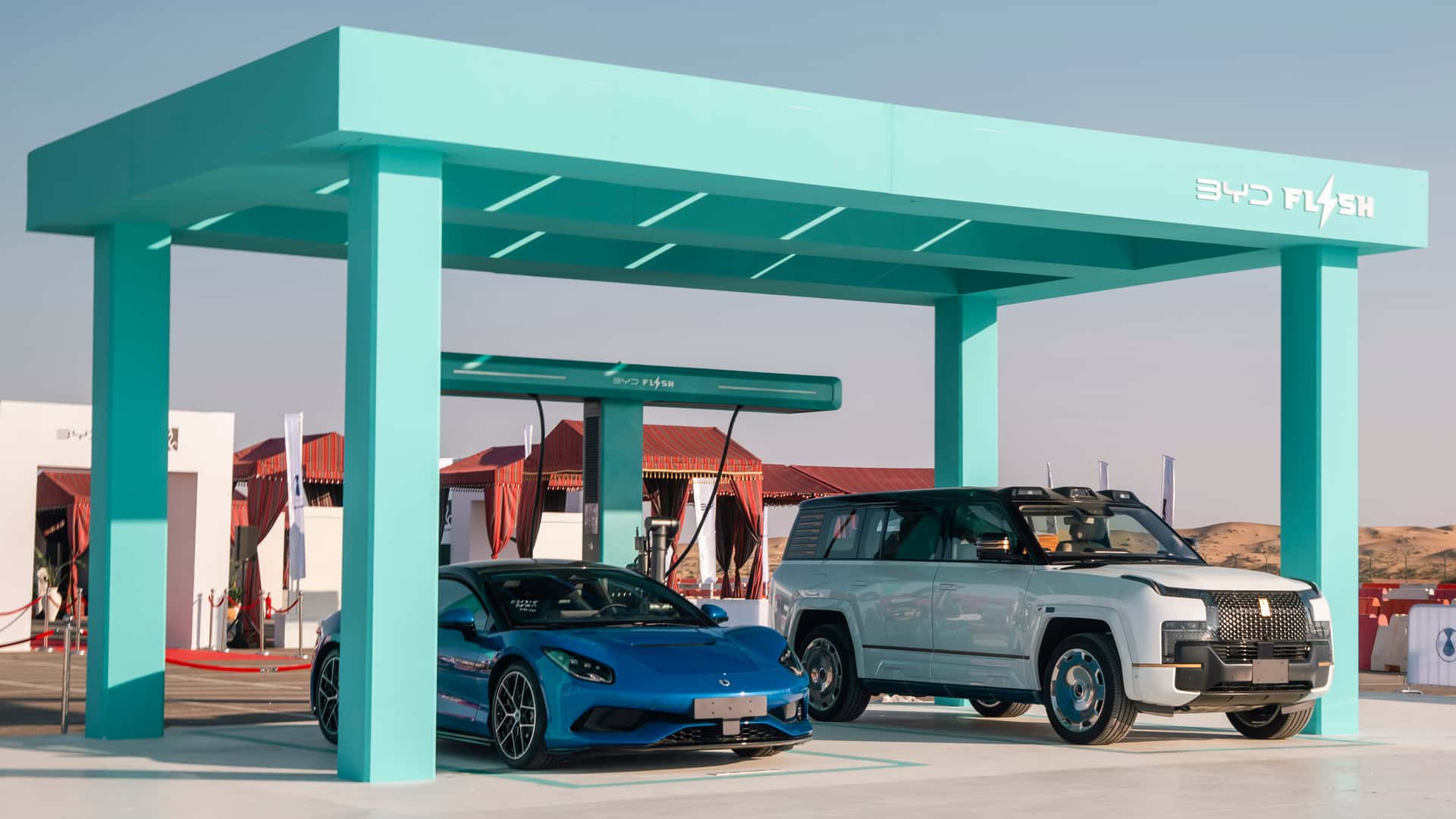
In a significant stride towards sustainable and accessible electric vehicle infrastructure, BYD, a global leader in new energy vehicles, has unveiled a pioneering EV charging station designed to operate independently of conventional electricity grids. This innovative system, demonstrated in the challenging environment of the Abu Dhabi desert, integrates solar panels, advanced battery storage, proprietary Flash Charging technology, and a sophisticated robotic arm for automated vehicle connection.

The introduction of this self-sufficient facility addresses a critical challenge in the widespread adoption of electric mobility: the availability of robust EV charging infrastructure in locations where grid connections are either impractical, costly, or unreliable. By harnessing solar energy and storing it in high-capacity batteries, BYD aims to democratise fast EV charging, making it viable in remote areas previously deemed unfeasible.
The Synergy of Solar, Batteries, and Robotics in EV Charging
At the heart of BYD’s latest innovation lies a harmonious integration of multiple advanced technologies. Solar panels serve as the primary energy source, converting sunlight into electricity. This energy is then channelled into substantial battery storage units, ensuring a consistent and ample power supply for rapid EV charging. The system’s fundamental premise is straightforward: generate power renewably, store it efficiently, and deliver it quickly to electric vehicles.
This holistic approach to energy management is gaining traction across the electric vehicle industry. Battery-backed EV charging solutions, in particular, are becoming increasingly prevalent. These systems allow charging stations to deliver significantly more power than their direct grid connection might otherwise permit, effectively acting as a buffer against peak demand and stabilising grid load. This strategy is not unique to BYD; industry giants like Tesla, with its largest Supercharger site, also incorporate solar panels and Megapack batteries to enhance their EV charging capabilities.

Specialised firms such as Electric Era and Beam Global are dedicated to developing and deploying battery-backed charging infrastructure, underscoring the growing importance of such solutions. Even BYD’s grid-connected Flash chargers utilise on-site energy storage to boost power delivery, demonstrating a broader industry trend towards intelligent energy management for efficient EV charging.
Unpacking the Flash Charging Technology
BYD’s Flash Charging units are central to the station’s high-speed capabilities. Each T-shaped Flash charger is equipped with two 185-kilowatt-hour (kWh) storage batteries, accumulating a total of 370 kWh of energy storage per charger. These batteries are designed to draw power from the grid at a variable rate, ranging from 100 to 560 kilowatts (kW), and then deliver it to connected vehicles at a substantially higher rate.
The impressive power delivery of these chargers is a game-changer for EV charging times. A single cable can supply up to an astounding 1,500 kW, while simultaneous use of both cables still provides up to 1,000 kW. Such high power outputs translate directly into drastically reduced charging durations, addressing a key consumer concern regarding electric vehicle ownership. This robust power distribution system ensures that even a moderate grid connection can facilitate ultra-fast charging by leveraging the stored energy in the on-site batteries.
While the technical specifications of the Flash chargers are clear, BYD has yet to provide comprehensive details regarding the specific battery capacity or solar output of this new desert installation. This missing information is crucial for accurately assessing the station’s full operational autonomy and how many vehicles it can charge, or how quickly, relying solely on solar power without any grid assistance. Future disclosures are anticipated to shed more light on the true off-grid capabilities of this innovative EV charging setup.
The Promise of Ultra-Fast Charging Speeds
The speed at which BYD’s Flash Chargers can replenish an electric vehicle’s battery is genuinely remarkable, setting new benchmarks in the EV charging landscape. Compatible vehicles, particularly those equipped with BYD’s second-generation Blade battery, can achieve a charge from 10% to 70% in a mere five minutes. Pushing this further, a 97% charge can be reached in just nine minutes.
These figures rival, and in many cases surpass, the time it takes to refuel a traditional internal combustion engine vehicle, effectively eliminating range anxiety related to charging durations. A recent demonstration involving the Denza Z9 GT, an electric wagon, showcased these capabilities firsthand. During the test, the vehicle charged from 10% to 80% in six minutes and 32 seconds, and achieved 97% in nine minutes and 22 seconds, validating the real-world efficiency of BYD’s high-speed EV charging technology.
Robotic Automation for Seamless Charging
Adding another layer of innovation, the BYD EV charging station incorporates a robotic arm designed to automatically plug in the electric vehicle. This feature, combined with automated parking systems, ushers in an era of entirely hands-free EV charging. The robotic arm enhances convenience, particularly in future scenarios involving autonomous vehicles, and mitigates the need for manual intervention, simplifying the charging process for drivers.
The integration of robotics into EV charging infrastructure represents a forward-thinking approach to user experience and operational efficiency. It reduces physical effort, ensures precise connection, and can potentially streamline the workflow in busy charging hubs. This automation positions BYD at the forefront of developing intelligent, user-centric EV charging solutions.
Global Expansion and Future Outlook for EV Charging
BYD has outlined an ambitious global expansion strategy for its Flash Charging network. The company aims to establish 6,000 Flash Charging stations worldwide by the end of 2027. This aggressive rollout plan underscores BYD’s commitment to accelerating the global transition to electric vehicles by building a robust and efficient EV charging ecosystem.
The expansion is already underway, with Flash Charging sites operational in several European countries, including Italy, Germany, France, and the United Kingdom. Canada is also slated to receive these advanced stations soon. While the sheer scale of this deployment is impressive, BYD has not yet specified how many of these upcoming stations will feature solar power integration, off-grid operational capabilities, or the robotic arm technology, indicating a flexible approach to deployment based on regional needs and infrastructure availability.
Currently, the Denza Z9 GT is one of the few vehicles sold in Europe that can fully leverage the immense power output of BYD’s Flash chargers, highlighting the importance of compatible vehicle technology to maximise the benefits of high-speed EV charging infrastructure. As more compatible models enter the market, the impact of these advanced charging solutions will become even more pronounced, facilitating a smoother and faster transition to electric mobility on a global scale.
FAQ Section
Q1: What is BYD’s new EV charging innovation?
A1: BYD has introduced an advanced EV charging station that combines solar panels, battery storage, Flash Charging technology, and a robotic arm. This system is designed to operate independently of the electricity grid, bringing fast charging to remote or underserved locations, and offering automated vehicle connection for enhanced convenience.
Q2: How does the off-grid EV charging system work?
A2: The system utilises solar panels to generate electricity, which is then stored in on-site batteries. These batteries power the Flash Chargers, enabling rapid EV charging without relying on a grid connection. This setup is ideal for areas where traditional grid infrastructure is not readily available or cost-effective to install.
Q3: What are the charging speeds offered by BYD’s Flash Chargers?
A3: BYD’s Flash Chargers can deliver up to 1,500 kW through a single cable. For compatible vehicles equipped with the second-generation Blade battery, this translates to charging from 10% to 70% in just five minutes, and reaching 97% in approximately nine minutes.
Q4: Why is battery-backed EV charging becoming more common?
A4: Battery-backed charging allows stations to deliver higher power output than their grid connection alone could supply. It also helps reduce demand on the main electricity grid during peak hours by discharging stored energy, thereby optimising grid stability and efficiency. It serves as an essential buffer for ultra-fast EV charging.
Q5: What role does the robotic arm play in BYD’s EV charging station?
A5: The robotic arm provides an automated, hands-free solution for plugging in electric vehicles. This feature streamlines the EV charging process, improving user convenience and setting the stage for more integrated systems with autonomous vehicles in the future.
Q6: What are BYD’s global expansion plans for its Flash Charging stations?
A6: BYD plans to establish 6,000 Flash Charging stations worldwide by the end of 2027. This ambitious expansion targets key markets including Europe (Italy, Germany, France, UK) and Canada, aiming to build a widespread, high-speed EV charging network.
Q7: Which BYD vehicles can fully utilise the Flash Charging technology?
A7: Currently, vehicles equipped with BYD’s second-generation Blade battery, such as the Denza Z9 GT, are capable of fully utilising the high power output of the Flash Chargers. This ensures that these models can achieve the advertised ultra-fast charging times, maximising the benefits of the technology.