
Key Takeaways
- BYD has introduced a groundbreaking EV charging station in Abu Dhabi, integrating solar panels, battery storage, and advanced Flash Charging technology.
- The innovative system features a robotic arm for automated vehicle connection, offering a hands-free charging experience.
- Designed for potential off-grid operation, this BYD EV charger aims to provide fast charging capabilities even in locations without a robust grid connection.
- BYD’s Flash Chargers boast impressive speeds, capable of delivering up to 1,500 kW and charging compatible vehicles from 10% to 70% in just five minutes.
- The company plans a significant global expansion, aiming to establish 6,000 Flash Charging stations worldwide by the end of 2027.
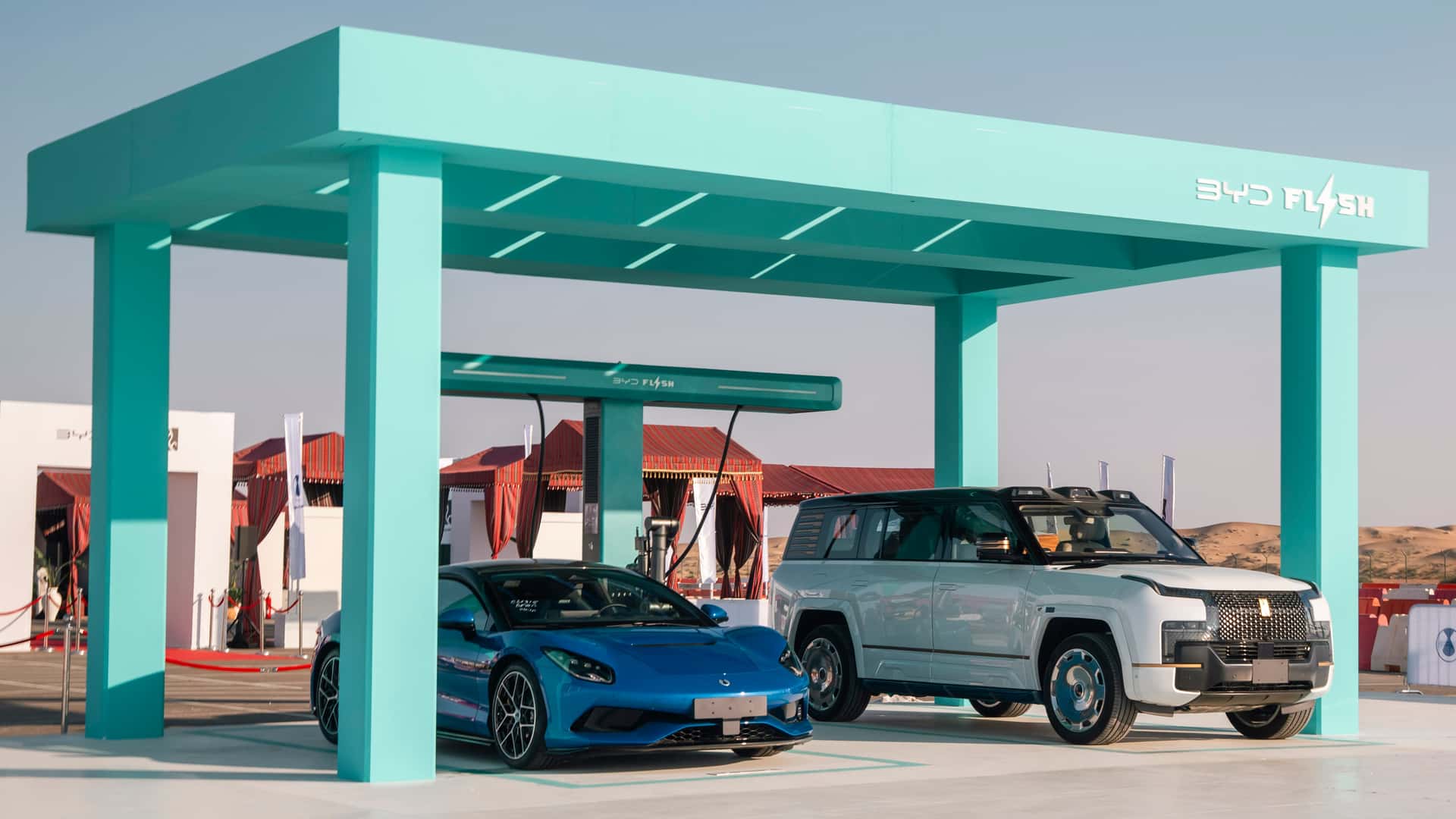
Shenzhen, China – In a significant leap forward for electric vehicle (EV) infrastructure, BYD, a leading global manufacturer of new energy vehicles, has unveiled a futuristic EV charging station that promises to redefine how electric cars are powered. Located in the demanding environment of the Abu Dhabi desert, this innovative facility combines solar energy generation, advanced battery storage, and a pioneering robotic arm to enable rapid charging, potentially without reliance on conventional electricity grids.
The new BYD EV charger system addresses a critical challenge in widespread EV adoption: ensuring access to high-speed charging in diverse locations, including those with limited grid access. By harnessing renewable energy and sophisticated automation, BYD is positioning itself at the forefront of sustainable and accessible electric mobility solutions.

Introducing the Off-Grid Charging Paradigm
BYD’s latest venture showcases a comprehensive approach to EV charging. The system integrates solar panels to generate electricity, large-capacity batteries for energy storage, and its proprietary Flash Charging technology, all orchestrated by a robotic arm that autonomously connects to the electric vehicle. This integrated design is engineered to function independently of traditional electricity grids, making it a viable solution for remote areas or locations where grid infrastructure is insufficient to support high-power charging.
The fundamental principle behind this setup is elegantly simple: solar panels capture sunlight to produce electricity, which is then stored in on-site batteries. These stored energy reserves are subsequently dispatched by the BYD EV charger to power compatible electric vehicles. This model not only promises grid independence but also offers enhanced energy resilience and reduced operational costs in the long term.
The Role of Battery-Backed Charging in Modern Infrastructure
The strategic incorporation of battery energy storage is becoming an increasingly prevalent feature in advanced EV charging infrastructure. This technology allows charging stations to deliver significantly more power than their direct grid connection might otherwise permit. Furthermore, it plays a crucial role in mitigating demand spikes on the electricity grid during peak usage hours, thereby enhancing overall grid stability.

Industry leaders are increasingly adopting this hybrid approach. Tesla, for instance, has implemented solar panels and its Megapack batteries at its largest Supercharger site, demonstrating a shared vision for robust, self-sufficient charging solutions. Specialized companies such as Electric Era and Beam Global are also carving niches in battery-backed charging systems, underscoring a growing industry trend. Even standard BYD Flash chargers, irrespective of their location or solar integration, leverage on-site energy storage to boost power delivery capabilities.
Technical Specifications of the Flash Charger
At the core of BYD’s rapid charging capabilities are its T-shaped Flash chargers. Each unit is reportedly connected to two 185-kilowatt-hour (kWh) storage batteries, culminating in a combined capacity of 370 kWh per charger. These batteries are designed to draw power from the grid within a range of 100 to 560 kilowatts (kW).
Crucially, when supplying power to an electric vehicle, these chargers can deliver an exceptionally high rate of up to 1,500 kW through a single cable. When two cables are simultaneously engaged, the power output remains substantial, reaching up to 1,000 kW. While the specific battery capacity and solar output for the new desert installation have not been fully disclosed by BYD, the existing technical prowess of their Flash Chargers sets a high benchmark for ultra-fast charging.
Unprecedented Charging Speeds and Vehicle Compatibility
The speed at which BYD’s Flash Chargers can replenish an EV’s battery is a cornerstone of its appeal. With the latest 1,500 kW Flash chargers, compatible vehicles equipped with BYD’s second-generation Blade battery can achieve a charge from 10% to 70% in an astonishing five minutes. Pushing further, these vehicles can reach 97% battery capacity in approximately nine minutes, effectively making EV charging times comparable to, or even faster than, traditional refuelling at a petrol pump.
This rapid charging capability was notably demonstrated with the Denza Z9 GT, an electric wagon. During a live demonstration, the vehicle charged from 10% to 80% in just six minutes and 32 seconds, proceeding to reach 97% in a mere nine minutes and 22 seconds. Such performance metrics underscore BYD’s commitment to eliminating range anxiety and streamlining the EV ownership experience.
The Robotic Arm: Enhancing Convenience and Automation
A distinctive feature of BYD’s innovative charging station is the integration of a robotic arm. This robotic component is engineered to autonomously plug the charging cable into the electric vehicle, effectively making the charging process entirely hands-free. This advanced automation, especially when coupled with automated parking systems, eliminates the need for human intervention during the connection process, significantly enhancing convenience and accessibility for EV drivers.
The robotic arm not only streamlines the charging experience but also represents a step towards fully automated vehicle ecosystems. It could prove particularly beneficial for diverse users, potentially simplifying charging for individuals with mobility challenges and improving efficiency in commercial fleet operations.
BYD’s Global Vision for EV Charging Infrastructure
BYD’s ambitious plans extend far beyond a single desert installation. The company has publicly declared its intention to establish an extensive network of 6,000 Flash Charging stations across the globe by the close of 2027. This aggressive expansion strategy highlights BYD’s commitment to fostering a robust global EV charging ecosystem.
The expansion is already underway, with Flash Charging sites operational in key European markets including Italy, Germany, France, and the United Kingdom. Future plans also indicate an imminent expansion into Canada. While the company has not specified the exact number of these forthcoming stations that will feature solar power, off-grid capabilities, or the robotic arm, the sheer scale of the planned deployment signals a transformative period for the global EV charging landscape.
This widespread development of advanced BYD EV charger points aims to support the rapidly growing adoption of electric vehicles worldwide, offering cutting-edge solutions for efficient and sustainable transportation. The focus on high-speed, accessible charging infrastructure is critical for reassuring consumers and accelerating the transition to electric mobility on a global scale.
Conclusion: A Glimpse into the Future of EV Mobility
BYD’s unveiling of this advanced BYD EV charger system marks a pivotal moment in the evolution of electric vehicle technology. By seamlessly integrating renewable energy, robust battery storage, ultra-fast charging, and sophisticated robotics, BYD is not merely building charging stations; it is engineering a future where electric vehicles are powered effortlessly, sustainably, and efficiently, regardless of their location. As the world continues its transition to electric mobility, such innovations will be instrumental in overcoming existing barriers and accelerating the widespread adoption of EVs.
FAQ Section
What is unique about BYD’s new EV charger?
BYD’s latest EV charger integrates solar panels for energy generation, battery storage for power reserves, and a robotic arm for automated vehicle connection. Its standout feature is the potential for off-grid operation, allowing fast charging even in locations without a strong electricity grid connection, promoting sustainable and accessible electric mobility.
How fast is the BYD Flash Charging technology?
The BYD Flash Chargers are exceptionally fast, capable of delivering up to 1,500 kW through a single cable. This allows compatible vehicles, especially those with BYD’s second-generation Blade battery, to charge from 10% to 70% in approximately five minutes, and reach 97% capacity in about nine minutes.
Where is this new BYD EV charger located?
The initial demonstration site for this advanced BYD EV charger system, which integrates solar panels, battery storage, and a robotic arm, is located in the Abu Dhabi desert. This strategic placement highlights the system’s capability to operate effectively in challenging and potentially grid-limited environments.
What is the purpose of the robotic arm?
The robotic arm’s primary function is to automate the charging process. It autonomously plugs the charging cable into the electric vehicle, making the experience hands-free. This enhances convenience for drivers and can integrate with automated parking systems, paving the way for fully autonomous EV charging solutions in the future.
Does this BYD EV charger operate entirely off-grid?
The system is designed with the capability for off-grid operation by combining solar energy generation and on-site battery storage. While the specific desert installation’s exact off-grid capacity and solar output details are not fully disclosed, the underlying technology allows for significant independence from the main electricity grid.
What are BYD’s global expansion plans for these chargers?
BYD has ambitious plans to deploy 6,000 Flash Charging stations worldwide by the end of 2027. These stations are already emerging in European countries like Italy, Germany, France, and the UK, with Canada soon to follow. This extensive network aims to significantly bolster global EV charging infrastructure.