
Elon Musk
MKBHD’s Tesla Cybercab Bet: A High-Stakes Challenge Nears Its Climax Amidst Order Confirmation
Key Takeaways (TL;DR)
- Marques Brownlee (MKBHD) placed an order for a Tesla Cybercab on November 15, 2026, two years after betting his hair that Tesla would not sell the autonomous vehicle to the public for under $30,000 before 2027.
- The Tesla Cybercab is priced at $29,990, requires a $1,000 non-refundable deposit, and mandates a $299 per month Autonomy Subscription. Deliveries are estimated for December in specific Texas cities.
- MKBHD maintains his hair is safe, citing no actual deliveries, the invite-only nature of the offer, and the vehicle’s limitations to personal use within Tesla’s existing Robotaxi geofences.
- Elon Musk has responded, confirming plans for nationwide availability pending regulatory approval, and acknowledging the current monthly fee is “too high,” suggesting a reduction to around ~$115/month.
- The bet’s outcome hinges on whether the Tesla Cybercab is genuinely “shipped to regular people” for under $30,000 by December 31, 2026, as per Brownlee’s refined terms.
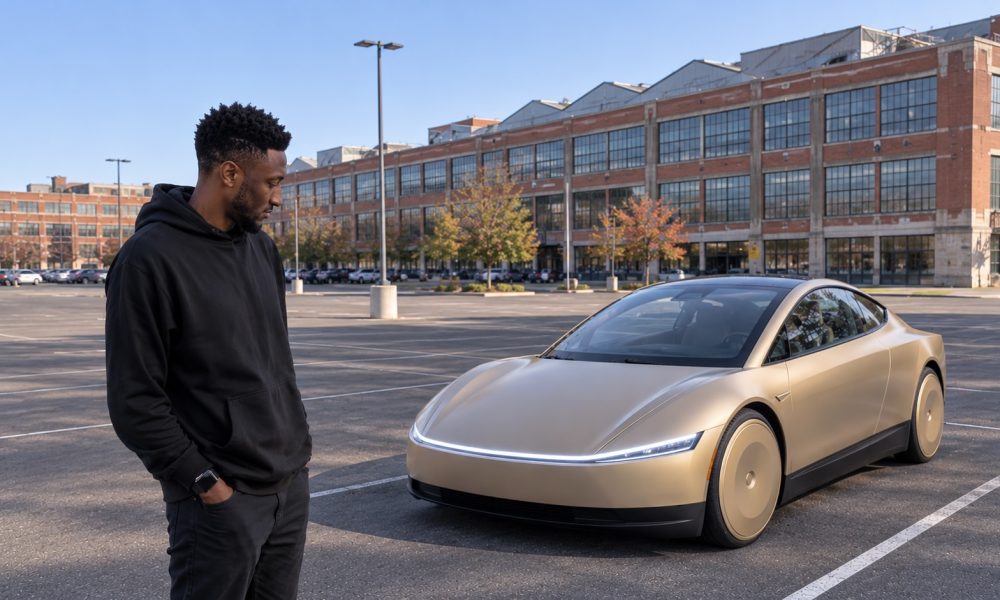
In a development that has captivated the tech and automotive world, popular YouTuber Marques Brownlee, widely known as MKBHD, has officially placed an order for a Tesla Cybercab. This move comes nearly two years after he publicly wagered his hair that Tesla would fail to sell its two-seat, autonomous vehicle to the public for less than $30,000 before the close of 2026.
On Friday, November 15, 2026, Brownlee took to X, formerly Twitter, to announce his provisional entry into the Tesla Cybercab ownership pool. “Alright chat I’m in,” he wrote, sharing a screenshot that prominently displayed the message: “Your Cybercab Order is Confirmed.” The confirmation marks a significant turn in a bet that has drawn considerable attention from enthusiasts and skeptics alike.
The Genesis of a High-Stakes Wager: Tesla’s Robotaxi Vision Unveiled
Musk’s Bold Promises and Brownlee’s Skepticism
The origins of this high-stakes challenge trace back to October 2024, when Tesla hosted its highly anticipated “We, Robot” event. During the presentation, CEO Elon Musk unveiled the innovative two-seat Tesla Cybercab, a purpose-built autonomous vehicle designed for the company’s ambitious Robotaxi network.
Musk made a series of bold pronouncements at the event, including the promise that customers would be able to purchase the Cybercab for under $30,000, with production slated to commence “before 2027.” These claims immediately sparked debate, given Tesla’s history of ambitious timelines for new product launches and autonomous driving capabilities.
Days following the announcement, MKBHD released a video titled “The Tesla Robotaxi is Confusing.” In the video, he expressed profound skepticism regarding Tesla’s ability to meet these aggressive targets, particularly the price point and delivery schedule. Brownlee characterized Musk’s timeline as “notorious Elon stuff,” referencing a pattern of optimistic projections that often face delays.
It was in this context of doubt that the bet was born. Brownlee declared that if Tesla managed to deliver on its promise, he would “shave my head on camera because I’m that confident.” This audacious challenge quickly gained traction, setting the stage for a public spectacle hinged on the success of Tesla’s next-generation autonomous vehicle.
A Bet Accepted: Defining the Terms of Engagement
From Gigafactory Line to YouTube Challenge
Elon Musk, known for his direct engagement on social media, formally accepted Brownlee’s challenge in February of the following year, 2025. This acceptance coincided with the milestone of the first production Tesla Cybercab units rolling off the assembly line at Gigafactory Texas, signaling tangible progress on the project.
When asked on X whether Tesla would indeed sell a Cybercab to a customer for $30,000 or less before 2027, Musk responded unequivocally with “Yes,” adding, “Gonna happen.” This exchange, as reported by Teslarati at the time, solidified the terms of the wager and escalated the anticipation surrounding its outcome.
As the deadline drew closer, Brownlee further refined the conditions of the bet in a September 2025 video. He specified that the bet was contingent on a “golden robotaxi with two seats and no driver and no steering wheel and no pedals” being shipped “to regular people like you and me for $30,000 before the end of this year,” explicitly referring to the end of 2026.
Tesla Cybercab Order Confirmed: A Pivotal Moment
Unpacking the Cybercab’s Specifications and Purchase Conditions
The recent invitation-only order page for the Tesla Cybercab reveals specific details that align closely with the parameters of Brownlee’s bet. The vehicle is listed at $29,990, positioning it precisely ten dollars below Brownlee’s $30,000 threshold. Estimated deliveries are slated for December 2026, further intensifying the ticking clock on the wager.
Prospective buyers are required to submit a $1,000 non-refundable deposit to secure their order. Crucially, initial deliveries are restricted to specific service areas within Texas: Austin, Dallas, Fort Worth, Houston, or San Antonio. Each buyer is also limited to purchasing only one Cybercab, underscoring the controlled rollout strategy.
A significant condition of ownership is the mandatory $299 per month Autonomy Subscription. This subscription is essential for the Cybercab to operate, integrating it into Tesla’s autonomous ride-hailing platform. This ongoing fee adds a layer of complexity to the overall cost of ownership, an aspect that has sparked further discussion.
MKBHD’s Defense: Why the Hair Remains Safe (For Now)
Scrutinizing Delivery, Accessibility, and Operational Limits
Despite placing an order, Marques Brownlee has not conceded the bet. He articulated several key reasons why his hair, in his view, remains safe for the time being. Central to his argument is the absence of actual physical deliveries of the Tesla Cybercab.
Brownlee highlighted that an order confirmation does not equate to a delivered vehicle, emphasizing that the spirit of the bet concerned the actual availability and shipment of the autonomous car. He also pointed out that the current ordering process is invite-only, meaning the Cybercab is not yet “publicly available” to “regular people” in the broadest sense.
Furthermore, Brownlee noted the vehicle’s functional limitations. The Cybercab is restricted to personal use exclusively within Tesla’s existing Robotaxi geofences. He humorously described the vehicle as “a paperweight if I take this thing home,” acknowledging that while this specific point was not part of the original bet, it underscores the limited utility for early adopters outside designated zones. To mark the approaching deadline, Brownlee publicly asked Grok, an AI chatbot, to set a timer for 48 days, counting down to December 31.
Elon Musk’s Counter-Arguments and Future Outlook
Addressing Availability and Subscription Model Criticisms
Elon Musk quickly responded to Brownlee’s detailed breakdown of the order page and his reservations. Addressing the concerns about limited operational areas, Musk stated that the Tesla Cybercab “will be available nationwide, as we receive regulatory approval.” This indicates Tesla’s intention to expand the vehicle’s operational scope beyond the initial Texas cities.
Interestingly, Musk also conceded a point regarding the Autonomy Subscription fee. He agreed that “the monthly fee is too high,” suggesting it should be more in line with the cost of Full Self-Driving (FSD) and connectivity on other Tesla models, estimating it at “more like ~$115/month.” This admission hints at potential future adjustments to the pricing model, which could impact the long-term affordability for owners.
In a separate, more direct reply concerning Brownlee’s hair, Musk lightheartedly quipped, “He’s a chicken.” This playful taunt underscores the personal nature of the bet and the ongoing public rivalry between the two prominent figures.
The Broader Implications for Tesla’s Autonomous Future
Connecting the Cybercab to the Expanding Robotaxi Ecosystem
The unfolding saga of the MKBHD bet and the Tesla Cybercab order confirmation has broader implications for Tesla’s long-term vision in the autonomous vehicle sector. The Cybercab is not merely a new electric vehicle; it represents a critical component of Tesla’s ambitious Robotaxi network, a cornerstone of its strategy to transform urban mobility.
Musk’s concept of a fully autonomous ride-hailing platform, where individual vehicle owners can deploy their cars to earn passive income, is contingent on the successful widespread adoption and operation of vehicles like the Cybercab. The sub-$30,000 price point was crucial for making this vision accessible to a broader consumer base, potentially accelerating the growth of the Robotaxi fleet.
The success of the Tesla Cybercab, both in terms of production and regulatory acceptance, is vital for Tesla to solidify its position as a leader in self-driving technology. It will demonstrate the company’s ability to move beyond conventional electric cars into a truly autonomous future, distinguishing itself from competitors in the evolving electric vehicle market.
Regulatory Landscape and Practicalities of Cybercab Ownership
Navigating Geofenced Operations and Ownership Restrictions
One of the most significant challenges highlighted by MKBHD, and tacitly acknowledged by Musk, pertains to the practicalities of Tesla Cybercab ownership. Brownlee, residing in New Jersey, is far outside any currently designated Robotaxi service area. This geographic constraint renders his ordered Cybercab largely unusable for its intended autonomous purpose at his home location.
Tesla’s agreements for Cybercab ownership are known to include strict restrictions on where owners can operate the vehicle and how they can resell it, as previously detailed by Teslarati. These limitations are critical for maintaining control over the Robotaxi network’s integrity and ensuring safe, compliant operations within defined geofences.
The need for regulatory approvals for nationwide availability, as mentioned by Musk, underscores the complex legal and logistical hurdles autonomous vehicles still face. Each state and municipality may have varying regulations, requiring extensive testing and validation before full deployment can occur. These factors are crucial for assessing whether the Cybercab is truly “shipped to regular people” for widespread, practical use by the deadline.
The December 31 Deadline: Awaiting the Final Verdict
As the calendar swiftly approaches December 31, 2026, all eyes remain on Tesla and Marques Brownlee. The outcome of this bet hinges entirely on whether a “golden robotaxi with two seats and no driver and no steering wheel and no pedals” is verifiably delivered to “regular people” for under $30,000 by the year’s end.
MKBHD’s order confirmation adds an unexpected layer of personal involvement to the public wager. However, his insistence on actual delivery and broader availability means the final verdict is still pending. Whether his hair remains intact or falls victim to the clippers will serve as a highly visible marker of Tesla’s progress in bringing its autonomous vision to market on its ambitious timelines.
The resolution of this bet will not only be a moment of personal triumph or concession but also a public barometer for the credibility of Tesla’s future product announcements and its advanced self-driving technology endeavors.
Frequently Asked Questions (FAQ)
What is the Tesla Cybercab?
The Tesla Cybercab is a purpose-built, two-seat autonomous vehicle designed by Tesla for its Robotaxi ride-hailing service. It lacks a steering wheel or pedals, emphasizing its fully autonomous operation within designated geofenced areas. It represents a key component of Tesla’s vision for future urban transportation.
What was the bet between MKBHD and Elon Musk?
MKBHD bet his hair that Tesla would not sell the Cybercab to regular buyers for under $30,000 before the end of 2026. Elon Musk accepted the challenge, stating that it would indeed happen, sparking significant public interest in Tesla’s ability to meet its ambitious timelines.
Has MKBHD officially conceded the bet?
No, MKBHD has not conceded the bet despite placing an order. He argues that his hair is safe because actual Cybercab deliveries have not yet occurred, the ordering process is invite-only, and the vehicle’s operational limitations within specific geofences do not fully meet the spirit of his original wager.
What are the current purchase conditions for the Tesla Cybercab?
The Tesla Cybercab is priced at $29,990, requires a $1,000 non-refundable deposit, and includes an estimated December delivery. Buyers are limited to one vehicle and must take delivery in one of five specific Texas cities. A mandatory $299 per month Autonomy Subscription is required for operation.
How does Elon Musk view the Cybercab’s monthly subscription fee?
Elon Musk has stated that the current $299 per month Autonomy Subscription fee is “too high.” He indicated that it should align more closely with Tesla’s Full Self-Driving and connectivity costs on other models, suggesting a potential reduction to approximately ~$115/month in the future.
Where can the Tesla Cybercab currently be operated?
Initially, the Tesla Cybercab is restricted to personal use within Tesla’s existing Robotaxi geofenced service areas, primarily in select Texas cities. Elon Musk has stated that it will become available nationwide as regulatory approvals are secured, but this expansion is an ongoing process.
What is the significance of the December 31 deadline?
The December 31, 2026, deadline is the critical date for the bet’s resolution. MKBHD’s wager hinges on the actual delivery of a Tesla Cybercab to “regular people” for under $30,000 by this date. It serves as a clear benchmark for Tesla’s execution on its ambitious production and sales targets for the autonomous vehicle.
Will the Cybercab be available nationwide soon?
Elon Musk has confirmed Tesla’s intent for the Tesla Cybercab to be available nationwide. However, this expansion is contingent upon receiving necessary regulatory approvals across various jurisdictions. The timeline for full nationwide availability remains subject to ongoing regulatory processes and technical readiness.