
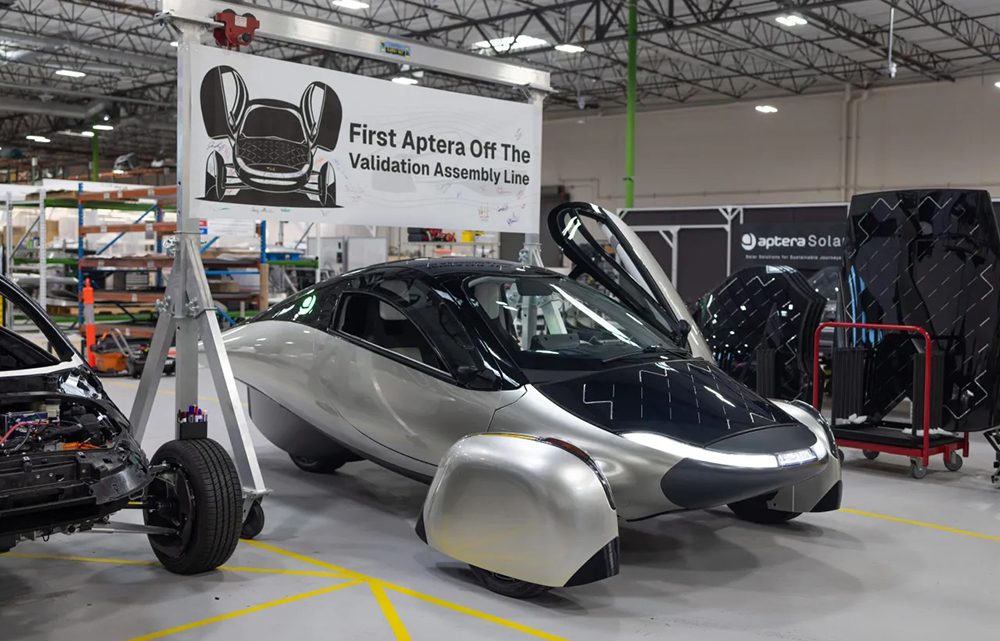
Aptera Motors, a company founded in 2006 with a unique vision for electric vehicle efficiency, has reached a significant milestone: the first solar-powered electric vehicle has rolled off its validation assembly line. This marks a pivotal transition for the company, moving from hand-built prototypes to a structured, low-volume production process.
A New Approach to EV Manufacturing
Unlike many electric vehicle startups that initially focused on high-volume luxury models before attempting to scale down to more affordable options, Aptera Motors has pursued a distinct strategy. The company’s core objective has always been to engineer the most efficient electric vehicle possible, leveraging current technology. This commitment is evident in the Aptera’s design, which emphasizes a highly aerodynamic shape, the use of lightweight materials, and the integration of solar cells directly into the vehicle’s structure.

Validation Assembly Line: A Step Towards Series Production
The newly operational validation assembly line is a crucial development for Aptera. This line is not intended for mass production but rather for refining the manufacturing process and producing vehicles for extensive testing. It comprises 14 specialized stations where a dedicated team of technicians assembles the vehicles.
The vehicles produced on this line will undergo a rigorous testing regimen. This includes critical evaluations such as thermal validation, detailed brake performance assessments, and even some destructive testing. The primary goal of this phase is to optimize every aspect of the assembly process, from the installation sequences of major vehicle systems to the layout of each workstation. This meticulous refinement is essential preparation for the upcoming phase of series volume assembly.
Leadership Perspective on the Milestone
Steve Fambro, Co-CEO of Aptera, expressed his enthusiasm for this achievement. “The completion of the first vehicle off our low-volume assembly line is a significant achievement for the entire company,” Fambro stated. He added, “These first vehicles will be used to complete the key tests and optimization required to sell our first vehicles to customers.”

This validation fleet will continue to expand in the coming weeks as more vehicles are assembled. Aptera plans to use this growing fleet to advance through the necessary testing and certification milestones required for market release.
Aptera’s Unique Solar EV Technology
The Aptera’s design is centered on maximizing efficiency and range. The Launch Edition model is equipped with a 44 kWh battery pack, which comprises 2,304 individual NMC cylindrical cells. This configuration is projected to deliver an impressive range of 400 miles on a single charge.
A standout feature of the Aptera is its integrated solar cells. These cells are designed to harness solar energy and are expected to provide up to 40 miles of driving range daily. This capability significantly reduces the reliance on external charging infrastructure for daily use, offering unprecedented convenience and energy independence.
For longer journeys or when solar charging is insufficient, the Aptera supports traditional charging methods. It is equipped with standard J1772 (Level 2) and CCS (DC fast) charging connectors, ensuring compatibility with the existing EV charging network.
Market Outlook and Future Plans
Aptera Motors has garnered substantial interest, with nearly 50,000 vehicle reservations already secured. These reservations represent a potential revenue exceeding $2 billion, underscoring strong market demand for the company’s innovative solar EV.
The company is targeting the commencement of customer deliveries for its vehicles later this year. The successful ramp-up of the validation assembly line and the progression through testing and certification phases are critical steps toward achieving this goal.