
Key Takeaways:
- Asahi Kasei has developed an innovative lithium pre-doping technology specifically designed for high-voltage lithium-ion batteries featuring silicon-based anodes.
- This pioneering method effectively mitigates the significant first-cycle capacity loss inherent in silicon-rich cells, a long-standing challenge in advanced battery development.
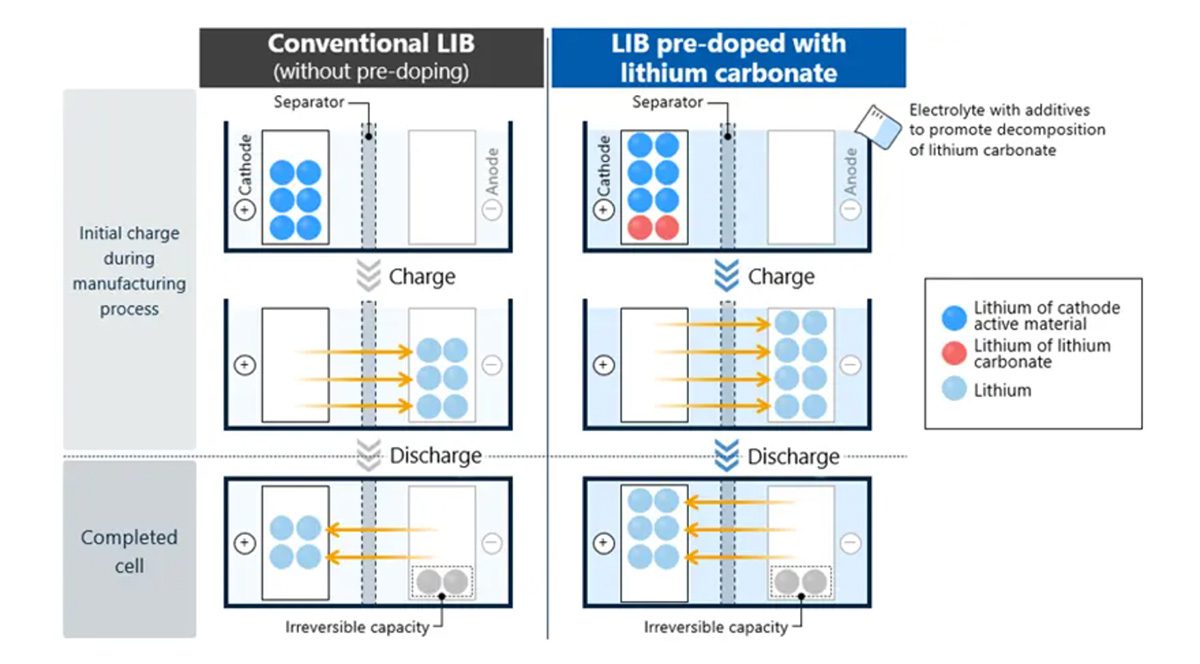
- By introducing lithium carbonate to the cathode alongside special electrolyte additives, the technology ensures that the necessary lithium is released during the initial charge at standard operating voltages.
- Internal tests have demonstrated a notable 10% increase in energy density in NMC cells utilizing a 90% graphite, 10% silicon monoxide (SiO) anode configuration.
- Beyond enhanced energy density, the technology also promises improved cycle life and a lower cost per Wh, making it a compelling solution for the electric vehicle (EV) sector.
- Crucially, this pre-doping approach is designed for seamless integration into existing battery manufacturing lines, offering compatibility across diverse cathode and anode material systems.
The relentless pursuit of higher energy density and extended range in electric vehicles (EVs) continues to drive innovation in battery technology. A significant hurdle in this quest has been the integration of silicon-based anode materials, which, despite their immense potential, introduce complexities that impact battery performance and longevity. Addressing this critical challenge, Asahi Kasei, a global leader in materials science, has unveiled a groundbreaking lithium pre-doping technology designed to unlock the full potential of silicon-rich cells.

This advanced solution directly targets the inherent first-cycle capacity loss experienced by lithium-ion batteries incorporating silicon anodes. By effectively compensating for this permanent reduction in capacity during the initial charge and discharge, Asahi Kasei’s innovation paves the way for more efficient, durable, and cost-effective EV battery packs.
The Quest for Higher Energy Density in Electric Vehicles
The burgeoning electric vehicle market places an ever-increasing demand on battery performance. Consumers and manufacturers alike are seeking solutions that deliver greater driving range, faster charging capabilities, and a longer overall lifespan for EV batteries. Traditional graphite anodes, while reliable, are reaching their theoretical limits in terms of energy storage capacity.
This limitation has spurred extensive research into alternative anode materials, with silicon emerging as a frontrunner due to its remarkable theoretical specific capacity. Silicon can store significantly more lithium ions per gram compared to graphite, making it an attractive candidate for dramatically boosting cell energy density.
Addressing the Silicon Anode Dilemma
Despite its promise, the adoption of silicon-based materials in commercial lithium-ion batteries has been hampered by several engineering challenges. Primarily, silicon undergoes substantial volume expansion and contraction during lithium intercalation and de-intercalation cycles, leading to mechanical stress and degradation.
More critically, silicon’s interaction with the electrolyte during the initial charge forms an irreversible Solid Electrolyte Interphase (SEI) layer. While essential for battery stability, this process consumes a significant amount of active lithium from the cathode, resulting in a substantial and permanent capacity loss during the very first cycle of operation.
Understanding First-Cycle Capacity Loss in Lithium-Ion Batteries
The irreversible capacity loss during the first charge, often termed ‘first-cycle irreversible capacity,’ poses a fundamental limitation to battery performance. This loss directly translates to a lower usable energy density and a reduced overall cycle life for the battery.
To compensate for this depletion of active lithium, battery manufacturers typically have to incorporate additional cathode active material. This approach, however, drives up both material usage and the overall cost of the battery cell, offsetting some of the energy density benefits gained from silicon integration.
Asahi Kasei Unveils Innovative Lithium Pre-Doping Technology
Asahi Kasei’s newly developed lithium pre-doping technology presents an elegant solution to the silicon anode dilemma. The core of this innovation lies in introducing an extra source of lithium directly into the battery cell to counterbalance the lithium consumed during the initial SEI formation on the silicon anode.
The company leverages lithium carbonate, a relatively inexpensive material with a well-established history as a battery component. By strategically adding lithium carbonate to the cathode, Asahi Kasei ensures that sufficient lithium is available to compensate for the first-cycle losses without the need for an excessive amount of expensive cathode active material.
Mechanism of Action: Overcoming Decomposition Hurdles
A key challenge with using lithium carbonate for pre-doping has historically been its high decomposition voltage, which typically sits above the nominal operating range of standard lithium-ion cells. This characteristic has made it difficult to integrate as a practical pre-doping agent.
Asahi Kasei’s breakthrough involves the use of special additives within the electrolyte. These proprietary additives facilitate the decomposition of lithium carbonate at the standard cell voltages at which conventional batteries already operate. During the initial charging process, the pre-added lithium carbonate decomposes, efficiently releasing its lithium into the cell to compensate for the irreversible consumption by the silicon anode.
Significant Performance Gains and Economic Advantages
The practical application of Asahi Kasei’s lithium pre-doping technology has yielded promising results in internal testing. The company reported a significant 10% increase in energy density in an NMC (nickel-manganese-cobalt) cell that utilized an anode composed of 90% graphite and 10% silicon monoxide (SiO).
This substantial boost in energy density directly translates to extended driving ranges for electric vehicles without increasing the battery’s physical size or weight. Such an improvement is pivotal for addressing range anxiety, a primary concern for many potential EV buyers.
Enhancing Energy Density and Battery Longevity
Beyond the impressive energy density gains, Asahi Kasei also highlights the technology’s ability to improve cycle life. By effectively managing the lithium balance within the cell from the very first cycle, the technology helps maintain the integrity of the active materials and the SEI layer, contributing to a more stable and longer-lasting battery.
Furthermore, the company emphasizes the economic benefits, noting a ‘low cost per Wh.’ This cost-effectiveness, coupled with enhanced performance, positions the pre-doping technology as a highly attractive solution for large-scale EV battery production.
Streamlined Integration into Existing Production Lines
A critical factor for the widespread adoption of any new battery technology is its compatibility with existing manufacturing processes. Asahi Kasei states that its lithium pre-doping technology can be applied without requiring significant modifications to current battery manufacturing lines.
This ease of integration drastically reduces the capital expenditure and time typically associated with implementing new material advancements. Moreover, the technology is expected to function effectively across a broad spectrum of cathode and anode material systems, offering versatility and broad applicability within the battery industry.
Paving the Way for Next-Generation EV Batteries
Asahi Kasei’s innovation arrives at a crucial juncture for the electric vehicle industry, which is continuously seeking to push the boundaries of battery performance while simultaneously striving for cost reductions. This pre-doping solution represents a significant step towards fully harnessing the advantages of silicon-based anodes, overcoming one of their most persistent drawbacks.
The ability to improve energy density and cycle life at a competitive cost, without necessitating extensive overhauls of manufacturing infrastructure, makes this technology a potential game-changer for next-generation EV battery development. It directly supports the industry’s objectives of delivering EVs with greater range, reduced charging frequency, and enhanced durability.
Future Prospects and Industry Adoption
Looking ahead, Asahi Kasei is set to embark on proof-of-concept evaluations with global customers. This crucial phase will involve rigorous testing and validation in real-world scenarios, paving the way for eventual commercialization. The company also plans to implement phased licensing arrangements, tailored to each customer’s specific stage of development, facilitating broader industry adoption.
The successful deployment of this lithium pre-doping technology could accelerate the transition to more advanced, silicon-rich lithium-ion batteries. This would not only benefit electric vehicles but also potentially impact other applications demanding high energy density, such as grid-scale energy storage and portable electronics, ultimately contributing to a more sustainable energy future. (Source: Asahi Kasei)
FAQ Section
What problem does Asahi Kasei’s lithium pre-doping technology solve?
The technology addresses the significant irreversible capacity loss that silicon-based anodes experience during their initial charge and discharge cycle. This loss typically reduces a battery’s usable energy density and shortens its overall cycle life. Asahi Kasei’s method effectively compensates for this lithium consumption from the outset.
How does the lithium pre-doping technology work?
Asahi Kasei’s innovation involves adding lithium carbonate, an extra source of lithium, to the cathode. Special electrolyte additives enable this lithium carbonate to decompose and release its lithium into the cell during the initial charge, even at standard operating voltages, thereby offsetting the lithium consumed by the silicon anode.
What are the main benefits of using this technology?
The primary benefits include a 10% increase in energy density, improved battery cycle life, and a lower cost per Wh compared to traditional methods of compensating for capacity loss. These advancements contribute to more efficient, durable, and economically viable lithium-ion batteries for various applications, especially EVs.
Is this technology compatible with existing battery manufacturing processes?
Yes, Asahi Kasei emphasizes that its lithium pre-doping technology can be integrated into existing battery manufacturing lines without requiring significant modifications. This ease of implementation makes it an attractive solution for battery manufacturers looking to upgrade their product performance efficiently.
What types of battery cells can benefit from this technology?
The technology is designed for high-voltage lithium-ion batteries that incorporate silicon-based anodes. Asahi Kasei expects it to be applicable across a range of cathode and anode material systems, offering broad compatibility within the advanced battery sector.
What is the significance of silicon anodes in EV batteries?
Silicon anodes are crucial for next-generation EV batteries because they have a much higher theoretical specific capacity than traditional graphite anodes. This means silicon can store significantly more lithium ions, leading to higher energy density and, consequently, longer driving ranges for electric vehicles.
What are Asahi Kasei’s next steps for this technology?
Asahi Kasei plans to conduct proof-of-concept evaluations with global customers to further validate the technology’s performance and applicability. They will also establish phased licensing arrangements tailored to each customer’s stage of development, paving the way for commercialization and widespread adoption.