
Key Takeaways
- Asahi Kasei has unveiled a novel lithium pre-doping technology designed to enhance the performance of high-voltage lithium-ion batteries, particularly those incorporating silicon-based anodes.
- The innovation effectively mitigates the significant first-cycle capacity loss inherent in silicon-rich cells by introducing lithium carbonate as an additional lithium source on the cathode.
- This proprietary technology facilitates the decomposition of lithium carbonate at standard battery operating voltages through specialized electrolyte additives, releasing lithium into the cell during the initial charge.
- Internal evaluations demonstrated a 10% increase in energy density for NMC cells utilizing a 10% silicon monoxide (SiO) anode, alongside improved cycle life and cost-effectiveness per Watt-hour.
- The technology is designed for seamless integration into existing battery manufacturing lines and is expected to be compatible with various cathode and anode material systems.
- Asahi Kasei is actively engaging with global customers for proof-of-concept evaluations and licensing, signaling a significant advancement for electric vehicle (EV) battery capabilities.
Revolutionizing EV Battery Performance with Lithium Pre-Doping Technology
Asahi Kasei, a global leader in materials science, has unveiled a groundbreaking lithium pre-doping technology poised to transform the landscape of high-voltage lithium-ion batteries, particularly those featuring silicon-based anodes. This innovative solution directly addresses one of the most persistent challenges in advanced battery chemistry: the irreversible capacity loss that silicon-rich cells typically experience during their inaugural charge and discharge cycle.
The burgeoning electric vehicle (EV) market is a primary driver for the continuous demand for higher cell energy density. To meet this critical need, battery developers have increasingly explored two key avenues: the partial replacement of graphite in anodes with silicon-based materials and the elevation of cathode operating voltages. Asahi Kasei’s breakthrough specifically tackles the inherent penalty associated with the former strategy.

The Promise and Pitfalls of Silicon Anodes
Silicon stands out as a highly attractive anode material due to its remarkable capacity to store significantly more lithium per gram compared to traditional graphite. This superior gravimetric energy density makes silicon-based materials crucial for achieving the extended range and faster charging capabilities demanded by modern EVs.
However, the integration of silicon into predominantly graphite anodes comes with a notable trade-off: a substantial irreversible capacity loss during the very first charge cycle. This phenomenon not only curtails the overall energy density of the cell but also imposes limitations on its long-term cycle life. To compensate for this initial loss, battery manufacturers often resort to incorporating additional cathode active material, which inevitably escalates both material consumption and manufacturing costs.
Asahi Kasei’s Innovative Pre-Doping Mechanism
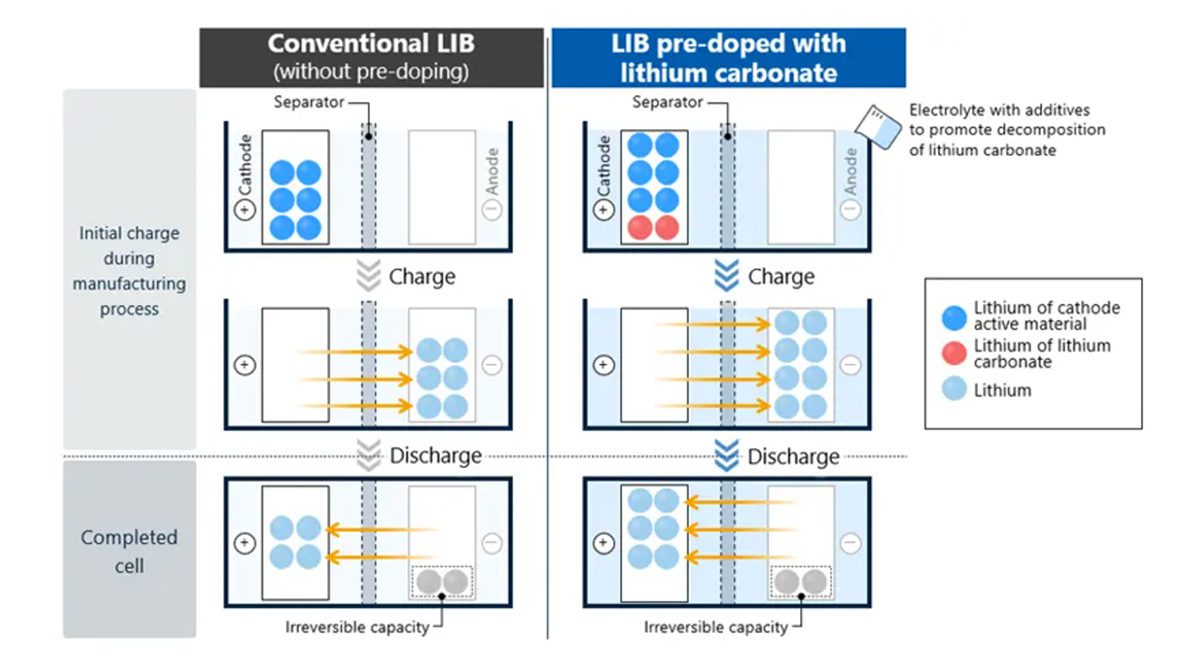
Asahi Kasei’s proprietary lithium pre-doping technology introduces lithium carbonate (Li₂CO₃) directly to the cathode as an extra source of lithium. This inexpensive and well-established battery material plays a pivotal role in offsetting the permanent capacity loss observed in silicon-rich cells during their initial operation.
Traditionally, leveraging lithium carbonate for pre-doping has been challenging because its decomposition voltage far exceeds the nominal operating range of typical lithium-ion cells. Asahi Kasei’s breakthrough lies in its development of specialized additives for the electrolyte. These additives actively promote the decomposition of lithium carbonate at cell voltages where standard batteries already operate, making the process highly efficient and practical.
Upon the initial charge, with the lithium carbonate pre-added to the cathode, it decomposes and subsequently releases its lithium into the cell. This strategic release effectively ‘pre-fills’ the capacity that would otherwise be permanently lost by the silicon anode, thereby ensuring higher usable capacity from the outset.
Tangible Benefits: Energy Density and Cycle Life
The efficacy of this lithium pre-doping technology has been rigorously validated through Asahi Kasei’s internal testing protocols. In evaluations conducted on an NMC (Nickel-Manganese-Cobalt) cell featuring an anode composed of 90% graphite and 10% silicon monoxide (SiO), the company recorded a significant 10% increase in energy density.
Beyond the enhanced energy density, the technology also promises substantial improvements in cycle life, a critical metric for EV battery longevity and consumer confidence. Crucially, these advancements are achieved at a low cost per Watt-hour, positioning Asahi Kasei’s solution as an economically viable option for mass production and widespread adoption within the automotive sector.
A notable advantage highlighted by Asahi Kasei is the technology’s potential for seamless integration into existing battery manufacturing lines. This ease of adoption is a significant factor for manufacturers, as it minimizes the need for costly and time-consuming retooling or extensive modifications to current production processes. Furthermore, the company anticipates that its pre-doping technology will be compatible across a broad spectrum of cathode and anode material systems, offering versatility to battery designers and producers.
Industry Impact and Future Outlook
The development of this lithium pre-doping technology represents a pivotal step forward in the quest for more powerful, durable, and cost-effective EV batteries. By effectively mitigating the first-cycle capacity loss in silicon-rich anodes, Asahi Kasei is enabling battery manufacturers to fully harness the superior energy storage capabilities of silicon, unlocking new possibilities for electric vehicle range, performance, and accessibility.
Asahi Kasei is now actively engaged in conducting proof-of-concept evaluations with global customers. This crucial phase will validate the technology’s performance under various real-world conditions and specific application requirements. Concurrently, the company is preparing to implement phased licensing arrangements, tailored to each customer’s specific stage of development, thereby facilitating the rapid commercialization and deployment of this promising battery innovation.
The success of such advanced material technologies is paramount for accelerating the global transition to sustainable transportation. As battery technology continues to evolve, innovations like Asahi Kasei’s lithium pre-doping method will play a critical role in defining the next generation of electric vehicles and energy storage solutions.
FAQ
- What is Asahi Kasei’s new lithium pre-doping technology?
- It’s an innovative method that adds lithium carbonate to the cathode of lithium-ion batteries. This extra lithium source compensates for the permanent capacity loss typically observed in silicon-rich anodes during the battery’s first charge and discharge cycle, boosting overall energy density and cycle life.
- Why is this technology important for electric vehicles (EVs)?
- EVs require high energy density batteries for extended range. Silicon anodes offer superior lithium storage, but their first-cycle capacity loss has been a barrier. Asahi Kasei’s technology overcomes this, enabling more efficient use of silicon and thus enhancing EV battery performance.
- How does the pre-doping technology work with lithium carbonate?
- Lithium carbonate’s high decomposition voltage usually limits its use. Asahi Kasei developed special electrolyte additives that promote the decomposition of lithium carbonate at standard operating voltages. During the initial charge, the carbonate breaks down, releasing lithium into the cell to pre-fill the silicon anode’s initial irreversible capacity.
- What performance improvements did Asahi Kasei observe?
- Internal tests on an NMC cell with a 10% silicon monoxide (SiO) anode showed a 10% increase in energy density. The technology also contributed to improved cycle life and maintained a low cost per Watt-hour, making it an economically attractive solution for battery manufacturers.
- Can this technology be easily integrated into existing battery production?
- Yes, Asahi Kasei emphasizes that its lithium pre-doping technology can be applied without significant modifications to current battery manufacturing lines. This ease of integration is crucial for rapid adoption and scaling by battery producers globally.
- Which battery systems are compatible with this pre-doping method?
- Asahi Kasei anticipates that the technology will be broadly applicable across a range of cathode and anode material systems. This versatility provides flexibility for battery designers to integrate it into various battery chemistries currently under development or in production.
- What are Asahi Kasei’s next steps for this technology?
- The company is currently undertaking proof-of-concept evaluations with international customers. Following successful validation, Asahi Kasei plans to enter into licensing arrangements, phased according to each customer’s stage of development, to bring the technology to market.