
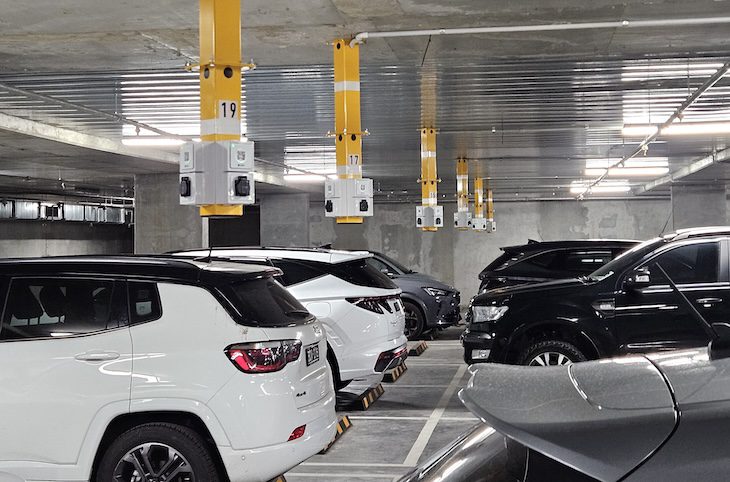
In a significant step for electric vehicle (EV) adoption in multi-unit dwellings, Melbourne’s Sierra Hawthorn apartment complex has successfully completed a large-scale installation of 251 EV charging points. This ambitious project demonstrates that retrofitting charging infrastructure into older apartment buildings is not only feasible but is also overcoming previous hesitations from strata committees and body corporates.
Shifting Attitudes Towards EV Charging in Apartments
The successful implementation at Sierra Hawthorn marks a turning point, according to Wylie Chak, founder of NOX Energy, the company responsible for the installation. Chak notes a substantial shift in sentiment over the past two years, moving beyond the initial concerns raised by some state fire services regarding EV charging safety in apartment blocks. “The conversation that we’re having this year compared to last year is completely different,” Chak told The Driven. “People… are needing EV charging in their strata. So the conversation, it’s easier and easier. Our sales cycle in 2025 was six months. [In] 2026, [it’s] six weeks.”

NOX Energy has completed what it claims is the largest number of EV chargers installed in a single apartment building in the southern hemisphere, a project costing $300,000. This development comes at a time when rising petrol prices are increasing the pressure on strata and body corporates to approve EV charging installations.
Government Endorsement and the ‘Demonstration Effect’
Federal Energy Minister Chris Bowen lauded the project’s success, highlighting its importance as a demonstration of what is achievable. Speaking at the charger launch, Bowen stated, “The reason ARENA has funded this program is not for 250 charges, per se. It’s to show it can be done. It’s the demonstration effect to say, look, yeah, it’s hard. It’s not too hard. See, the building has not caught on fire. Insurance is still fine. Everything is fine. It can be done.”
Bowen also emphasized the strategic advantage of EVs in an era of geopolitical instability affecting fuel supplies. “In this environment where I’m spending most of my waking hours this fortnight on fuel security, I can tell you no international geopolitical crisis will impact on the distribution of the sun in Australia or the wind blowing.”
This sentiment is echoed by an analysis from the think tank Ember, which found that EVs avoided the global consumption of 1.7 million barrels of oil per day in 2025, a figure approaching Iran’s exports through the Strait of Hormuz. EV charging policy expert Ross De Rango anticipates that global energy challenges will likely accelerate interest in EVs, noting that the availability of charging is becoming a key factor in home purchasing decisions.
Innovative Solutions for Apartment Charging Demands
The Sierra Hawthorn project is part of a larger initiative by NOX Energy, supported by a $1.5 million grant from the Australian Renewable Energy Agency (ARENA), aimed at installing 2,000 charge points. To date, NOX has installed 460 points, with demand particularly high in Melbourne and growing in inner-city Sydney.
This particular installation addresses several key challenges faced by apartment building managers. The complex features 251 Level 1, or ‘trickle-charging,’ plugs integrated into existing power points or mounted from the ceiling of the multi-level car park, alongside a commercial fast charger. Crucially, each car park is equipped with a charge point that handles individual billing, ensuring EV owners pay for their own usage while also managing overall demand.
The system employs smart software to manage demand, preventing the need for expensive upgrades to the building’s substation. If all 251 chargers were activated simultaneously, the software would cycle charging in batches, providing a set amount of charge before switching to the next group. This ensures the apartment complex does not face overwhelming simultaneous demand, thereby avoiding the significant cost of new infrastructure.
Chak noted that while the physical installation took three months, the negotiation process with the body corporate committee required four months of dedicated effort.
Addressing Fire Safety Concerns
A significant advancement in the system is its integration with the building’s fire alarms. The charging system is designed to shut off automatically if a fire is detected anywhere within the building, enhancing the overall safety profile. “It actually improves the fire safety profile of the building,” Chak stated.
Chak believes that public perception regarding EV fire risks is evolving as understanding of charging technology improves. “People can’t say ‘EVs are now fire bombs’ anymore. No one is saying this or asking these kinds of questions anymore,” he remarked.
Data from the NRMA insurance company supports this view, indicating a stark contrast between EV and internal combustion engine (ICE) fires. Between 2021 and 2026, there were 13 EV fires recorded, compared to 11,582 ICE fires. Of the ICE fires, three occurred during charging but were not attributed to the charging process itself.
Chak further elaborated on insurance implications: “We’ve dealt with hundreds of stratas, and when they looked into the insurance, having EV charge points inside a building will not necessarily increase your fire premium, your insurance premium, and it actually does not increase the fire safety risk if you have the right solution installed by certified installers.”
Ross De Rango, now Director of Vehicle Charging Solutions Australia, confirmed that insurance companies are increasingly comfortable with properly installed charging equipment for road-registered EVs in apartment settings. “IAG (whose brands include NRMA, CGU, RACQ) consider that ‘There’s virtually zero fire risk if an undamaged EV is charged correctly’,” de Rango told The Driven. “Sadly, fire services continue to maintain an anti-EV posture, despite the evidence. FRNSW continues to hold the position that EVs and their charging apparatus should be treated as a ‘special hazard’ in buildings, despite the CEO of the Australian Building Codes Board publicly stating that this was not appropriate two years ago.”