
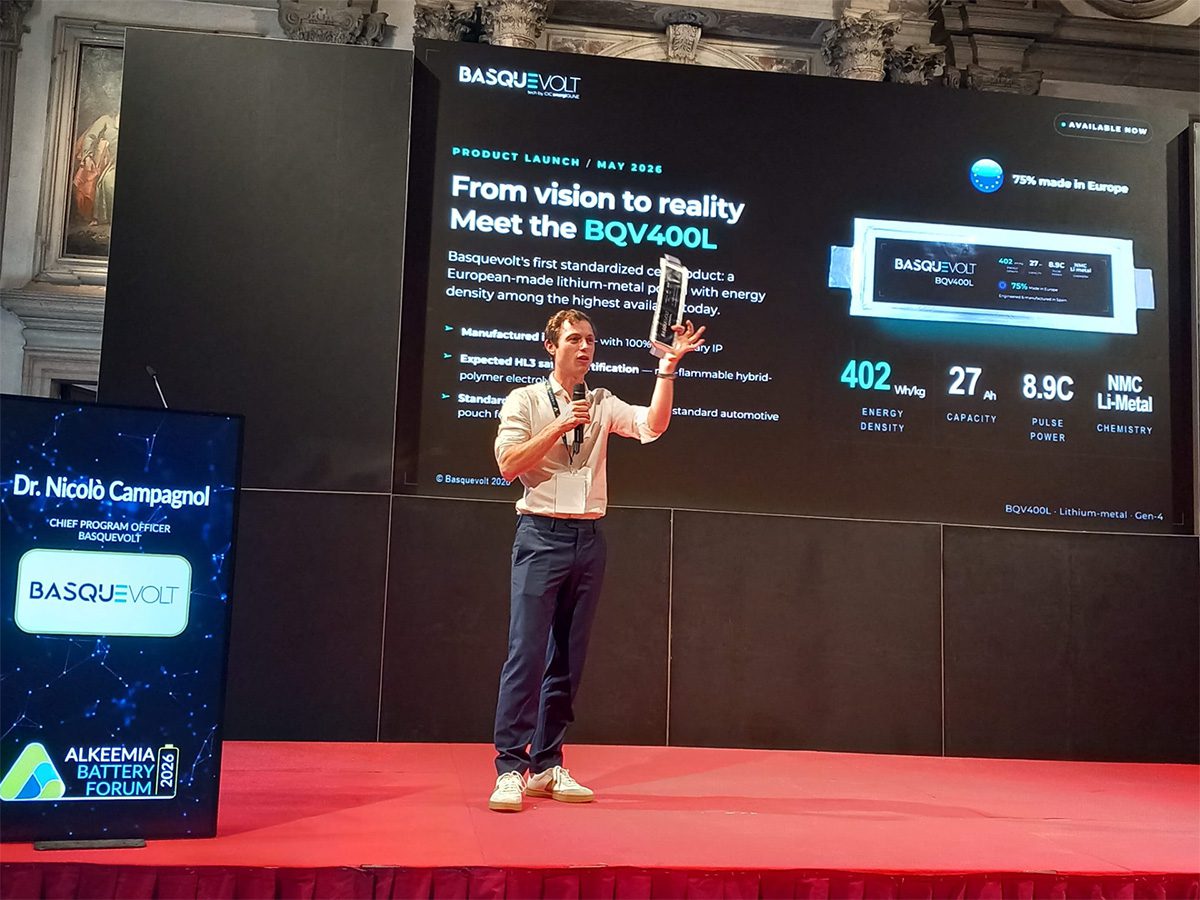
Key Takeaways:
- BASQUEVOLT has officially launched the BQV400L, its first standardized commercial battery cell, featuring a significant 402 Wh/kg energy density.
- This advanced lithium-metal NMC cell offers an impressive 8.9C pulse power capability, ideal for high-performance electric vehicle applications and regenerative braking.
- Manufactured in Spain, the BQV400L boasts 75% European component sourcing, strengthening regional supply chains and sustainability efforts.
- The cell incorporates BASQUEVOLT’s proprietary polymer electrolyte, a crucial step towards full solid-state battery architecture, addressing historical challenges of lithium-metal technology.
- With anticipated HL3 safety certification and validation by automotive giants like Ampere (Renault Group) and EDF, the BQV400L is poised to significantly impact the global EV battery landscape.
- The technology is designed for compatibility with existing gigafactory infrastructure, reducing the barrier to industrial-scale production.
BASQUEVOLT, a prominent innovator in energy storage solutions, announced on May 21, 2026, the commercial launch of its BQV400L battery cell. This groundbreaking 27 Ah, 402 Wh/kg lithium-metal NMC cell represents a significant leap forward in electric vehicle (EV) battery technology, combining high energy density with robust power delivery capabilities.

The new cell is not only engineered for superior performance but is also a testament to European manufacturing prowess, being produced in Spain with an impressive 75% of its components sourced within the continent. This strategic local sourcing underscores a commitment to resilient supply chains and regional economic development within the rapidly expanding EV market.
Understanding the Lithium-Metal NMC Cell Breakthrough
At the core of the BQV400L is a sophisticated lithium-metal (Li-metal) anode coupled with a Nickel-Manganese-Cobalt (NMC) cathode. Lithium-metal anodes are highly sought after in advanced battery development due to their substantially higher theoretical energy density compared to conventional graphite anodes. This inherent advantage promises to deliver longer ranges for electric vehicles and enable lighter battery packs, critical factors for widespread EV adoption.
Historically, integrating lithium-metal anodes into commercial battery cells has presented considerable challenges. Issues such as dendritic growth, which can compromise cell safety and significantly reduce cycle life, have been persistent hurdles for researchers and manufacturers.

Proprietary Polymer Electrolyte: A Stepping Stone to Solid-State
BASQUEVOLT addresses these long-standing challenges with its proprietary polymer electrolyte. This innovative material is described by the Basque Country-based company as a vital transitional step towards achieving full solid-state battery architecture. By managing the complexities associated with lithium-metal anodes, the polymer electrolyte enhances safety and extends the operational lifespan of the battery cell, even as the broader solid-state technology continues its industrial maturation.
This strategic approach allows BASQUEVOLT to leverage the energy density benefits of lithium metal while mitigating its historical drawbacks, paving a clearer path for the future of advanced EV battery technology. The company’s focus on a polymer-based solution highlights a pragmatic pathway to next-generation energy storage.
Unprecedented Energy Density and Power Delivery
The BQV400L’s energy density of 402 Wh/kg positions it among the most energy-dense commercially available battery cells globally. This high gravimetric energy density is a crucial metric for electric vehicles, directly translating into extended driving ranges and reduced vehicle weight, both of which are paramount for consumer appeal and operational efficiency.
Beyond its energy storage capacity, the cell demonstrates an exceptional 8.9C pulse power capability. This means the battery can deliver approximately nine times its rated capacity in short bursts. Such high pulse power is vital for performance-oriented electric vehicles, enabling rapid acceleration and efficient capture of energy through regenerative braking. This feature contributes significantly to both the dynamic driving experience and overall energy efficiency of an EV.
Streamlined Manufacturing and European Sourcing
A key advantage highlighted by BASQUEVOLT is the BQV400L’s compatibility with existing gigafactory manufacturing infrastructure. This crucial design consideration means that producers can integrate the new lithium-metal NMC cell technology without requiring major additional capital investment in new equipment or processes. This compatibility significantly lowers the barrier to entry for widespread adoption and accelerates the potential for large-scale production.
Furthermore, the commitment to sourcing 75% of the components within Europe represents a strategic move towards building a more self-reliant and sustainable supply chain for advanced battery manufacturing. This not only bolsters the European industrial base but also reduces dependency on international logistics, enhancing resilience against global supply chain disruptions.
Rigorous Safety Validation and Industry Partnerships
Safety remains a paramount concern in battery technology, especially for high-energy density cells destined for automotive applications. BASQUEVOLT has confirmed that the BQV400L is expected to achieve HL3 safety certification, a stringent industry standard. The results of this certification process are currently undergoing independent validation by a reputable third-party testing laboratory, ensuring impartiality and scientific rigor.
The company has also forged significant alliances within the automotive and energy sectors to rigorously test and validate its technology. A Joint Development Agreement has been signed with Ampere, the dedicated electric vehicle arm of the Renault Group. This partnership aims to validate BASQUEVOLT’s lithium-metal cells under real-world automotive conditions, a critical step towards broad industry integration.
Additionally, EDF, a leading global energy company, has conducted its own comprehensive safety and performance tests on BASQUEVOLT’s cells. An unnamed Original Equipment Manufacturer (OEM) has also participated in these evaluations, signaling strong industry interest and confidence in the cell’s potential.
Leadership Insights and Market Availability
Commenting on this significant milestone, Nicolò Campagnol, Chief Program Officer at BASQUEVOLT, expressed optimism about the company’s achievements and future trajectory. “Reaching over 400 Wh/kg in a commercially available, European-made cell is something we have worked toward for a long time,” Campagnol stated. “The technology roadmap ahead of us is the most compelling it has ever been.” His remarks underscore the years of dedicated research and development that have culminated in this commercial launch.
The BQV400L is available now, marking its immediate readiness for integration into various applications. Its introduction is poised to significantly influence the development and deployment of next-generation electric vehicles, offering manufacturers a powerful, efficient, and increasingly sustainable battery solution from the heart of Europe.
Looking Ahead: The Impact on EV Engineering
The launch of the BQV400L lithium-metal NMC cell represents a pivotal moment for EV engineering. By pushing the boundaries of energy density and pulse power, BASQUEVOLT is enabling car manufacturers to design electric vehicles with improved performance metrics, from longer ranges to faster charging capabilities. The strategic emphasis on European manufacturing and sourcing also contributes to the establishment of robust, regional supply chains, crucial for the long-term sustainability and growth of the European electric vehicle industry.
As the electric vehicle market continues its rapid expansion, innovations like the BQV400L will be instrumental in overcoming existing limitations and accelerating the transition to a fully electric future. The successful development and commercialization of such advanced battery cells underscore the critical role of continuous research and development in driving sustainable mobility globally.
FAQ Section
What is the BQV400L battery cell?
The BQV400L is BASQUEVOLT’s first standardized commercial battery cell, a 27 Ah lithium-metal NMC cell with an energy density of 402 Wh/kg and 8.9C pulse power. It’s designed for high-performance electric vehicle applications.
What makes the BQV400L’s energy density significant?
At 402 Wh/kg, the BQV400L offers one of the highest energy densities commercially available globally. This enables longer driving ranges for electric vehicles and contributes to lighter battery packs, improving overall vehicle efficiency.
How does BASQUEVOLT address the challenges of lithium-metal batteries?
BASQUEVOLT utilizes a proprietary polymer electrolyte. This material serves as a transitional step toward full solid-state architecture, effectively managing the historical issues of lithium-metal anodes like safety concerns and cycle life limitations.
What is the importance of 8.9C pulse power capability?
An 8.9C pulse power capability allows the cell to deliver roughly nine times its rated capacity in short bursts. This is crucial for rapid acceleration in EVs and efficient energy capture during regenerative braking, enhancing driving dynamics and energy recovery.
Where is the BQV400L manufactured, and what about its components?
The BQV400L is manufactured in Spain. Notably, 75% of its components are sourced within Europe, emphasizing a commitment to regional supply chain resilience, sustainability, and supporting the European industrial ecosystem.
Has the BQV400L undergone independent safety validation?
Yes, the BQV400L is expected to achieve HL3 safety certification, with results currently being independently validated by a third-party testing laboratory. Additionally, partners like Ampere (Renault Group) and EDF have conducted their own safety and performance tests.
Is this new battery technology compatible with existing manufacturing facilities?
BASQUEVOLT states that the BQV400L is compatible with existing gigafactory manufacturing infrastructure. This design choice minimizes the need for major additional capital investment, facilitating easier and faster adoption for large-scale production.