
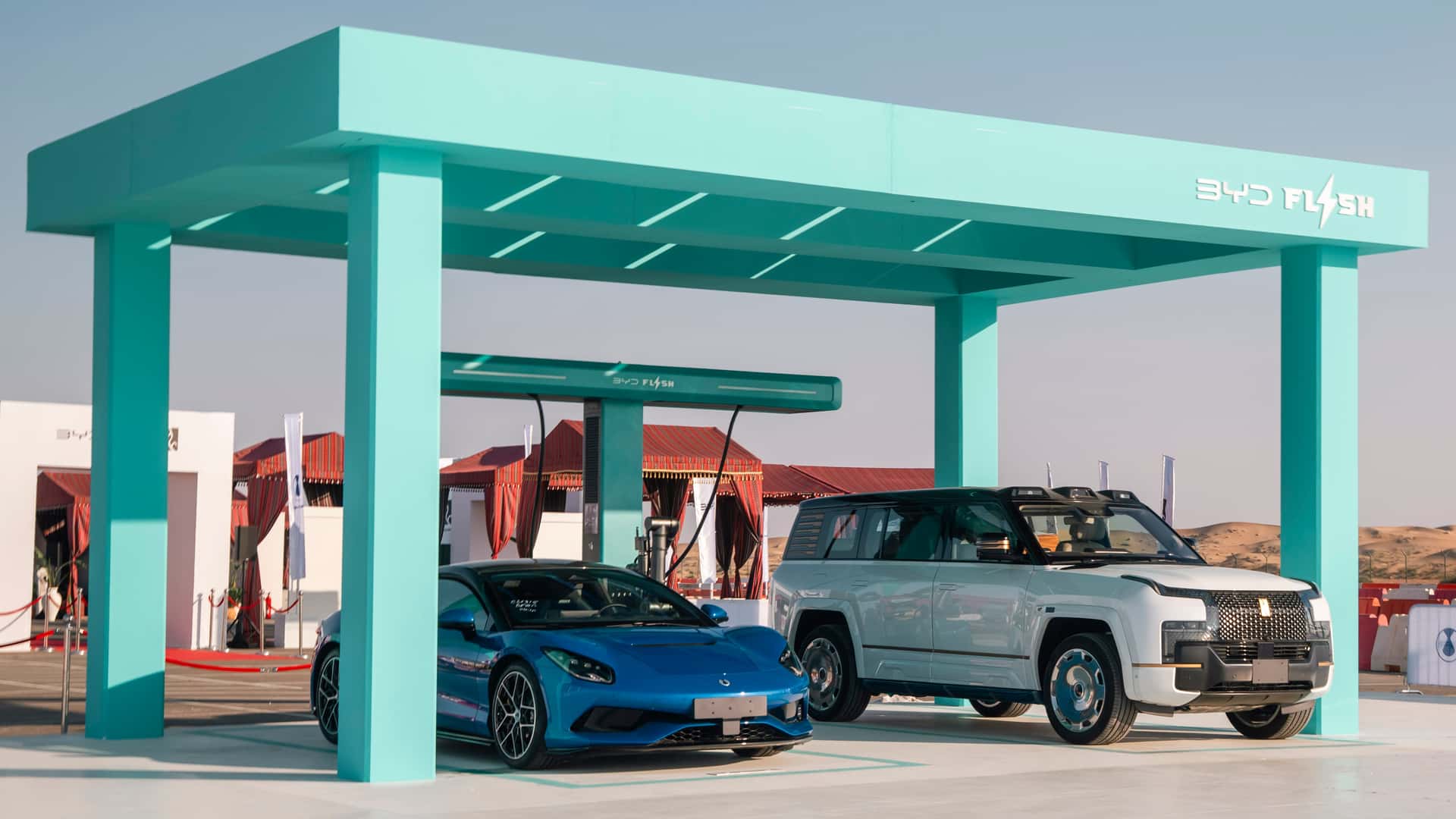
In a significant stride towards revolutionising electric vehicle (EV) infrastructure, Chinese automotive giant BYD has introduced an advanced charging station concept that promises to redefine how electric cars are powered. The innovative system combines solar energy generation, substantial battery storage, ultra-fast Flash Charging technology, and a robotic arm for automated vehicle connection. This holistic approach aims to overcome current limitations in grid connectivity and charging speed, particularly in challenging environments.
The company demonstrated its futuristic BYD EV charging station in the Abu Dhabi desert, showcasing its potential for self-sufficient operation. This setup is engineered to function independently of conventional electricity grids, opening avenues for deploying fast-charging solutions in areas previously deemed unfeasible due to lack of power infrastructure.

Integrating Renewable Energy and Advanced Storage
The core proposition of BYD’s new charging infrastructure is remarkably straightforward yet profoundly impactful. Solar panels harness energy from the sun, which is then stored in large-capacity batteries. This stored energy is subsequently dispatched to electric vehicles via advanced chargers, creating a self-sustaining loop.
This integration of renewable energy sources directly addresses the growing demand for sustainable EV charging. By generating electricity on-site, the system significantly reduces its carbon footprint while offering a resilient power supply.
Battery-Backed Charging: A Growing Trend
The concept of battery-backed charging is gaining considerable traction within the EV sector, primarily because it enables charging stations to deliver higher power outputs than their direct grid connections might otherwise permit. This strategy also plays a crucial role in alleviating strain on local electricity grids during peak demand periods.

Leading companies like Tesla have already implemented similar solutions; its largest Supercharger site, opened earlier in 2023, incorporates solar panels alongside Tesla’s Megapack batteries. Specialised firms such as Electric Era and Beam Global also focus on developing battery-backed charging solutions, highlighting a clear industry shift.
Even BYD’s standard Flash chargers, which are connected to the grid, utilise on-site energy storage to enhance power delivery. This demonstrates the company’s commitment to maximising efficiency and performance across its charging network.
The Mechanics of BYD’s Flash Charging System
Each of BYD’s distinctive T-shaped Flash chargers is equipped with two 185-kilowatt-hour (kWh) storage batteries, accumulating a total on-site storage capacity of 370 kWh per charger. These batteries draw power from the electricity grid at varying rates, ranging from approximately 100 to 560 kilowatts (kW).
Once charged, these batteries can then supply power to an electric vehicle at a substantially higher rate. The chargers are engineered to deliver up to an impressive 1,500 kW through a single charging cable. When both cables are simultaneously engaged, the power output remains robust at up to 1,000 kW.
Off-Grid Potential and Technical Disclosures
The addition of solar panels to this equation signifies that a portion, or even the entirety, of the electricity consumed can be generated directly on-site. This capability is paramount for establishing a truly grid-independent BYD EV charging station.
However, BYD has not yet disclosed specific technical details regarding the total battery capacity or the solar output for this novel desert installation. Consequently, it remains unclear precisely how many vehicles the station can sustain, or at what speed, when operating solely on solar power and its integrated energy storage.
Rapid Charging Capabilities and Vehicle Compatibility
The charging hardware itself is engineered for remarkable speed. With BYD’s latest 1,500-kW Flash chargers, compatible vehicles equipped with the company’s second-generation Blade battery can achieve a charge from 10% to 70% in just five minutes. Furthermore, these vehicles can reach 97% battery capacity in a mere nine minutes, effectively mirroring the time taken to refuel a conventional gasoline vehicle.
A recent demonstration highlighted the efficacy of this advanced BYD EV charging technology. The Denza Z9 GT, an electric wagon and one of the compatible vehicles, showcased its rapid charging capabilities by progressing from 10% to 80% charge in six minutes and 32 seconds, reaching 97% in nine minutes and 22 seconds during a public display.
The Role of the Robotic Arm in Automated Charging
Adding another layer of innovation and convenience, the BYD EV charging station incorporates a robotic arm designed to plug the charging cable into the vehicle automatically. This feature, when synergised with automated parking systems, paves the way for a fully hands-free and seamless charging experience for users.
The integration of robotics enhances operational efficiency and user accessibility, moving towards a future where EV charging requires minimal human intervention. This automated process can significantly improve the user experience, making electric vehicle ownership even more convenient.
BYD’s Ambitious Global Expansion Strategy
BYD’s vision extends beyond individual installations; the company has articulated an ambitious plan to establish a vast network of Flash Charging stations globally. It aims to deploy 6,000 such stations worldwide by the close of 2027, marking a significant expansion of its EV charging infrastructure.
Despite this clear quantitative target, BYD has not yet specified the proportion of these upcoming stations that will feature solar power integration, off-grid operational capabilities, or the robotic charging arm. This leaves open questions regarding the scale and distribution of its most advanced charging solutions.
Expanding Presence in International Markets
The European market is already witnessing the deployment of BYD’s Flash charging technology, with operational sites established across Italy, Germany, France, and the United Kingdom. This expansion underscores BYD’s commitment to bolstering EV infrastructure in key international automotive markets.
Additionally, Canada is slated to be among the next regions to experience the benefits of BYD’s high-speed charging solutions. While the Denza Z9 GT is currently the primary vehicle in Europe capable of fully utilising the maximum power output of these chargers, the growing adoption of BYD’s Blade battery technology suggests broader compatibility in the near future.
The Future of Electric Mobility
BYD’s latest BYD EV charging station represents a significant leap forward in addressing critical challenges faced by the electric vehicle ecosystem: charging speed, grid dependency, and user convenience. By integrating renewable energy with cutting-edge battery and robotic technologies, BYD is setting new benchmarks for sustainable and efficient EV charging infrastructure.
The deployment of such advanced systems, particularly in remote areas or regions with nascent grid infrastructure, holds the potential to accelerate global EV adoption. As BYD continues its global expansion, the impact of its Flash Charging network, especially those leveraging solar and battery storage, could be transformative for the future of electric mobility worldwide.