
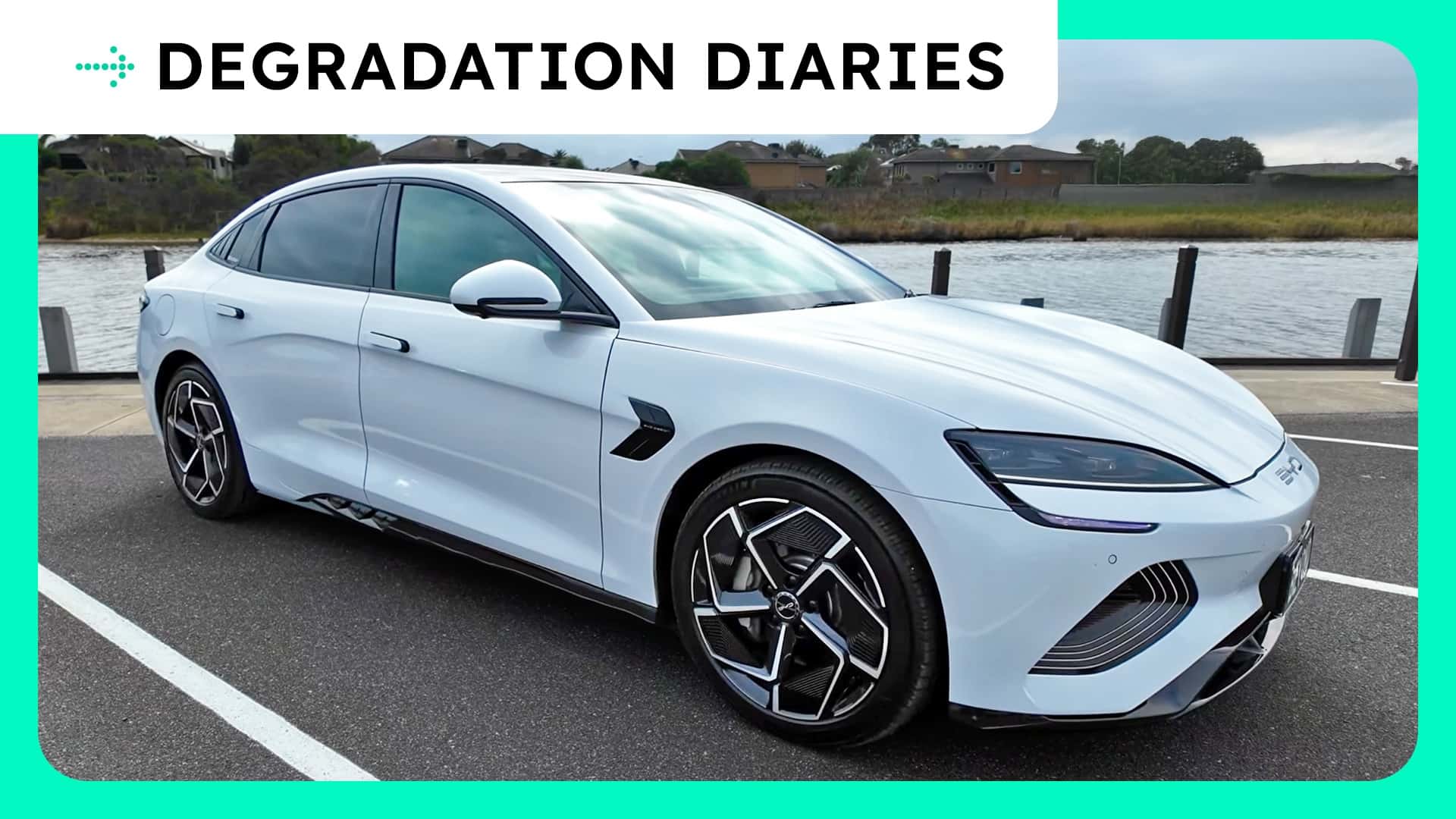
As the adoption of electric vehicles (EVs) accelerates globally, concerns surrounding battery longevity and range degradation remain a key consideration for both prospective buyers and existing owners. Understanding how EV batteries perform over time and mileage is crucial for evaluating long-term ownership costs and vehicle resale value. A recent real-world assessment of a BYD Seal, a prominent electric sedan, provides valuable data points on its Lithium-Iron Phosphate (LFP) Blade battery performance after two years and substantial mileage.
Key Takeaways
- A two-year-old BYD Seal, after accumulating 31,000 miles (50,000 km), exhibited approximately 5% battery capacity degradation.
- The initial 82.56 kWh LFP Blade battery retained 95.08% of its original capacity, equating to roughly 78.5 kWh.
- This real-world data aligns with a non-linear degradation pattern often observed in lithium-ion batteries, suggesting that initial losses may not dictate future rates.
- Despite a measurable reduction, the BYD Seal’s battery performance after significant use is considered within normal, reassuring parameters for EV owners.
The Growing Importance of EV Battery Health
Battery degradation is a central topic in the electric vehicle discourse, influencing consumer confidence and shaping the perception of EV reliability. For many, the prospect of diminished range over time is a significant barrier to entry into electric mobility. Industry studies generally indicate robust performance from EV batteries under normal usage conditions, yet specific examples offer more tangible insights into real-world scenarios.

This column, ‘Degradation Diaries,’ aims to demystify EV range loss by examining individual vehicle examples. The inaugural case focuses on a BYD Seal, a single-motor variant from 2024, which has been in operation for approximately two years. Its journey across 31,000 miles (50,000 km) in Australia offers a practical glimpse into how its LFP battery stands up to regular use.
Unpacking the BYD Seal’s Battery Specifications
The BYD Seal in question is equipped with an advanced Lithium-Iron Phosphate (LFP) Blade battery, known for its enhanced safety, longer lifespan, and improved thermal stability compared to some other battery chemistries like Nickel Manganese Cobalt (NMC). When new, this LFP pack boasted a capacity of 82.56 kilowatt-hours (kWh), with a total energy reserve of approximately 85 kWh when factoring in the buffer.
This substantial battery capacity translated to an official WLTP (Worldwide Harmonized Light Vehicles Test Procedure) range rating of approximately 354 miles (570 km). Notably, this single-motor configuration offered a range advantage of about 31 miles (50 km) over its quicker, dual-motor counterpart, underscoring the efficiency considerations in EV design.

Real-World Range Versus Manufacturer Claims
While official ratings provide a baseline, real-world driving conditions often present a different picture. The Australian Automobile Association (AAA) conducted independent tests on a single-motor BYD Seal on public roads. Their findings indicated a theoretical maximum range of 303 miles (488 km).
This figure represents a 14.4% reduction compared to the manufacturer’s WLTP claim. Such discrepancies are not uncommon in the automotive industry, where various factors like driving style, terrain, temperature, and auxiliary usage can significantly impact actual range figures compared to controlled laboratory tests.
Assessing Battery State of Health After 31,000 Miles
The core of this analysis involves the post-mileage battery health assessment. Using an OBD2 dongle—a diagnostic tool that connects to the vehicle’s onboard computer—and the ‘Car Scanner’ application, the researchers from the YouTube channel ‘Beyond EV’ in Australia measured the battery’s current capacity. This methodology offers a practical way for owners to monitor their vehicle’s state of health (SOH).
The assessment revealed that the BYD Seal’s battery retained 95.08% of its original capacity. In absolute terms, this translates to approximately 78.5 kWh of usable energy remaining from its initial 82.56 kWh. This result indicates an approximate 5% capacity loss over two years and 31,000 miles of use.
Factors Influencing BYD Seal Battery Degradation
While the 5% capacity loss is a concrete figure, interpreting it requires understanding the multifaceted nature of battery degradation. Several factors are known to influence how quickly an EV battery’s capacity diminishes. Crucially, the detailed charging history of this particular BYD Seal was not available for the analysis.
One primary factor is the type of charging employed. Frequent reliance on public DC fast chargers, while convenient, can generally accelerate battery degradation more than consistent Level 2 (AC) charging, typically done overnight at home. LFP batteries, like those in the BYD Seal, are often observed to exhibit better resilience to DC fast charging compared to NMC chemistries, providing a potential advantage in longevity.
Other variables include storage conditions—whether the car is routinely parked in a temperature-controlled garage or exposed to extreme heat or cold outdoors—and the owner’s charging habits. Maintaining battery charge levels within a moderate range (e.g., between 20% and 80%) and avoiding prolonged periods at very low or very high states of charge are widely recommended practices for preserving battery health.
The Non-Linear Nature of Battery Capacity Loss
A crucial aspect of interpreting this BYD Seal battery degradation data lies in the non-linear pattern of battery capacity loss. Initial degradation, such as the observed sub-5% drop, does not necessarily set a consistent rate for future losses. As stated in one study in the Journal of Power Sources, “lithium-ion battery degradation (including LFP) is often non-linear, so a sub-5% state-of-health drop after 31,000 miles does not mean the car will continue to lose capacity at exactly the same rate.”
This scientific understanding suggests that batteries often experience a more rapid initial degradation phase, which then tends to slow down over subsequent years and mileage. Therefore, while a 5% loss is measurable, it doesn’t automatically predict an alarming trajectory for the battery’s remaining lifespan. This nuance is vital for a realistic assessment of long-term EV ownership.
Implications for Current and Future EV Owners
The findings from this BYD Seal case study offer a reassuring perspective for the electric vehicle community. A 5% reduction in capacity over two years and 31,000 miles suggests a healthy, sustainable rate of battery performance, especially considering the unknowns regarding its usage patterns.
For prospective buyers considering a used BYD Seal or other LFP-equipped EVs, this data provides a benchmark, indicating that significant range anxiety due to early degradation may be unwarranted. For current owners, it reinforces the confidence in their vehicle’s long-term viability and range capabilities. The robust performance of LFP batteries, as showcased here, is a positive indicator for the broader electric mobility ecosystem.
The Evolving Landscape of Electric Vehicle Longevity
The continuous advancements in battery technology, coupled with sophisticated battery management systems (BMS) in modern EVs, contribute significantly to improved longevity and slower degradation rates. Manufacturers are increasingly offering substantial warranties on their battery packs, often covering them for eight years or 100,000 miles (or more) with a guarantee of a certain percentage of original capacity remaining. This reflects growing confidence in the durability of EV batteries.
Data from individual vehicles, such as this BYD Seal, serve as vital real-world validation points, complementing broader statistical studies. They help in building a more comprehensive picture of EV battery health, fostering trust, and dispelling common myths about rapid battery decline.
Frequently Asked Questions (FAQ)
1. What is BYD Seal battery degradation?
BYD Seal battery degradation refers to the gradual loss of the battery’s maximum energy storage capacity over time and usage. In a recent case, a BYD Seal showed approximately 5% capacity loss after two years and 31,000 miles, indicating a healthy and expected rate of decline for its LFP battery.
2. How was the BYD Seal battery health assessed?
The battery health of the BYD Seal in this study was assessed using an OBD2 dongle connected to the vehicle’s diagnostic port and processed via the ‘Car Scanner’ application. This method allows for reading the battery’s current state of health (SOH) and capacity.
3. What is an LFP Blade battery?
An LFP (Lithium-Iron Phosphate) Blade battery is a specific type of lithium-ion battery developed by BYD. It is characterized by its blade-like cell structure, which enhances safety, thermal stability, energy density, and offers a longer cycle life compared to some other lithium-ion chemistries.
4. Is 5% battery degradation normal after 31,000 miles?
Yes, a 5% battery degradation after 31,000 miles (50,000 km) and two years is generally considered normal and healthy for an electric vehicle. Battery degradation is often non-linear, meaning initial losses may not continue at the same rate, and the majority of EV batteries exhibit robust performance over similar periods.
5. Do charging habits affect BYD Seal battery degradation?
Yes, charging habits significantly impact battery degradation. Frequent DC fast charging can accelerate capacity loss more than Level 2 (AC) charging. Additionally, consistently charging to 100% or letting the battery drain too low can also contribute to faster degradation, though LFP batteries are more tolerant.
6. What is the official WLTP range of the BYD Seal?
When new, the single-motor BYD Seal, equipped with an 82.56 kWh LFP Blade battery, had an official WLTP (Worldwide Harmonized Light Vehicles Test Procedure) range rating of approximately 354 miles (570 km). Real-world driving conditions may result in different actual ranges.
7. How does LFP compare to NMC batteries in terms of degradation?
LFP batteries, like those in the BYD Seal, generally demonstrate superior longevity and better resilience to rapid charging and full charge cycles compared to NMC (Nickel Manganese Cobalt) batteries. This makes them a preferred choice for durability and reduced degradation over the vehicle’s lifespan.