
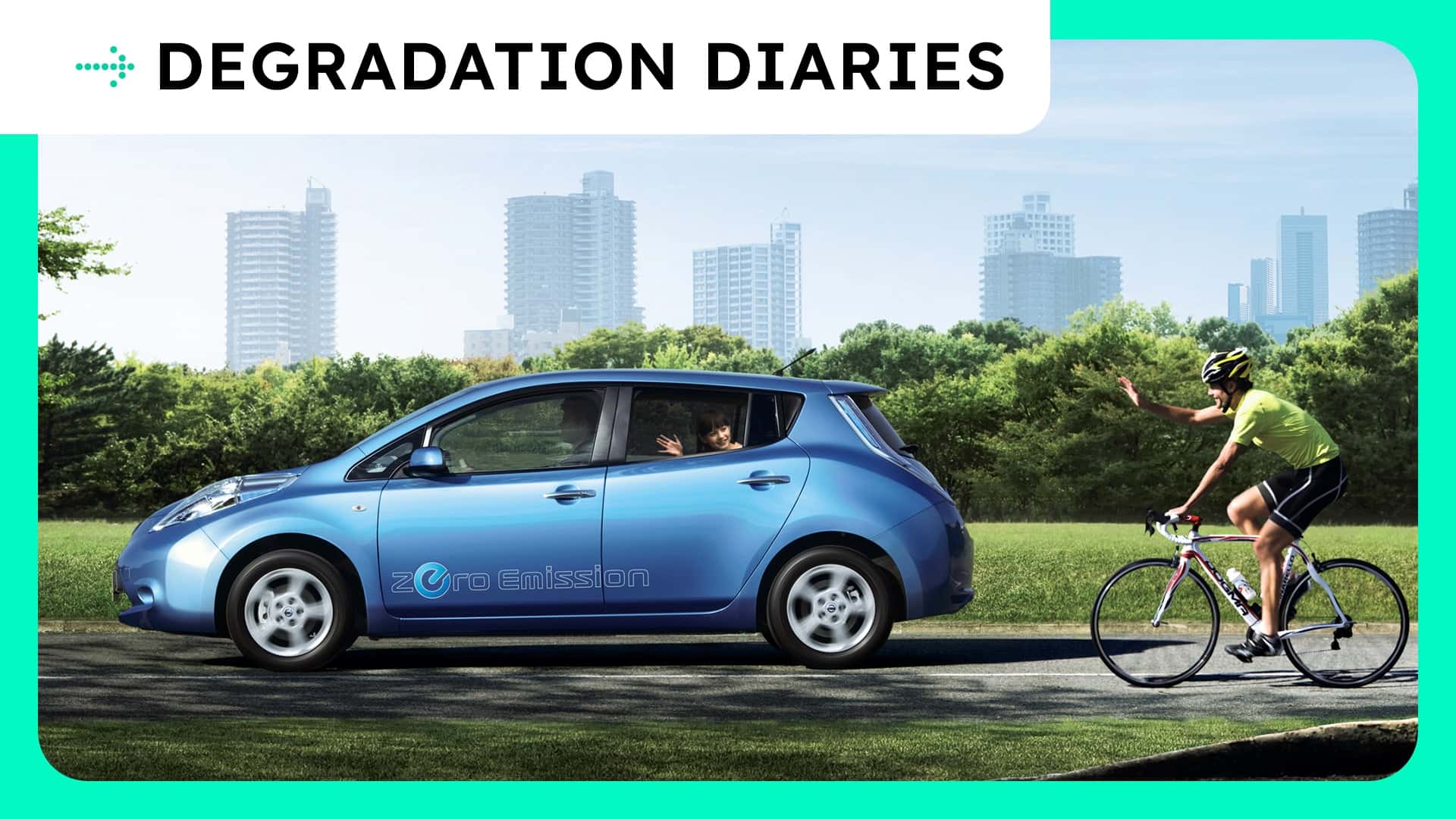
The term “EV battery degradation” often conjures images of rapidly diminishing electric vehicle range, a fear largely rooted in the early experiences of pioneering models. Among these, the Nissan Leaf stands out as a crucial reference point. As one of the original purpose-built electric vehicles, the Leaf was, in many respects, an advanced, likable, and genuinely important innovation. However, an engineering decision regarding its battery cooling system inadvertently created a lasting public perception challenge for the entire electric vehicle industry.
The core of the issue lay in the Leaf’s passively air-cooled battery pack. This design choice provided minimal control over cell temperature, a critical factor in battery longevity. The significant drawback was that Nissan Leafs, particularly those operating in warmer climates, tended to experience a more accelerated loss of battery capacity compared to other electric vehicles equipped with actively liquid-cooled battery packs.

Key Takeaways
- The early Nissan Leaf’s passively air-cooled battery contributed significantly to public concerns about EV battery degradation due to faster capacity loss, especially in hot climates.
- Studies showed early 30-kWh Leaf models experienced annual degradation rates as high as 9.9%, a stark contrast to modern EVs.
- High battery replacement costs cited in surveys like AAA’s (56% of consumers) underscore the financial anxieties associated with degradation.
- Modern electric vehicles universally employ active thermal management systems, often liquid-cooled or integrated with heat pumps, to maintain optimal battery temperatures.
- These advanced systems drastically reduce EV battery degradation, with many modern EVs retaining high capacity even after over a decade and hundreds of thousands of miles.
- The industry has moved beyond rudimentary cooling, ensuring that battery longevity is no longer a primary concern for new EV buyers.
Understanding EV Battery Degradation
For prospective electric vehicle owners, battery degradation can be a particularly daunting concern. Unlike easily understandable issues such as charging delays or winter range loss, a degraded battery evokes a sense of terminal failure, akin to a conventional engine seizing. This apprehension is often amplified by the prospect of a high-cost battery replacement.
Indeed, a 2026 AAA consumer survey highlighted this financial worry, revealing that the high cost of battery repair or replacement was the most-cited reason (56%) people were hesitant to purchase an EV. This ranked higher than concerns about purchase price, long-distance suitability, range anxiety, and charging infrastructure.
However, the reality of **EV battery degradation** is often less alarming than many believe, especially when viewed through the lens of modern electric vehicle technology. While the gradual capacity loss inherent to lithium-ion batteries is unavoidable over time, actual battery failure in contemporary cars remains exceedingly rare. Many older, high-mileage EVs are still operating efficiently on their original battery packs, some over a decade old, maintaining sufficient range for practical use.

The Leaf’s Historical Impact on Perception
The Nissan Leaf, throughout its first two model generations spanning over 15 years, consistently utilized air-cooled battery technology. Despite numerous other improvements to the vehicle, this design choice persisted. Given its status as one of the world’s most recognizable early EVs, reports of its battery degradation spread widely, extending far beyond dedicated owner forums and contributing significantly to the broader public’s apprehension regarding EV battery longevity.
A New Zealand study, based on 1,382 battery-health readings from 283 Nissan Leafs, provided concrete data on this issue. It found that 30-kWh Leaf models exhibited an unusually high annual battery health decline of 9.9% at just two years old. This figure is exceptionally high when compared to virtually any modern EV equipped with active battery cooling. Even the earlier 24-kWh models, while performing better, still showed an average degradation of 3.1% per year.
Nissan later issued a software update for some 30-kWh models, acknowledging that the battery controller could sometimes incorrectly report capacity. However, by then, the negative early owner experiences had already cemented a reputation for rapid **EV battery degradation** in the minds of many.
Early Degradation and Replacement Costs
Anecdotal evidence further fueled concerns. Early Leaf forums were rife with stories of drivers observing battery capacity bars disappear rapidly, particularly in regions with hot climates. An independent test conducted in Arizona in 2012, as cited by Green Car Reports, highlighted the severity: one Leaf tested, less than two years old, retained only 60-65% of its original battery capacity, capable of driving just 59 miles before depletion.
The financial implications of such degradation were also significant. In January 2014, Nissan priced a replacement battery pack for an early first-generation Leaf at $5,499 before tax and installation. This price also assumed that the dealership would retain the old pack, which Nissan valued at $1,000. These costs, combined with reduced usability, meant that a vehicle originally capable of around 80 miles might fall to a mere 30 miles of range after a few years, transforming it from a versatile car into a limited local errand runner.
While third-party companies eventually emerged to offer upgraded battery packs with higher capacity and improved cell density, the initial battery issues of the Leaf left a lasting mark on the perception of electric vehicles. Despite data now demonstrating the superior performance of modern EV batteries, overcoming this early reputational damage has proven to be a persistent challenge for the industry.
Modern EV Battery Management: A Paradigm Shift
The concerns surrounding **EV battery degradation** have been largely mitigated by significant advancements in thermal management systems. Research from the National Renewable Energy Laboratory (NREL) provides clarity on this, stating that “High or low average battery temperature can accelerate lithium-related capacity loss in any EV.” Crucially, NREL points out that high temperatures specifically “speed up unwanted chemical reactions inside the cell, including the growth of a protective layer that gradually consumes usable lithium as the battery ages.”
This understanding has driven the widespread adoption of active battery thermal management systems. These systems are designed to maintain the battery pack within its optimal operating temperature window, minimize temperature differentials between cells, and prevent the accelerated wear associated with extreme temperatures. Today, every EV sold in the U.S. and most worldwide incorporate such systems as standard.
A compelling study published by Geotab in January further illustrates this progress: “the 2015 Tesla Model S, which uses liquid cooling, has an average degradation rate of 2.3%. In contrast, the 2015 Nissan Leaf, with passive air cooling, shows a much higher rate of 4.2%.” This stark difference underscores the efficacy of active cooling in preserving battery health.
Liquid Cooling and Longevity
The real-world longevity of actively cooled batteries is impressive. For instance, a 2014 Tesla Model S with over 100,000 miles can still retain a remarkable 85% of its original battery capacity after more than 11 years on the road. Such a performance would have been virtually unattainable in a first- or second-generation Nissan Leaf.
Glycol-based liquid cooling systems are now the industry standard for this reason, found in vehicles from Tesla and Ford to Chevrolet and Volkswagen. Automakers have unequivocally learned that maintaining the battery within its optimal temperature range is paramount for long-term reliability and minimizing **EV battery degradation**. Even alternative approaches, such as BMW’s original i3, which cleverly integrated the air-conditioning system to cool its battery, demonstrate the importance of direct temperature control.
Advanced Thermal Management Systems and Future Innovations
Thermal management systems have evolved considerably even beyond the early designs seen in models like the Tesla Model S. Most contemporary electric vehicles now pair their glycol-based battery cooling systems with heat pumps to maximize efficiency. While heat pumps are often highlighted for their ability to extend cold-weather range by more efficiently heating the cabin than resistive heaters, their role in a comprehensive thermal management system extends far beyond this.
Instead of merely generating heat, a heat pump efficiently moves it around, allowing the vehicle to scavenge warmth from various components—including the motors, power electronics, the battery itself, or even the outside air—and direct it precisely where needed. In vehicles like the Tesla Model Y, the heat pump works in conjunction with components like the Octovalve, which acts as a sophisticated coolant traffic director. This system routes heat between the battery, cabin, drivetrain, chiller, and radiator, dynamically responding to whether the car requires battery preconditioning for fast charging, cooling during intensive use, or efficient cabin heating without wasteful energy consumption.
The trajectory of EV battery thermal management promises continued innovation. Shell recently showcased a unique EV concept featuring direct immersion cooling, where battery cells are fully submerged in a specialized coolant. This approach aims to make heat extraction even more effective and efficient than current methods, where coolant typically circulates around, rather than through, the cells. Increasingly, EVs are designed to route coolant directly through the top and along the sides of the cells, ensuring the elimination of localized hot spots that could otherwise accelerate **EV battery degradation**.
Ultimately, the electric vehicle landscape has progressed significantly since the Nissan Leaf’s rudimentary air-cooled battery management approach. Modern engineering solutions have largely overcome the early challenges, enabling batteries to perform reliably for hundreds of thousands of miles without crippling degradation. While the Leaf was an indispensable pioneer, the industry’s crucial lesson has led to the widespread adoption of active battery cooling systems across nearly every new model. Thanks to these advancements, contemporary EV owners can confidently expect long-term dependability from their vehicle’s battery.
FAQ Section
What is EV battery degradation?
EV battery degradation refers to the natural, gradual loss of an electric vehicle battery’s capacity and performance over time and use. It manifests as a reduction in the total available range and, in some cases, power output. This process is inherent to lithium-ion chemistry but can be significantly slowed by modern thermal management.
How quickly do modern EV batteries degrade?
Modern EV batteries, equipped with active thermal management, degrade much slower than early models. Studies indicate average annual degradation rates often fall between 1% and 2.5%. Many EVs can retain 80-85% of their original capacity after 8-10 years or 100,000-150,000 miles, making significant capacity loss a less pressing concern.
Why was the Nissan Leaf’s battery degradation so prominent?
The early Nissan Leaf generations used passively air-cooled batteries, which struggled to regulate temperature, especially in hot climates. High temperatures accelerate unwanted chemical reactions, leading to faster capacity loss. This design, combined with the Leaf’s popularity as an early EV, made its degradation issues widely known.
What is active thermal management in EV batteries?
Active thermal management systems use liquid coolants (like glycol), refrigerants, or integrated heat pumps to actively regulate the battery’s temperature. These systems keep the battery within an optimal operating range, preventing overheating during charging or discharge, and protecting it from extreme cold, thereby significantly minimizing degradation.
Do all EVs use liquid-cooled batteries now?
While not every EV uses an identical liquid-cooling setup, virtually all modern electric vehicles on sale today incorporate some form of active thermal management. This often includes glycol-based liquid cooling loops, sometimes integrated with the vehicle’s air conditioning or advanced heat pump systems, to ensure optimal battery temperature control.
Is EV battery replacement expensive?
Yes, replacing an entire EV battery pack can be very expensive, often costing several thousand dollars, making it a significant concern for consumers. However, actual battery failures necessitating a full replacement are rare in modern EVs due to improved thermal management and robust warranties, which typically cover the battery for 8 years or 100,000 miles.
How do heat pumps help with battery longevity?
Heat pumps in EVs are multi-functional. Beyond efficient cabin heating, they are integral to advanced thermal management systems. They can move heat away from the battery during hot conditions or rapidly preheat it for optimal charging and performance in cold weather. This active temperature regulation directly contributes to slowing down battery degradation.