
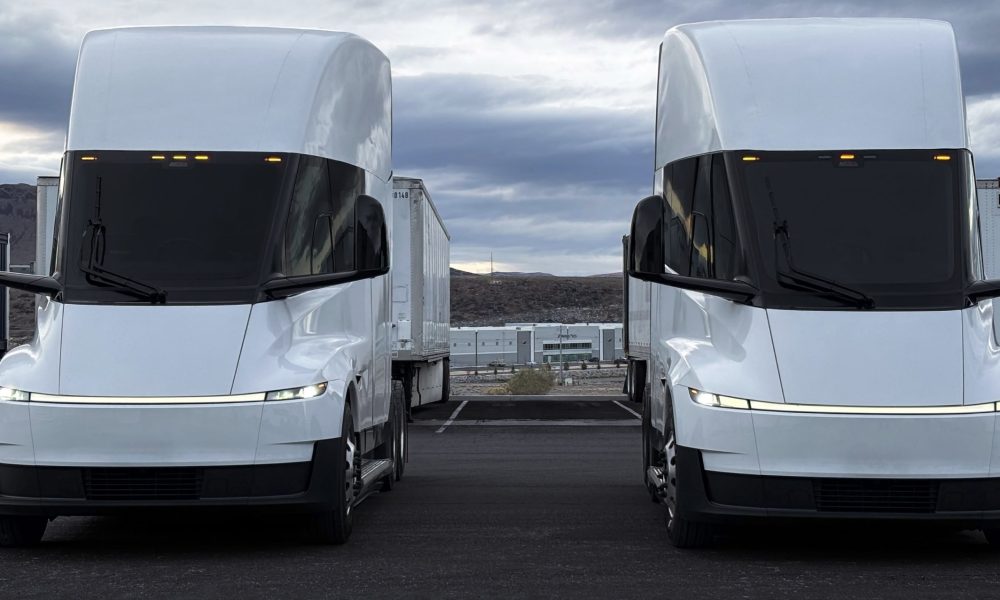
Tesla’s all-electric Semi is rapidly transforming perceptions within the heavy-duty trucking industry, moving beyond a mere concept to become a highly sought-after workhorse. A groundswell of positive feedback from professional truck drivers participating in pilot programs across North America highlights the vehicle’s profound impact on operational efficiency and driver experience.
These professionals, long accustomed to diesel rigs, are consistently praising the Tesla Semi for its unique features, which include a centrally positioned driver’s seat, expansive touchscreen visibility, immediate torque, and the complete absence of gear-shifting fatigue. These design and engineering choices are proving instrumental in making long shifts behind the wheel significantly less strenuous and more productive.

Transforming the Driver Experience: Comfort Meets Performance
The transition from traditional diesel trucks to the electric Tesla Semi marks a pivotal moment for drivers. The consensus among those who have spent extensive time operating the vehicle is clear: the Semi offers a demonstrably quieter ride, superior acceleration, and a far less physically demanding experience compared to its internal combustion counterparts. It delivers three times the power while simultaneously boasting dramatically lower operating costs, a significant advantage for logistics companies.
Drivers engaged in early pilot programs have provided glowing testimonials, underscoring the innovative design and technological prowess of the Tesla Semi. Dakota Shearer of IMC Logistics recounted an incident illustrating the Semi’s maneuverability, stating, “I backed right out of there, no problem. It’s like I’d never done it in the first place. That right there showed me that the technology the Tesla has makes a big difference.” This anecdote highlights the vehicle’s ability to simplify complex maneuvers, a critical factor in urban and tight operational environments.
Angel Rodriguez, a colleague from Hight Logistics, who transitioned from a 13-speed diesel truck, echoed similar sentiments regarding physical comfort. “It’s just easier on your body. It’s less stressful because you’re not really having to engage the clutch and the stick shift,” Rodriguez noted, emphasizing the reduction in physical exertion due to the electric powertrain.

Advanced Navigation and Unparalleled Driving Dynamics
Beyond ergonomic benefits, the Tesla Semi integrates cutting-edge technology designed to enhance every aspect of driving. Tom Sterba, a Senior Driver at Saia, expressed particular admiration for the vehicle’s navigation capabilities after extensive testing. “The navigation systems in these trucks are just unbelievable. That’s what I love about it,” he remarked, pointing to the sophistication that aids in route optimization and driver confidence.
Sterba’s overall experience left a lasting impression, culminating in a statement that has resonated widely within the trucking community: “I hope I retire in this truck.” This fervent wish from a seasoned professional speaks volumes about the superior driving environment and future potential offered by the Tesla Semi.
Feedback from other pilot programs, including those conducted with ArcBest, thyssenkrupp Supply Chain Services, and Mone Transport, consistently aligns with these observations. Drivers universally lauded the center-seat layout for its ability to eliminate traditional blind spots, the incredibly smooth and instant acceleration, and the overall heightened sense of comfort and safety provided by the electric truck.
Real-World Efficiency and Operational Superiority
The enthusiastic driver feedback is robustly supported by concrete real-world data demonstrating the Tesla Semi’s operational excellence. ArcBest, for instance, has successfully logged thousands of miles, showcasing remarkable efficiency rates even when tackling notoriously challenging routes such as Donner Pass. This performance underscores the Tesla Semi’s capability to maintain efficiency under demanding conditions, dispelling doubts about electric trucks’ viability in varied terrains.
Moreover, several fleets participating in the pilot programs have reported achieving efficiency targets that surpassed even Tesla’s own projections. This consistent outperformance highlights the intrinsic economic advantages of the electric drivetrain, primarily through reduced fuel consumption and lower maintenance requirements compared to diesel trucks.
The collective experience indicates that the Tesla Semi not only offers superior power output – triple that of conventional diesel rigs – but also promises significantly lower operating costs over its lifespan. This combination of enhanced performance and economic benefit positions the Tesla Semi as a disruptive force, poised to redefine industry standards for heavy-duty freight transport.
A Glimpse into the Future: Production Model Upgrades and Innovation
The ongoing evolution of the Tesla Semi recently captured public attention during an appearance on Jay Leno’s Garage. The segment featured Jay Leno, the first outsider to drive the updated long-range production model, alongside Tesla Chief Designer Franz von Holzhausen and Semi Program Director Dan Priestley, offering a detailed look at the enhancements slated for volume production.
Key upgrades revealed during the episode include a significant weight reduction, with the truck shedding approximately 1,000 pounds. This reduction contributes to improved efficiency and payload capacity. The vehicle now incorporates a 48-volt architecture, a more efficient electrical system that reduces wiring complexity and weight. Furthermore, the Tesla Semi adopts a fully electric steering system, leveraging Cybertruck-derived actuators for precise and responsive handling.
A critical innovation is the integration of 4680 battery cells, meticulously engineered to provide an impressive lifespan of over one million miles. This enhanced battery technology, coupled with improved aerodynamics, allows the long-haul version of the Tesla Semi to achieve a substantial 500-mile range. A shorter-wheelbase standard-range model will offer an approximate 325-mile range, catering to diverse logistical needs.
Charging infrastructure has also seen remarkable advancements. The Megachargers designed for the Tesla Semi can now deliver up to 1.2 megawatts of power, enabling the addition of roughly 300 miles of range in approximately 30 minutes. This rapid charging capability is crucial for minimizing downtime and maximizing operational uptime for fleets.
During his drive, Leno maneuvered heavy loads with ease, expressing astonishment at the vehicle’s agility and effortless power delivery. “I don’t feel like I’m pulling anything,” he exclaimed, encapsulating the transformative driving experience of the electric truck even under significant strain.
The Road Ahead for Electric Trucking
With hundreds of Tesla Semis already in operation, accumulating over 13.5 million fleet miles and demonstrating consistently high uptime, the path forward for electric heavy-duty trucking appears increasingly clear. The widespread and overwhelmingly positive reviews from truck drivers are not merely anecdotal; they represent a fundamental shift in industry sentiment.
These seasoned professionals, who are at the forefront of freight transport, are not just endorsing the Tesla Semi; they are ready to fully embrace the electric trucking industry. Their experiences validate Tesla’s vision for a sustainable, efficient, and driver-friendly future for commercial logistics, signaling a significant acceleration in the adoption of electric trucks across the continent and potentially globally.