
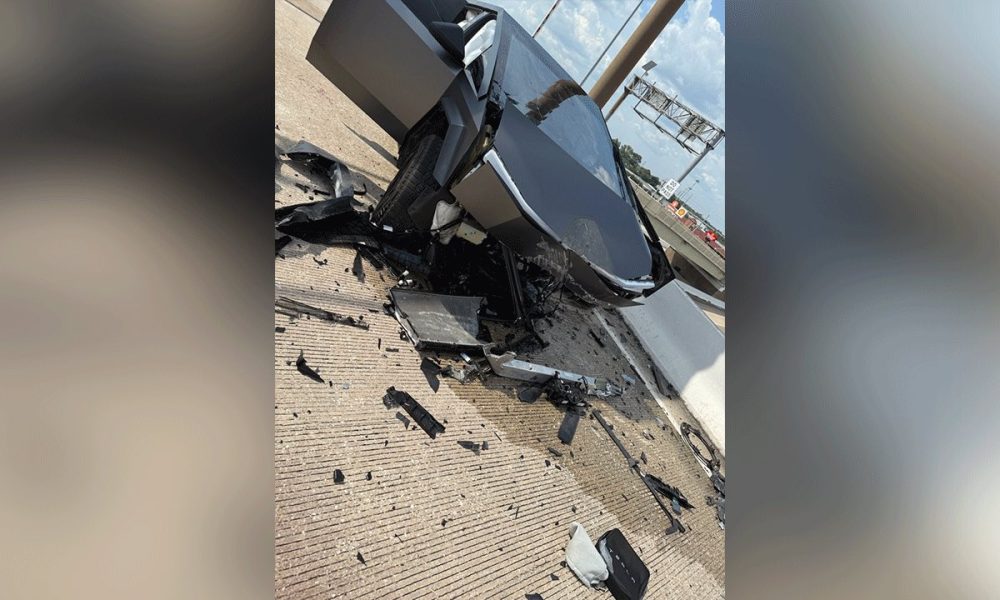
Tesla CEO Elon Musk has provided an update regarding a viral incident involving a Cybertruck, citing driver logs that reportedly indicate the driver deactivated Autopilot moments before the collision. The clarification comes amid a lawsuit filed against the automaker.
Cybertruck Accident Under Scrutiny
A video depicting a Tesla Cybertruck colliding with an overpass barrier in August 2025 gained significant attention recently. The incident led to a $1 million lawsuit from Justine Saint Amour, who is suing Tesla for liability and negligence.

In her suit, Saint Amour stated, “Something terrifying happened, without warning, the vehicle attempted to drive straight off an overpass.” Her attorney, Bob Hilliard, added that she “tried to take control, but crashed into the barrier and was seriously injured (mostly her shoulder, neck, and back).”
Tesla’s Reliance on Vehicle Data Logs
Tesla has a history of utilizing internal vehicle data logs to address accusations related to its driver-assistance systems, such as Autopilot and Full Self-Driving (Supervised). These logs record various metrics from the vehicle at the time of an incident, providing a detailed account of the events leading up to a collision.
Mainstream media outlets frequently report on Tesla vehicle accidents, often including the automaker’s name prominently in headlines. This reporting frequently leads to speculation about whether advanced driver-assistance systems were responsible for the crash.

However, Tesla maintains access to comprehensive data from its fleet. This data can confirm whether Autopilot or Full Self-Driving was active, whether the accelerator was engaged, the vehicle’s speed, and other critical factors that may have contributed to an accident.
Musk’s Statement on the Cybertruck Incident
Elon Musk addressed the specific Cybertruck incident via a post on X (formerly Twitter). He stated, “Logs show driver disengaged Autopilot four seconds before crashing.” This assertion suggests that the vehicle’s advanced driver-assistance system was not active at the precise moment of impact.
The data from the logs will likely play a crucial role in the ongoing legal proceedings. If Tesla can substantiate that Autopilot was disengaged by the driver prior to the crash, it could shift the focus of the investigation away from the vehicle’s software capabilities.
Implications for Driver Assistance Systems
The situation raises pertinent questions about driver engagement and the current limitations of Tesla’s driver-assistance technology. Even with systems like Full Self-Driving, which is still considered a supervised system, drivers are required to remain attentive and prepared to take control at all times.
The outcome of this particular case is anticipated with interest, especially given that the video released by the law firm reportedly begins approximately four seconds before the collision occurred. Previous instances have seen Tesla’s data logs contradict media reports, leading to significant scrutiny over the company’s technology and its role in accidents.
The reliance on driver logs in accident investigations highlights the ongoing debate surrounding the capabilities and responsibilities associated with advanced driver-assistance systems in modern vehicles.