
Key Takeaways for EV Charging Reliability
- The NEMA 14-50 receptacle is a critical, often overlooked component in residential and light commercial Level 2 EV charging setups.
- Unlike standard electrical devices, EV charging subjects receptacles to sustained, high-current loads and repeated use, demanding specialized design and robust materials.
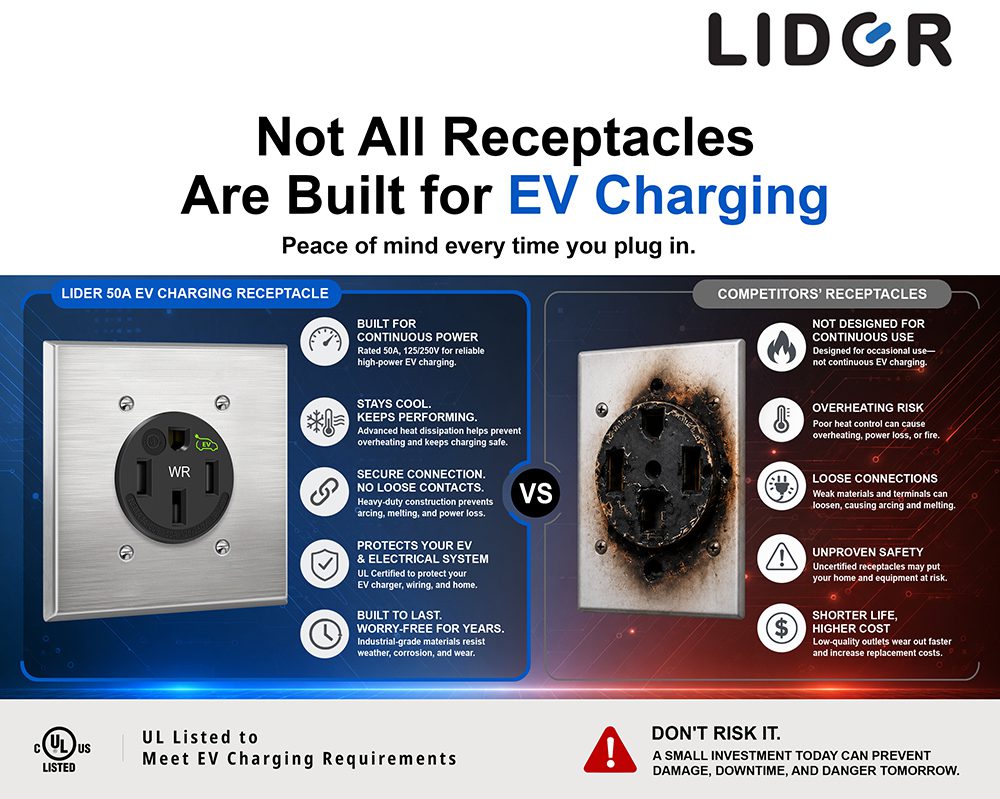
- Lider Electric’s LN-1450RH and LN-1450RHW NEMA 14-50 receptacles feature Electric Vehicle Marking and UL certification, providing clear identification for EV-specific applications.
- These specialized receptacles are engineered with fortified enclosures, silver-plated brass contacts, and secure clamping mechanisms to ensure stable power delivery and heat resistance, crucial for long-term EV charging reliability.
- Certification from reputable bodies like UL offers a documented basis for product evaluation, helping installers, builders, and EV owners make informed decisions beyond mere marketing claims.
As the adoption of electric vehicles (EVs) accelerates globally, discussions surrounding charging infrastructure often focus on high-level components such as charger output, vehicle compatibility, and grid capacity. While these systemic elements are undoubtedly crucial, the foundation of reliable EV charging frequently rests upon a seemingly modest, yet profoundly critical, physical component: the electrical receptacle.
For millions of EV owners utilizing plug-in Level 2 charging at home or in light commercial settings, the NEMA 14-50 receptacle serves as the essential connection point. It is here that the building’s electrical system interfaces with the charging equipment, a nexus where factors like wiring integrity, contact pressure, mechanical fit, thermal management, repeated usage, and installation quality converge to dictate the overall EV charging reliability.

Lider Electric has placed a significant focus on this critical juncture with its LN-1450RH and LN-1450RHW NEMA 14-50 receptacles. These models stand out due to their recent UL certification documentation, which includes a distinct Electric Vehicle Marking. This marking offers installers and consumers unequivocal identification of their suitability and certification status for EV-related applications, underscoring Lider Electric’s commitment to safety, connection reliability, and long-term charging performance.
The Unique Demands of EV Charging on Electrical Connections
Electric vehicle charging presents a fundamentally different electrical load profile compared to most household appliances. It is not a fleeting event but rather a sustained, high-current demand over several hours, often repeated daily. This constant duty cycle—plugging in, charging, unplugging, and repeating—places exceptional stress on the entire electrical pathway, particularly within residential garages, driveways, workshops, multi-family properties, and light commercial environments.
Traditional wiring devices, while suitable for intermittent use, may not be engineered to withstand the thermal and mechanical stresses imposed by continuous EV charging. This sustained demand necessitates a paradigm shift in how electrical components, especially the receptacle, are selected and evaluated for EV-related applications.
Considerations must extend beyond basic plug configuration and initial purchase price. The optimal receptacle for EV charging reliability should be rigorously assessed for its ability to manage sustained electrical load, ensure secure wiring connections, provide effective heat dissipation, and exhibit robust long-term durability under repetitive stress.
It is important to remember that the receptacle does not function in isolation. Its performance is intrinsically linked to the correct selection of circuit breakers, appropriate wire sizing, proper grounding, suitable enclosure, precise terminal torque, and strict adherence to local electrical codes by a qualified installer. However, as the physical interface where electrical power transitions into the vehicle, the receptacle’s inherent design and quality are paramount to the entire charging setup.
Engineering for Sustained EV Charging Performance
Lider Electric’s design philosophy for its NEMA 14-50 receptacles is rooted in a deep understanding of actual EV charging usage patterns. The LN-1450RH and LN-1450RHW models are specifically engineered for installations where consistent, long-duration charging performance is a non-negotiable requirement for optimal EV charging reliability.
These receptacles are rated at 50A, 125/250V, and prioritize several key design features:
- Reliable Power Delivery: Ensuring a stable and consistent electrical flow at the connection point.
- Heavy-Duty Construction: Built to withstand the rigors of frequent use and high current.
- Secure Connections: Maintaining optimal contact under sustained electrical load, minimizing resistance and heat generation.
- Enhanced Thermal Management: Contacts are designed to support heat resistance during extended charging sessions.
- Clear Product Identification: Featuring Electric Vehicle Marking for unambiguous suitability in EV applications.
This meticulous attention to detail is critical in a market where products may appear superficially similar online. While two receptacles might share the same physical configuration, significant differences often exist in their internal construction, contact design, material selection, terminal strength, and crucially, their certification status. These underlying engineering distinctions directly influence the confidence with which a product can be chosen for an EV-ready electrical upgrade, impacting its contribution to overall EV charging reliability.
Inside the Engineering: Components for Durability
Lider Electric’s commitment to robust design for EV charging reliability is evident in the internal components chosen for its receptacles. These elements are specifically selected to support stable connection performance under sustained use:
- Fortified Nylon Enclosure: Reinforced with glass fibers, this enclosure provides superior durability, heat resistance, and wear resistance, crucial for the demanding environment of EV charging.
- Silver-Plated Solid H65 Brass Contacts: These contacts are engineered for optimal conductivity and enhanced resistance to oxidation, ensuring efficient power transfer and longevity.
- V-Shaped High-Purity ETP Copper Clamp: With a copper purity of ≥ 99.9%, this clamp design securely holds both stranded and solid wires, preventing loosening and maintaining a stable connection over time.
- Max 75 lb-in Torque Hexagon Terminal Screws: These robust screws are designed to facilitate secure installation, provided they are tightened according to applicable requirements and professional electrical practices.
- Self-Grounding Design: Aids in establishing a reliable ground path when the device is properly installed, enhancing safety.
- Electric Vehicle Marking: This distinctive marking facilitates clearer product identification specifically for EV-related applications, streamlining selection and inspection processes.
Each of these engineering choices reinforces the foundational principle guiding the broader product design: that superior EV charging reliability begins with the uncompromising quality of the physical electrical connection.
The Critical Distinction: Claims Versus Certification
The burgeoning EV charging market has seen a proliferation of products, many of which claim to meet applicable industry standards. However, a fundamental and critical distinction exists between a manufacturer’s self-declared claim and a product that has successfully completed a rigorous, independent certification process. This difference is paramount for ensuring EV charging reliability and safety.
In practical terms, independent certification provides installers, inspectors, and end-users with a documented, unbiased basis for product evaluation. This documentation becomes a reliable reference point, confirming that the product has undergone specified testing and meets established safety and performance criteria, provided the certification reference aligns with an authorized UL Mark and its scope.
For homeowners embarking on EV-ready upgrades, commercial property managers, electricians, contractors, and builders, this distinction is invaluable. UL certification offers a transparent benchmark, allowing purchasing decisions to be grounded in verified performance rather than solely on marketing assertions. It instills confidence in the components chosen for residential and commercial EV projects, contributing directly to long-term EV charging reliability and safety.
For Lider Electric’s LN-1450RH and LN-1450RHW, the latest certification documentation explicitly identifies them as NEMA 14-50 receptacles with Electric Vehicle Marking. This marking signifies that the receptacles have been specifically evaluated under UL certification requirements for EV-related use. It is far more than a mere label; it serves as a practical, unambiguous product identification tool in a category where clarity and verified performance are increasingly vital for maintaining robust EV charging reliability.
According to the UL Certificate of Compliance, representative samples of Lider Electric’s LN-1450RH-** and LN-1450RHW-** underwent evaluation by UL in accordance with the Standards indicated on the Certificate. For the U.S. Listing, the certificate explicitly references “UL 498 – Attachment Plugs and Receptacles.” The Models section further specifies “LN-1450RH-** Electric Vehicle Marking – Suitable for USL only” and “LN-1450RHW-** Electric Vehicle Marking – Suitable for USL only.”
Lider Electric has offered further insights into its certification journey in its UL certification announcement and its EV Marking Article, elaborating on how official documentation reinforces clearer product identification for EV-specific applications.
Implications for the Field: Ensuring Future-Ready EV Infrastructure
The implications of this focused engineering and clear certification extend across the entire ecosystem of EV adoption:
For Electricians and Installation Professionals
Clear product identification, such as the Electric Vehicle Marking, significantly supports more consistent specification and selection practices. When a receptacle is explicitly marked and documented for EV-related use, it provides installers with an additional, crucial reference point during the planning and execution of charging setups. This clarity helps minimize errors, streamline inspections, and ultimately enhance the EV charging reliability of every installation.
For Builders and Property Managers
As EV readiness rapidly transitions from a luxury to a standard expectation, it is becoming an integral part of long-term property planning and valuation. Selecting components that are purpose-built and certified for the unique demands of EV charging behavior allows for the development of more future-ready electrical projects. This foresight ensures infrastructure can reliably support the growing number of electric vehicles, adding value and convenience.
For EV Owners
The message for electric vehicle owners is straightforward yet profound: dependable charging begins long before the charging cable is plugged into the car. It originates with the integrity of the underlying electrical pathway, the precision and quality of the installation, and fundamentally, the inherent reliability of the receptacle serving as the primary connection point. Investing in robust, certified components is an investment in long-term peace of mind and consistent EV charging reliability.
Building Towards a More Demanding Charging Future
As the global fleet of electric vehicles expands, so too must the expectations for the quality and resilience of the charging infrastructure. While factors such as charging speed and convenience will remain paramount, the foundational quality of the components integrated behind the wall will increasingly determine the overall user experience and system longevity. Though the receptacle may appear a minor component compared to the sophisticated charger or the vehicle itself, its role in supporting daily charging performance is undeniably significant.
Lider Electric’s NEMA 14-50 receptacles with Electric Vehicle Marking—the LN-1450RH and LN-1450RHW—embody this forward-thinking approach. They are meticulously designed for EV charging environments where connection reliability, unambiguous product identification, secure installation, and unwavering long-term performance are not merely desired, but essential for sustained EV charging reliability.
For readers evaluating NEMA receptacle options for their EV-ready projects, Lider Electric provides a comprehensive overview through the LIDER NEMA receptacle collection. Model-specific details can be reviewed on the LN-1450RH product page or the LN-1450RHW product page. For those preferring marketplace purchasing, the LN-1450RHW is also available on Amazon.
Ultimately, robust and reliable power delivery commences at the fundamental connection point. For Lider Electric, this understanding is the bedrock upon which thoughtful and durable EV charging design is built, ensuring a safer and more dependable future for electric mobility.
Frequently Asked Questions About EV Charging Receptacles
Q1: Why is the NEMA 14-50 receptacle so important for EV charging?
The NEMA 14-50 receptacle is the standard connection point for many Level 2 EV chargers in homes and businesses. It’s crucial because it’s where the building’s electrical system meets the EV charger, handling sustained high currents over many hours, demanding specific design for safety and EV charging reliability.
Q2: How is an EV-specific NEMA 14-50 receptacle different from a standard one?
An EV-specific NEMA 14-50 receptacle, like those from Lider Electric, is engineered for the unique demands of continuous, high-current EV charging. This includes features like reinforced enclosures, enhanced heat resistance in contacts, robust terminal connections, and often a dedicated Electric Vehicle Marking, distinguishing it from general-purpose receptacles.
Q3: What does ‘Electric Vehicle Marking’ signify on a receptacle?
Electric Vehicle Marking indicates that the receptacle has been specifically evaluated and certified under UL requirements for EV-related use. This marking provides clear product identification, assuring installers and consumers that the device meets stringent standards for sustained EV charging applications, enhancing EV charging reliability and safety.
Q4: Why is UL certification critical for EV charging receptacles?
UL certification provides an independent, documented verification that a product meets established safety and performance standards. For EV charging receptacles, it assures that the device can safely handle sustained electrical loads and repeated use, offering a reliable benchmark beyond marketing claims for ensuring long-term EV charging reliability.
Q5: What are the key engineering features in Lider Electric’s EV charging receptacles?
Lider Electric’s LN-1450RH and LN-1450RHW receptacles feature a fortified nylon enclosure, silver-plated solid H65 brass contacts for conductivity, a V-shaped high-purity ETP copper clamp for secure wiring, and high-torque terminal screws. These components are chosen to support durability, heat resistance, and stable connection performance for optimal EV charging reliability.
Q6: Does the receptacle’s quality impact overall EV charging safety?
Absolutely. A low-quality or improperly installed receptacle can lead to overheating, poor electrical contact, fire hazards, and reduced charging efficiency. Choosing a purpose-built, certified receptacle is a critical step in ensuring the overall safety and consistent EV charging reliability of your charging setup, protecting both your vehicle and property.