
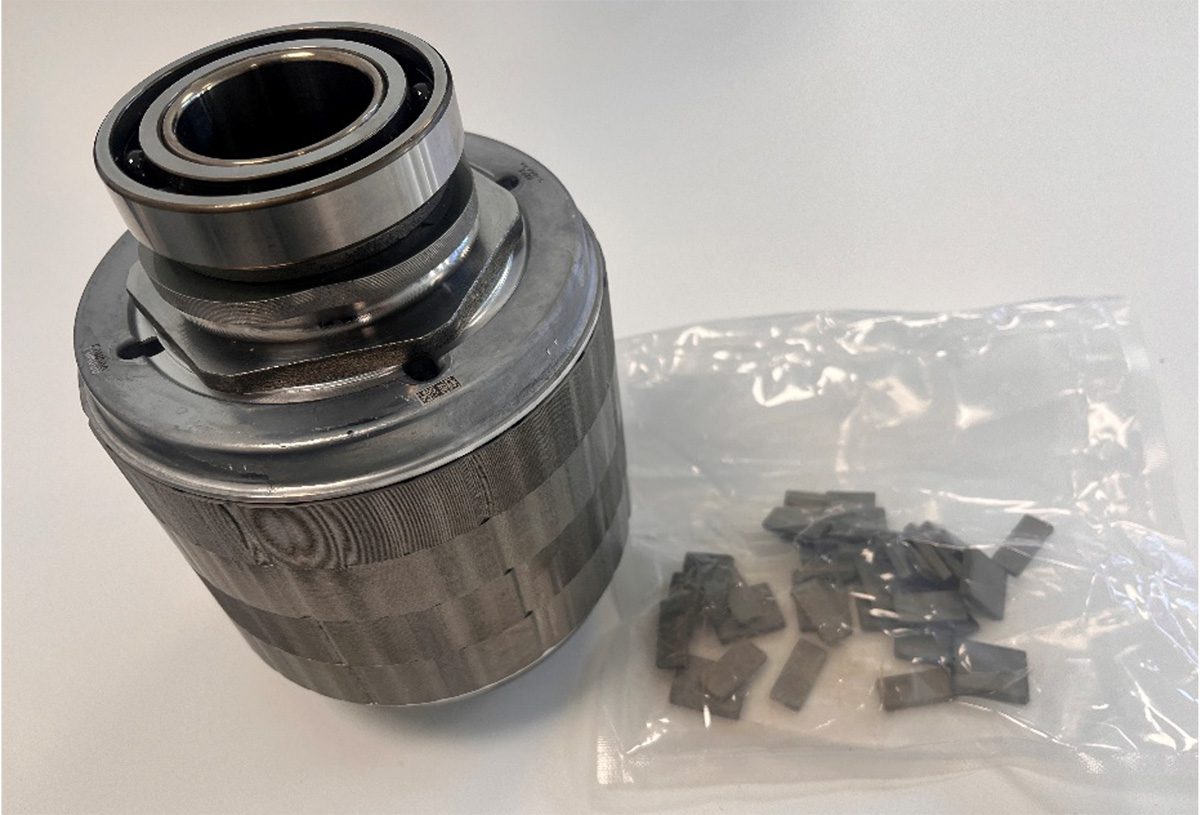
In a significant stride towards sustainable automotive manufacturing, a UK consortium has successfully established an end-to-end circular supply chain for electric vehicle (EV) motor magnets made entirely from recycled rare earth materials. The groundbreaking initiative culminates with Ford Motor Company validating the performance of these 100% recycled rare earth magnets at its advanced Research & Development facility in Dunton, UK.
This achievement marks a pivotal moment for the global automotive industry, particularly as it grapples with increasing demand for EVs and the associated challenges of securing critical raw materials. The validation by a major automaker like Ford underscores the commercial viability and performance reliability of magnets produced through this innovative recycling process.

Key Takeaways
- A UK consortium has established a fully circular supply chain for EV motor magnets using 100% recycled rare earth materials.
- Ford has rigorously validated a test rotor built with these recycled rare earth magnets, confirming their durability and performance equivalence to virgin materials.
- The initiative addresses critical supply chain vulnerabilities for heavy rare earth elements, particularly dysprosium and terbium, crucial for EV traction motors.
- Ionic Technologies achieved high purity levels (Nd₂O₃ at 99.87%, Dy₂O₃ at 99.56%, Tb₄O₇ at 99.75%) from 100% recycled feedstock.
- The project received significant funding and support from the UK Government, with plans for a large-scale commercial plant underway.
- This breakthrough sets a new precedent for sustainable manufacturing practices within the electric vehicle sector.
Establishing a Circular Economy for EV Magnets
The consortium’s work delineates a clear pathway for a closed-loop system for EV motor production. The process began with Ionic Technologies, a Belfast-based subsidiary of Australia’s Ionic Rare Earths (ASX: IXR), which played a crucial role in extracting and separating rare earth oxides from scrap neodymium-iron-boron (NdFeB) magnets and alloy.
Following this initial recycling phase, Less Common Metals (LCM) took the purified rare earth oxides and transformed them into metal and strip-cast alloy, meticulously adhering to precise magnet specifications. This critical step ensures that the recycled materials possess the exact metallurgical properties required for high-performance applications.
The next stage involved GKN, which manufactured the finished magnets at its facility in Radevormwald, Germany. Throughout the manufacturing process, GKN reported that the recycled alloy flakes behaved identically to virgin material, producing magnets that met the same rigorous end specification standards.
Ford then integrated these recycled rare earth magnets into two test rotors, built at its Halewood e-motor plant. One of these rotors underwent an exhaustive durability test cycle on a dynamometer at Ford’s Dunton R&D facility. Remarkably, the test results were comparable to rotors constructed with production-grade magnets made from newly mined materials, signaling a significant technological achievement for recycled rare earth magnets.
Rigorous Purity and Performance Validation
The success of this circular supply chain hinges on the exceptional purity of the recovered rare earth elements. Ionic Technologies’ processes yielded neodymium oxide (Nd₂O₃) at an impressive 99.87% purity, dysprosium oxide (Dy₂O₃) at 99.56%, and terbium oxide (Tb₄O₇) at 99.75%. These high purity levels, all derived from 100% recycled feedstock, are crucial for maintaining the performance characteristics required for advanced EV motors.
The batch volumes involved in this project were also substantial, exceeding Less Common Metals’ minimum batch requirements. The consortium processed 120 kg of Nd₂O₃, 10 kg of Dy₂O₃, and 8 kg of Tb₄O₇, demonstrating the scalability of the recycling process for critical EV components.
Dennis Witt, UK Innovation Manager at Ford, highlighted the significance of the validation process. He stated, “Electric vehicle motors rely on high quality rare earth permanent magnets. We proved that recycled magnets can meet our rigorous commercial standards on the first attempt.” This endorsement from a leading automotive manufacturer underscores the readiness of these recycled rare earth magnets for industrial application.
Addressing Global Supply Chain Vulnerabilities
The development of a robust, circular rare earth supply chain is particularly pertinent given the current geopolitical landscape. Recent export controls on rare earth materials announced by China, a dominant global supplier, have intensified focus on the resilience and diversification of Western automotive supply chains.
Dysprosium and terbium, both successfully produced from recycled scrap in this project, are heavy rare earth elements. These elements are especially affected by such controls due to their critical role in ensuring high-temperature coercivity in EV traction motor magnets. Without these specific elements, the performance and efficiency of EV motors, particularly under demanding operating conditions, can be compromised.
By establishing a domestic UK-based circular economy for these vital materials, the consortium’s work directly mitigates supply chain risks. This strategic independence enhances resource security for manufacturers like Ford, fostering greater stability in EV production and reducing reliance on potentially volatile international markets for raw materials, especially for components utilizing recycled rare earth magnets.
Government Backing and Future Commercialization
The foundational work for this project was financially supported under the UK Government’s CLIMATES initiative, with contributions from the Department for Business and Trade and InnovateUK. This government backing highlights a national commitment to fostering innovation in critical materials and sustainable manufacturing.
While the current achievement focuses on proof-of-concept and validation, the consortium is already looking towards large-scale commercialization. Ionic Technologies is actively working towards a Final Investment Decision for an ambitious £85 million commercial plant slated for Queen’s Island in Belfast. The proposed facility has already secured an offer in principle for a substantial £12 million UK government capital grant.
This future plant is designed to have an impressive annual capacity of 400 metric tonnes of magnet rare earth oxides (REOs), signifying a major step towards making recycled rare earth magnets a significant part of the global supply. Furthermore, a follow-on project, named CirculaREEconomy, is already underway with the same partners. This initiative is funded through the Advanced Propulsion Centre UK’s £2 billion DRIVE35 programme, underscoring continued investment and commitment to advancing sustainable propulsion technologies.
Implications for Sustainable EV Manufacturing
The successful validation of 100% recycled rare earth magnets by Ford carries profound implications for the future of sustainable EV manufacturing. It demonstrates that performance-critical components can be produced with significantly reduced environmental impact, moving away from virgin material extraction.
This circular approach not only addresses environmental concerns related to mining and processing rare earth elements but also contributes to the overall sustainability goals of automakers. Integrating recycled rare earth magnets into production lines can lead to a lower carbon footprint for electric vehicles, appealing to environmentally conscious consumers and supporting broader global climate objectives.
As the automotive industry accelerates its transition to electrification, the demand for rare earth elements is set to skyrocket. Innovations like this, focusing on efficient recycling and closed-loop material flows, are indispensable for ensuring that this transition is both economically viable and ecologically responsible. The pioneering work of this UK consortium and Ford sets a benchmark for resource efficiency and supply chain resilience in the rapidly evolving EV landscape.
FAQ Section
What are recycled rare earth magnets?
Recycled rare earth magnets are permanent magnets for electric vehicle motors and other applications, manufactured using rare earth elements (like neodymium, dysprosium, and terbium) recovered from discarded magnets or manufacturing scrap, rather than relying on newly mined raw materials.
Why are recycled rare earth magnets important for electric vehicles?
They are crucial for reducing the environmental impact of EV production, enhancing supply chain security by decreasing reliance on virgin rare earth mining, and mitigating geopolitical risks associated with concentrated global rare earth supplies. This supports more sustainable and resilient EV manufacturing.
Which companies are involved in this UK consortium?
The consortium includes Ionic Technologies (a subsidiary of Ionic Rare Earths) for recycling, Less Common Metals (LCM) for converting oxides to alloy, GKN for magnet manufacturing, and Ford for building and validating the test rotors in EV motors.
Did the recycled magnets perform as well as new ones in testing?
Yes, Ford’s rigorous durability tests on a dynamometer showed that rotors built with these 100% recycled rare earth magnets performed comparably to those made with production-grade magnets using virgin, mined materials, meeting stringent commercial standards.
How pure were the recycled rare earth oxides produced?
Ionic Technologies successfully produced neodymium oxide (Nd₂O₃) at 99.87% purity, dysprosium oxide (Dy₂O₃) at 99.56%, and terbium oxide (Tb₄O₇) at 99.75%, all from 100% recycled feedstock, demonstrating high material quality.
What is the future outlook for commercializing this technology?
Ionic Technologies plans to build an £85 million commercial plant in Belfast with a capacity of 400 metric tonnes of magnet rare earth oxides per year. A follow-on project, CirculaREEconomy, also signals continued investment and development in this area.
How does this initiative address rare earth export controls?
By establishing a domestic, circular supply chain for critical heavy rare earth elements like dysprosium and terbium, the project reduces the UK automotive sector’s vulnerability to international export controls and supply disruptions, enhancing national resource security.
What is the role of government funding in this project?
The UK Government, through initiatives like CLIMATES and the Advanced Propulsion Centre UK’s DRIVE35 programme, has provided significant funding and grants. This demonstrates a strategic commitment to fostering innovation in sustainable manufacturing and securing critical materials for the nation’s industrial future.