
Key Takeaways:
- Hyundai Mobis has successfully developed a 160 kW Power Electric (PE) system designed as a universal platform model, offering unprecedented versatility to global automakers.
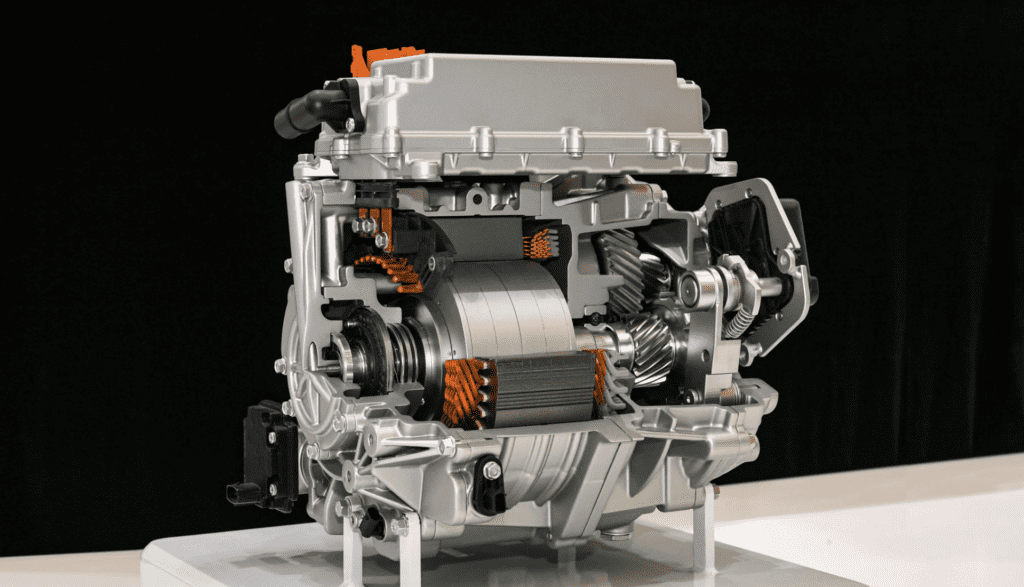
- The new EV drive system integrates the motor, inverter, and reduction gear into a single, compact unit, providing up to 215 horsepower.
- Significant engineering advancements have led to a 16% improvement in specific power and a nearly 20% reduction in overall system volume compared to previous designs.
- This innovative modular approach allows for broad scalability across various vehicle classes, fundamentally shifting from traditional component-specific co-development models.
- The 160 kW system complements Hyundai Mobis’s existing 250 kW high-performance unit and an upcoming 120 kW model, establishing a comprehensive EV powertrain lineup.
Hyundai Mobis Revolutionizes EV Powertrains with Advanced 160 kW System
In a significant stride for electric vehicle (EV) technology, Hyundai Mobis has announced the completion of its groundbreaking 160 kW Power Electric (PE) system. This state-of-the-art EV drive system is not merely an incremental upgrade but a strategically developed universal platform model, poised to redefine how global original equipment manufacturers (OEMs) approach EV powertrain integration.

Unlike conventional systems tailored for specific vehicle programs, Hyundai Mobis’s latest innovation is standardized, making it readily adaptable for diverse global OEM customers. This forward-thinking design marks a pivotal moment in the industry, promising enhanced flexibility and efficiency for automakers worldwide as they accelerate their transition to electric mobility.
The 160 kW PE System: A New Benchmark in EV Drive Technology
At the core of this advancement is a highly integrated PE system that seamlessly combines three essential components: the electric motor, the inverter, and the reduction gear, all within a single, cohesive unit. This integrated design is critical for optimizing space and performance in modern electric vehicles.
The newly developed 160 kW EV drive system is engineered to deliver robust performance, generating an impressive 215 horsepower (HP). Hyundai Mobis highlights that this power output is more than sufficient to meet the demands of the vast majority of EVs currently in mass production, positioning it as a highly versatile solution for the burgeoning electric car market.

Engineering Innovations Driving Efficiency and Compactness
The breakthroughs achieved in this 160 kW EV drive system are substantial. Compared to the company’s previous generations, the specific power—a crucial metric representing output per unit weight—has seen an impressive improvement of approximately 16%. Simultaneously, the overall system volume has been significantly reduced by nearly 20%.
These remarkable gains are the direct result of several sophisticated engineering strategies. A key factor is the adoption of a modular design, which allows for greater flexibility and simplifies manufacturing processes. Furthermore, the standardization of critical components plays a vital role in achieving consistent quality and performance across units.
A novel motor cooling structure is another innovation that contributes to the system’s enhanced efficiency and compact form factor. By effectively managing heat, the new design allows for more power density without compromising reliability or lifespan. This holistic approach ensures that the EV drive system operates optimally even under demanding conditions.
For vehicles requiring even greater power, the system’s modularity allows for two units to be deployed—one in the front and one in the rear—effectively doubling the total output to a formidable 320 kW. This scalability underscores the system’s adaptability to a wide range of vehicle types, from standard passenger cars to more performance-oriented models. The underlying power module itself is constructed using high-efficiency power semiconductors, which are fundamental to achieving superior energy conversion and reduced power loss.
Universal Platform Approach: A Strategic Shift in Automotive Development
The true innovation behind Hyundai Mobis’s new PE system lies in its revolutionary platform approach. This strategy centers on standardizing three core components across its product lineup: the drive motor stator, the inverter, and the power module. By doing so, the same foundational architecture can be scaled and adapted across various vehicle classes without necessitating a complete redesign of the powertrain for each new program.
This methodology represents a significant departure from how global automakers have traditionally operated. Historically, OEMs and individual suppliers would often engage in co-development efforts to create component-specific systems, a process that can be time-consuming, resource-intensive, and less flexible. The universal platform model, conversely, offers a streamlined solution that accelerates development cycles and reduces costs for manufacturers.
For automakers, this means a simplified integration process, allowing them to focus more on vehicle design, performance tuning, and market differentiation rather than extensive powertrain development. The standardized nature of the EV drive system also promises greater reliability and easier maintenance, as components are designed for interoperability and consistent performance across a broader fleet.
Expanding the EV Powertrain Portfolio for Global Markets
The 160 kW EV drive system is a crucial piece of Hyundai Mobis’s broader strategy to establish a comprehensive portfolio of electric powertrains. The company is actively developing a range of solutions to cater to the diverse needs of the global EV market, from compact urban mobility to high-performance luxury vehicles.
Last year, Hyundai Mobis successfully completed a 250 kW high-performance PE system, demonstrating its capability to produce powerful solutions for top-tier EVs. Building on this, the company plans to complete a 120 kW model in the first half of 2026. This smaller, more cost-effective unit is specifically targeting compact vehicles and emerging markets, where minimized size, weight, and cost are paramount.
With the 120 kW, 160 kW, and 250 kW systems, Hyundai Mobis will offer a complete spectrum of EV drive systems, covering virtually every segment of the electric vehicle market. This diversified lineup positions the company as a leading global supplier, capable of meeting the evolving demands of various automakers and consumer preferences across different regions.
Global Market Implications and Future Outlook
The development of this modular and scalable EV drive system holds significant implications for the global automotive industry. By offering standardized, high-performance, and efficient powertrain solutions, Hyundai Mobis is empowering OEMs to expedite their electrification strategies and bring new EV models to market more quickly and affordably.
The company has already reported significant interest from overseas customers, a clear indicator of the market’s recognition of the value proposition offered by these advanced PE systems. This strong international demand underscores the universal applicability and competitive advantage of Hyundai Mobis’s innovative approach to EV component development.
As the automotive industry continues its rapid shift towards electrification, partnerships with forward-thinking suppliers like Hyundai Mobis become increasingly vital. Their commitment to innovation in the EV drive system and powertrain technology is not only strengthening their own market position but also playing a crucial role in accelerating the global transition to sustainable mobility. This development solidifies Hyundai Mobis’s expertise and authority in advanced EV engineering.
Frequently Asked Questions (FAQ)
What is the core innovation of Hyundai Mobis’s new EV drive system?
The primary innovation is a 160 kW Power Electric (PE) system designed as a universal platform. It integrates the motor, inverter, and reduction gear into a single unit, offering standardized components for multiple global OEM customers instead of being built for a specific vehicle model.
How does this new system improve efficiency and compactness?
The system achieves about a 16% improvement in specific power (output per unit weight) and nearly a 20% reduction in overall volume. These gains stem from a modular design, standardized core components, a new motor cooling structure, and the use of high-efficiency power semiconductors.
What power output does the 160 kW system deliver, and what kind of vehicles is it suitable for?
The 160 kW EV drive system delivers up to 215 horsepower. Hyundai Mobis states this is sufficient for most EVs currently in mass production, making it a versatile solution for a wide range of electric passenger vehicles.
How does Hyundai Mobis’s platform approach differ from traditional development methods?
Traditionally, automakers co-developed component-specific systems with individual suppliers. Hyundai Mobis’s platform approach standardizes key components (drive motor stator, inverter, power module) allowing the same architecture to scale across various vehicle classes without a full powertrain redesign per program, streamlining development.
What other EV powertrain systems does Hyundai Mobis offer or plan to offer?
Hyundai Mobis completed a 250 kW high-performance PE system last year. They also plan to complete a 120 kW model in the first half of 2026, targeting compact vehicles and emerging markets. This range will allow them to cover small mobility to high-performance EVs.
Why is a universal platform model significant for global automakers?
A universal platform model offers global automakers greater flexibility, reduced development costs, and faster time-to-market for new EV models. It simplifies the integration process and allows them to source standardized, high-performance EV drive systems for diverse vehicle lineups, accelerating their electrification strategies.
Source: Hyundai Motor Group Newsroom