
Key Takeaways
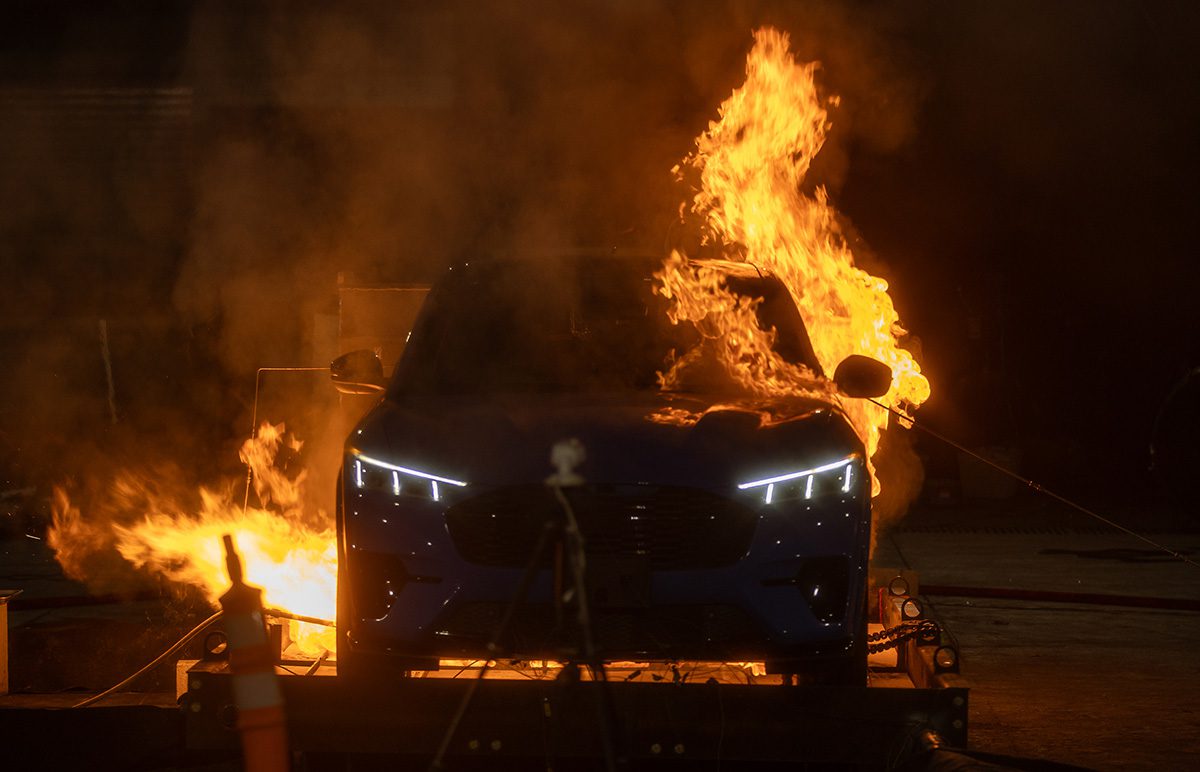
- UL Research Institutes conducted full-scale burns of 18 EVs to inform new fire safety guidelines.
- EV and traditional Internal Combustion Engine (ICE) vehicle fires show similar growth rates, peak sizes, and durations.
- Water remains the most effective suppression agent for cabin fires and controlling flames, even if it doesn’t halt battery thermal runaway.
- EV fire blankets can control flaming but pose an explosion hazard due to gas accumulation, making them unsuitable as a sole suppression method.
- Firefighters must always use full personal protective equipment (PPE) and self-contained breathing apparatus (SCBA) during EV fire incidents.
- A new EV Fire Tactical Decision Aid has been developed to enhance fireground decision-making for these incidents.
As the global automotive landscape rapidly shifts towards electrification, ensuring the safety of electric vehicles (EVs) remains a paramount concern for both consumers and emergency services. A groundbreaking study by the UL Research Institutes’ Fire Safety Research Institute (FSRI) has delivered crucial insights into electric vehicle fire safety and suppression tactics, offering invaluable guidelines for first responders worldwide. The comprehensive report, titled “Full-Scale Electric Vehicle Fire Experiments and Recommendations for Fire Incident Response,” details an extensive research initiative involving the deliberate burning of 18 electric vehicles.
This landmark research aims to bridge the knowledge gap concerning EV fires, providing firefighters with the necessary tools and understanding to effectively manage these incidents. The findings offer a clearer perspective on the similarities and differences between EV fires and those involving traditional internal combustion engine (ICE) vehicles, thereby enhancing preparedness and operational safety for emergency personnel dealing with high-voltage battery incidents.
Rigorous Methodology: Full-Scale EV Fire Experiments
To generate robust data on electric vehicle fire safety, UL Research Institutes undertook an ambitious experimental program. Researchers conducted full-scale burn tests on a total of 18 electric vehicles, meticulously documenting fire dynamics and suppression efficacy. This rigorous methodology allowed for direct observation of how EV fires initiate, spread, and respond to various intervention strategies, providing a realistic assessment of challenges faced by fire departments.
The experiments were divided into two main phases. Initially, nine EVs underwent ‘free burns,’ meaning these tests were conducted without any active fire suppression efforts. This phase was critical for understanding the intrinsic characteristics of EV fires, including their growth rates, peak heat release, and overall duration, establishing a baseline for comparison with ICE vehicle fires. The data from these free-burn experiments offered vital clues into the inherent risks associated with battery fires and thermal runaway events.
Following the free-burn phase, another nine EVs were subjected to experiments designed to evaluate common fire suppression tactics. These included the application of water only, the deployment of specialized EV fire blankets, and the use of water enhanced with an added suppression agent. Each EV was fully charged prior to the tests, and battery fires were intentionally initiated using a propane burner. To simulate real-world emergency scenarios, fires were allowed to grow for six minutes before any suppression efforts began. This six-minute delay accurately replicates the standard fire response time observed across North America, ensuring the research’s practical relevance for first responders.
Key Findings on EV Fire Dynamics and Suppression
The extensive testing yielded several pivotal findings that significantly advance the understanding of electric vehicle fire safety and guide effective response protocols. These insights are critical for fire departments adapting to the increasing prevalence of EVs on roadways.
Similarities with Internal Combustion Engine Vehicle Fires
One of the most significant revelations from the free-burn experiments was the notable similarity between EV and ICE vehicle fires. Data indicated that both types of vehicle fires share comparable characteristics in terms of fire growth rate, peak fire size, and overall fire duration. This finding is crucial as it suggests that many foundational principles of vehicle fire suppression, familiar to firefighters, remain applicable to electric vehicle incidents. While the fuel source differs, the immediate visual progression and intensity of the cabin fire can appear strikingly similar, reducing the need for entirely novel initial assessment protocols.
The Efficacy of Water-Based Suppression
For the majority of EV fire incidents, the study confirmed that water remains a highly effective and primary tool for firefighters. Water can be effectively used to suppress the cabin fire, limit exposure to adjacent vehicles or structures, and control the flaming associated with thermal runaway. While the research unequivocally showed that none of the tested suppression techniques, including copious amounts of water, could halt thermal runaway once it commenced, water proved invaluable in managing the visible fire and its immediate hazards. Furthermore, the experiments demonstrated that adding a suppression agent to water offered no discernible advantage over water alone, simplifying the recommendation for standard operational procedures.
Caution Advised for EV Fire Blankets
While often considered a potential solution, the research highlighted that EV fire blankets should be used with significant caution. Though effective in controlling visible vehicle flaming, researchers observed a critical safety concern: an explosion hazard can occur when flammable gases accumulate underneath a deployed EV fire blanket. This accumulation poses a serious risk to firefighters, indicating that blankets should not be considered a standalone replacement for water-based suppression. Instead, if used, they must be part of a carefully considered strategy that addresses the potential for gas build-up and ensures continued cooling and monitoring.
Non-Negotiable Personal Protective Equipment Requirements
Emphasizing firefighter safety, the report unequivocally states that full personal protective equipment (PPE) and self-contained breathing apparatus (SCBA) are required throughout any EV fire incident. The nature of EV fires, including the potential release of toxic gases and the inherent high-voltage risks, necessitates robust protection for all personnel on the fireground. This reinforces existing safety protocols but underscores their critical importance in the context of electric vehicle emergencies.
Enhancing Fireground Decision-Making and First Responder Preparedness
Beyond the core findings, the UL Research Institutes team has developed practical resources to aid firefighters. The full report provides detailed considerations, offering nuanced advice on various aspects of EV fire response. Crucially, the team also introduced an EV Fire Tactical Decision Aid. This step-by-step tool is specifically designed to assist fire incident commanders and crews in analyzing situations, developing effective strategies, and improving fireground decision-making in real time. Such a resource is vital for standardizing response protocols and ensuring consistent safety across different fire departments.
Adam Barowy, Principal Research Engineer for the Fire Safety Research Institute, underscored the significance of the work. “This research moves us closer to understanding how batteries change the fire environment and helps equip first responders to adequately address fires involving this new source of fuel,” Barowy stated. He further added, “Our findings demonstrate that when it comes to EVs, first responders can effectively manage the hazard with familiar tools and tactics.” His statement offers reassurance that while EV technology presents new challenges, existing firefighting expertise, combined with updated guidelines, can effectively mitigate risks.
The Future of Electric Vehicle Fire Safety
The proliferation of electric vehicles necessitates a proactive approach to emergency response. This comprehensive study by UL Research Institutes’ Fire Safety Research Institute represents a critical step forward in understanding electric vehicle fire safety. By rigorously testing various scenarios and documenting findings, the research not only informs but also empowers first responders with actionable intelligence and practical tools. The insights gained from burning 18 EVs provide a foundation for developing robust training programs and updating standard operating procedures, ensuring that fire departments are well-prepared to tackle the challenges of a rapidly electrifying world. This commitment to ongoing research and development is crucial for maintaining public safety and confidence in EV technology.
Frequently Asked Questions (FAQ)
What was the primary goal of the UL Research Institutes’ study?
The primary goal was to examine the differences and similarities between gas-vehicle and electric vehicle fires through full-scale burn experiments. This research aimed to develop comprehensive guidelines and recommendations for firefighters responding to EV fire incidents, enhancing overall electric vehicle fire safety protocols.
How many electric vehicles were involved in the burn experiments?
UL Research Institutes conducted full-scale burn experiments on a total of 18 electric vehicles. Nine vehicles were subjected to ‘free burns’ without suppression, while another nine were used to evaluate various fire suppression tactics, providing extensive data for analysis.
Are EV fires fundamentally different from traditional vehicle fires?
The study found that EV and Internal Combustion Engine (ICE) vehicle fires are similar in their fire growth rate, peak fire size, and fire duration. While the fuel source differs, the visual and physical progression of the cabin fire can be comparable, allowing for some shared response strategies.
Is water an effective agent for suppressing EV fires?
Yes, for most EV fire incidents, water can effectively suppress the cabin fire, limit exposures, and control visible flaming from thermal runaway. Although water does not halt thermal runaway once it begins, it is crucial for managing the immediate hazards and protecting surrounding areas.
What is the recommendation regarding EV fire blankets?
EV fire blankets should be used with caution. While they can control vehicle flaming, researchers observed a potential explosion hazard due to the accumulation of flammable gases underneath. Blankets should not be considered a primary replacement for water-based suppression and require careful management.
What safety equipment is mandated for firefighters responding to EV fires?
The report emphasizes that full personal protective equipment (PPE) and self-contained breathing apparatus (SCBA) are required throughout any EV fire incident. This is crucial for protecting firefighters from toxic gases, high voltage, and other inherent dangers associated with battery fires.
What is the EV Fire Tactical Decision Aid?
The EV Fire Tactical Decision Aid is a step-by-step tool developed by the research team. It is designed to help firefighters analyze incidents, develop appropriate strategies, and improve fireground decision-making specifically for electric vehicle fire responses, enhancing operational efficiency and safety.