
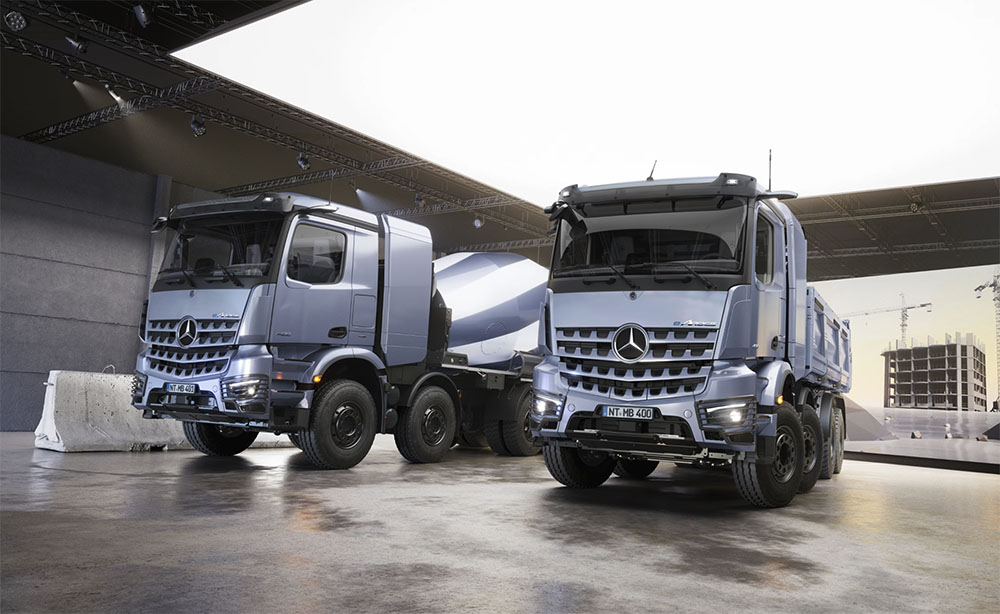
Mercedes-Benz Trucks is set to significantly expand its electric vehicle portfolio with the introduction of the new battery-electric eArocs 400, specifically designed for the demanding construction segment. The global sales launch for this innovative electric construction truck commenced in April, marking a pivotal moment for sustainable heavy-duty transport solutions.
This strategic move underscores Mercedes-Benz Trucks’ commitment to decarbonizing various industry sectors, bringing its proven electric propulsion technology to a challenging environment traditionally dominated by diesel powertrains. The eArocs 400 is engineered to address the unique requirements of construction sites, offering a robust, efficient, and emission-free alternative.

Strategic Market Rollout and Production Hub
Following its much-anticipated debut at last year’s prestigious bauma trade fair in Munich, the Mercedes-Benz eArocs 400 is now available for order in an initial 13 markets across the European Union. This phased market introduction allows for a focused and strategic penetration into key regions ready for electric heavy-duty commercial vehicles.
The manufacturing process for the eArocs 400 involves a collaborative approach, combining established expertise with specialized electric vehicle integration. Beginning in the third quarter of 2026, the base vehicle will be produced at Mercedes-Benz’s state-of-the-art plant in Wörth am Rhein, Germany.
Subsequently, the crucial integration of the advanced electric drivetrain will be undertaken by Paul Group, headquartered in Vilshofen an der Donau. This collaboration leverages Paul Group’s specialized knowledge in commercial vehicle modifications and electric powertrain integration, ensuring that the Mercedes-Benz eArocs 400 meets the stringent performance and reliability standards expected from a Mercedes-Benz product.

Advanced Powertrain and Battery Architecture
At the heart of the Mercedes-Benz eArocs 400 lies a highly efficient electric powertrain, drawing key components from the second-generation Mercedes-Benz eActros portfolio. This cross-platform integration ensures that the construction truck benefits from proven, reliable, and advanced electric vehicle technology already deployed in other heavy-duty applications.
The eArocs 400 is equipped with two robust LFP (Lithium Iron Phosphate) battery packs, each delivering an impressive 207 kWh of usable capacity. LFP battery technology is renowned for its durability, extended cycle life, and enhanced safety characteristics, making it particularly well-suited for the rigorous demands and operational profiles of construction vehicles. The battery packs are strategically housed in a protective tower located behind the cab, optimizing space and ensuring protection from harsh working conditions.
The truck operates on an advanced 800-volt onboard electrical architecture, a feature typically associated with faster charging capabilities and improved energy efficiency. This high-voltage system allows for efficient power delivery to the drive components and supports rapid replenishment of the battery packs.
Powering the eArocs 400 is an integrated 3-speed transmission, designed to manage the significant torque demands of heavy construction work. The electric motor system provides a continuous output of 380 kW (approximately 510 horsepower), with a peak output capability reaching 450 kW (approximately 600 horsepower). This substantial power output ensures that the electric construction truck can handle challenging tasks such as hauling heavy loads and navigating difficult terrains with ease, matching or exceeding the performance of its diesel counterparts.
Tailored for Demanding Construction Applications
The Mercedes-Benz eArocs 400 electric construction truck has been meticulously engineered for urban and near-road construction work. This focus ensures it is optimized for scenarios where emissions and noise reduction are paramount, such as building sites within city limits or infrastructure projects close to residential areas. Its electric nature allows for operations in low-emission zones and during restricted hours, providing significant operational flexibility for construction companies.
A key operational advantage highlighted by Mercedes-Benz Trucks is the eArocs 400’s ability to complete a full workday without the need for intermediate charging in many typical use cases. This capability is critical for maintaining productivity on busy construction sites, minimizing downtime, and optimizing logistics.
Versatility in Configurations and Use Cases
To cater to the diverse requirements of the construction industry, the eArocs 400 is initially being offered in two primary versions. These variants feature technically permissible gross vehicle weights of 37 tonnes and 44 tonnes, allowing operators to choose the model best suited for their specific hauling and operational needs. This flexibility is vital for applications ranging from smaller-scale urban developments to larger infrastructure projects.
The vehicle is available in an 8×4/4 axle configuration, a robust setup commonly required for heavy-duty construction tasks to distribute weight effectively and enhance traction. Furthermore, customers can select from four different wheelbase options, enabling customization for various body types and operational requirements. This adaptability ensures that the Mercedes-Benz eArocs 400 can serve a wide array of functions within the construction sector.
The design versatility of the electric construction truck makes it eminently suitable for integration with various specialized bodies. It is engineered to accommodate essential construction applications such as dump bodies, crucial for transporting materials like sand, gravel, and demolition waste, as well as concrete mixer bodies, which are indispensable for delivering ready-mix concrete to construction sites. This inherent adaptability positions the eArocs 400 as a highly versatile and practical solution for electrifying critical segments of the construction fleet.
Rapid Charging for Enhanced Operational Flow
Understanding the critical need for quick turnaround times in commercial operations, the Mercedes-Benz eArocs 400 supports high-power charging at up to 400 kW. This fast-charging capability significantly reduces the time required to replenish its battery packs, allowing the truck to quickly return to service and maximize its operational uptime.
The truck is equipped with the standard CCS2 (Combined Charging System 2) charging interface, which is widely adopted across Europe and increasingly globally for DC fast charging. For enhanced flexibility and convenience on construction sites, charging ports are available on both sides of the vehicle, simplifying maneuverability and optimizing charging logistics, regardless of site layout or charger placement.
Stina Fagerman, Head of Marketing, Sales and Services at Mercedes-Benz Trucks, succinctly captured the essence of this new offering, stating, “The new battery-electric eArocs 400 combines the robustness required with an efficient electric drive system, covering key use cases in near-road construction.” This statement underscores the dual emphasis on enduring strength and environmental responsibility that defines the eArocs 400.
Looking Ahead: The Future of Electric Construction
The launch of the Mercedes-Benz eArocs 400 electric construction truck represents a significant step forward in the electrification of heavy-duty vehicles, particularly within the demanding construction industry. By offering a robust, powerful, and efficient electric solution, Mercedes-Benz Trucks is addressing the growing imperative for sustainable transport while maintaining the performance standards expected from its renowned Arocs series.
As regulatory landscapes evolve and environmental concerns intensify, the eArocs 400 is poised to play a crucial role in enabling construction companies to meet their sustainability goals, reduce operational costs associated with fuel and emissions, and contribute to cleaner, quieter urban environments. This new electric construction truck is not merely an alternative; it signifies a definitive step towards a more sustainable and technologically advanced future for the global construction sector.