
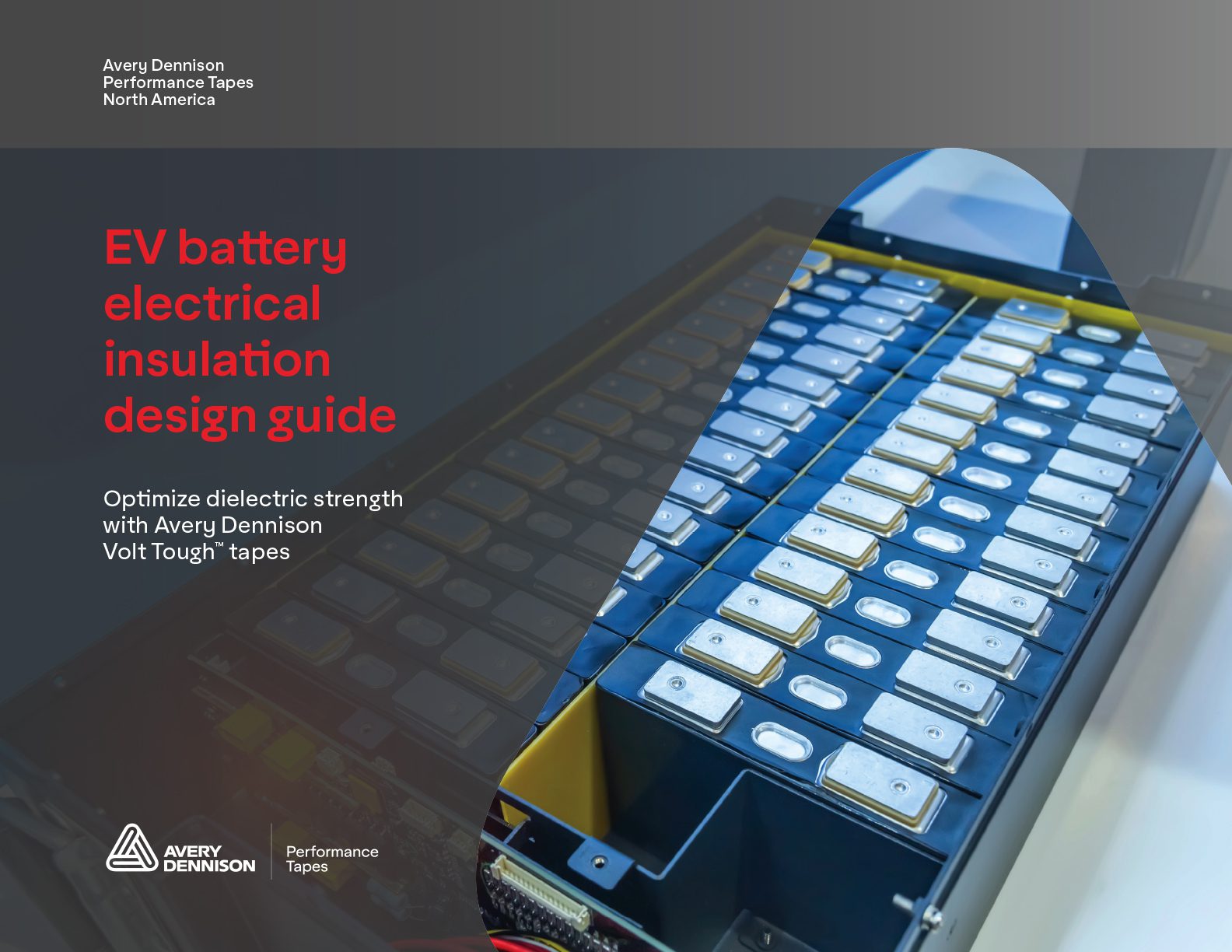
Key Takeaways:
- The new EV battery electrical insulation design guide from Avery Dennison Performance Tapes offers critical insights for engineers and decision-makers in electric vehicle (EV) battery design and manufacturing.
- The guide focuses on dielectric tapes, specifically the Volt Tough™ portfolio, as a superior electrical insulation solution over traditional coatings.
- These advanced tapes provide benefits such as high dielectric strength within thin profiles, enabling higher energy density in battery packs.
- Key advantages include instant bonding for faster production, durable and conformable options for complex designs, and adherence to flame-retardant standards like UL® 94V-0.
- The resource aims to educate on tape properties, facilitate informed material selection, illustrate integration methods, and promote custom solution development.
As the global electric vehicle market continues its rapid expansion, the design and manufacturing of EV battery packs remain at the forefront of innovation. Ensuring optimal safety, performance, and longevity of these critical power sources requires meticulous attention to every component, particularly electrical insulation. A new comprehensive resource, the “EV battery electrical insulation design guide” from Avery Dennison Performance Tapes, now serves as an indispensable tool for engineers and decision-makers navigating the complexities of modern battery pack architecture.

This specialised guide is precisely tailored for professionals involved in EV battery design, manufacturing, and implementation. Its primary objective is to empower readers with a profound understanding of dielectric tapes as a cutting-edge electrical insulation solution, enabling them to make well-informed material choices.
The Critical Role of Electrical Insulation in EVs
Electrical insulation is a fundamental pillar of EV battery pack safety and efficiency. Within a battery pack, numerous cells are interconnected, operating at high voltages and generating significant heat. Effective insulation is essential to prevent short circuits, mitigate thermal runaway events, and protect delicate electronic components from environmental factors and mechanical stress.
Inadequate insulation can lead to catastrophic failures, including fires or explosions, posing severe risks to vehicle occupants and infrastructure. Therefore, the selection and application of robust, high-performance insulation materials are paramount for the credibility and widespread adoption of electric mobility.

Challenges in Modern EV Battery Pack Design
Designing advanced EV battery packs presents a unique set of challenges. Engineers must balance the need for high energy density, rapid charging capabilities, extended range, and rigorous safety standards within limited physical space. Traditional insulation methods, such as coatings, often add undesirable bulk or necessitate lengthy curing times, impacting both performance and production efficiency.
Furthermore, the intricate geometries and sharp corners inherent in modern battery module and pack designs demand insulation solutions that are highly conformable, durable, and resistant to tearing. As manufacturers strive to push the boundaries of battery performance, the insulation must evolve in tandem, offering innovative attributes without compromising safety or manufacturability.
Innovative Solutions: Dielectric Tapes for Insulation
Addressing these critical design hurdles, dielectric tapes have emerged as a highly effective and versatile electrical insulation solution. These pressure-sensitive adhesive (PSA) tapes combine advanced dielectric films with high-performance adhesives, engineered to meet the stringent specifications of contemporary battery packs.
Unlike conventional methods, dielectric tapes offer a compelling blend of benefits that directly translate into improved battery performance, enhanced safety, and streamlined manufacturing processes. Their thin profiles allow for greater volumetric efficiency, contributing to higher energy density within the battery pack.
Introducing Avery Dennison’s Volt Tough™ Portfolio
The aforementioned design guide prominently features the Volt Tough™ portfolio from Avery Dennison Performance Tapes. This specialised range comprises electrically insulative, single-sided filmic PSA tapes meticulously engineered for demanding EV battery applications. The Volt Tough™ series exemplifies how the synergistic combination of advanced dielectric films and high-performance adhesives can seamlessly integrate into modern battery pack designs.
Each product within the Volt Tough™ lineup is developed with the specific challenges of electric vehicle battery environments in mind, offering tailored solutions for various insulation requirements across different battery architectures.
Key Advantages of Advanced Dielectric Tapes
Enhanced Dielectric Strength and Energy Density
A primary advantage of dielectric tapes, such as those in the Volt Tough™ portfolio, is their exceptional dielectric strength within remarkably thin profiles. This characteristic is crucial for maximising the energy density of EV battery packs. By providing robust insulation in a compact form, these tapes allow designers to pack more active material into the same volume, directly translating to increased vehicle range and performance without adding significant weight or bulk.
Accelerated Production Through Instant Bonding
The instant bonding capability of pressure-sensitive adhesive tapes offers a significant boon to EV battery manufacturing lines. Traditional liquid coatings often require extensive curing times, which can slow down assembly processes and increase production costs. Dielectric tapes, conversely, provide immediate adhesion upon application, enabling faster production cycles and greater throughput, thereby enhancing overall manufacturing efficiency.
Durability and Adaptability for Complex Geometries
Modern battery packs frequently feature complex geometries, including sharp corners, irregular shapes, and tight spaces. The conformability and tear resistance of advanced dielectric tapes make them ideal for these challenging applications. They can be precisely applied to intricate surfaces, ensuring consistent and reliable insulation even in demanding configurations where traditional materials might fail or prove impractical.
Meeting Stringent Flame Retardancy Standards
Battery safety is non-negotiable, and flame retardancy is a critical aspect of EV battery design. The technology described in the design guide includes flame-retardant versions of these tapes, specifically engineered to maintain UL® 94V-0 requirements within the battery pack. This compliance underscores a commitment to the highest safety standards, providing an essential layer of protection against thermal events.
Strategic Integration of Insulation Solutions
The “EV battery electrical insulation design guide” extends beyond theoretical understanding by demonstrating practical methods for integrating Volt Tough™ solutions within battery packs. It provides insights into utilising automation and other sophisticated techniques for tape application, ensuring precise, efficient, and consistent insulation across mass production environments.
Proper integration is key to leveraging the full potential of these advanced materials, ensuring that the benefits of dielectric strength, conformability, and rapid application are realised throughout the entire battery system.
Collaborating for Customised EV Battery Solutions
Recognising that specific EV battery designs often require unique insulation properties, the guide also highlights avenues for collaboration between organisations and Avery Dennison Performance Tapes. It illustrates how companies can partner with the manufacturer to develop customised Volt Tough™ solutions tailored to their exact specifications and performance needs.
This collaborative approach ensures that innovative insulation technologies can be precisely adapted to emerging battery chemistries and architectural innovations, fostering continuous advancements in EV battery design and safety.
Conclusion: Advancing EV Battery Design and Safety
The “EV battery electrical insulation design guide” from Avery Dennison Performance Tapes marks a significant contribution to the evolving landscape of electric vehicle technology. By offering a deep dive into the properties and applications of advanced dielectric tapes, it equips engineers with the knowledge to make informed decisions that enhance battery safety, optimise performance, and streamline manufacturing processes.
In an industry where innovation and reliability are paramount, comprehensive resources like this guide play a crucial role in driving the adoption of safer, more efficient, and higher-performing electric vehicles for a sustainable future.
Frequently Asked Questions About EV Battery Electrical Insulation
What is the primary purpose of electrical insulation in EV batteries?
The primary purpose of electrical insulation is to prevent short circuits between high-voltage components, protect sensitive electronics, and mitigate the risk of thermal runaway. It ensures the safety of the battery pack and its occupants by isolating conductive parts and maintaining the integrity of the electrical system under various operating conditions.
Why are dielectric tapes preferred over traditional coatings for EV battery insulation?
Dielectric tapes offer several advantages over traditional coatings. They provide high dielectric strength within thin profiles, contributing to increased energy density. They also offer instant bonding for faster production, superior conformability for complex geometries, and often include flame-retardant properties, overcoming the bulk and curing time limitations of coatings.
What are the key benefits of Avery Dennison’s Volt Tough™ portfolio?
The Volt Tough™ portfolio offers electrically insulative, single-sided filmic pressure-sensitive adhesive (PSA) tapes. Key benefits include high dielectric strength, enabling higher pack energy density; instant bonding for efficient manufacturing; durable and conformable options for intricate designs; and flame-retardant versions that meet UL® 94V-0 requirements for enhanced safety.
How do thin insulation profiles contribute to EV performance?
Thin insulation profiles are critical because they allow more active battery cell material to be packed into the same volume. This increases the overall energy density of the battery pack, leading to longer driving ranges and improved vehicle performance without adding significant weight or requiring larger physical space, optimising the vehicle’s design.
What role does flame retardancy play in EV battery insulation design?
Flame retardancy is a vital safety feature in EV battery insulation design. Materials that meet standards like UL® 94V-0 help prevent the spread of fire in the event of a thermal incident. This enhanced protection is crucial for occupant safety and to minimise damage, making it a non-negotiable requirement for modern battery packs.
Can dielectric tapes be integrated with automated manufacturing processes?
Yes, dielectric tapes are highly compatible with automated manufacturing processes. Their consistent dimensions, roll form, and instant bonding properties make them suitable for automated application equipment. This capability helps ensure precise placement, reduces human error, and significantly speeds up the assembly of EV battery packs, contributing to overall production efficiency.
How can engineers get customised insulation solutions for specific EV battery needs?
Engineers can collaborate directly with manufacturers like Avery Dennison Performance Tapes to develop customised insulation solutions. This involves sharing specific design requirements, performance parameters, and material needs. Such partnerships facilitate the creation of tailor-made Volt Tough™ solutions that precisely meet the unique challenges and innovations of specific EV battery architectures and applications.