
Key Takeaways:
- The integration of large batteries into high-performance vehicles has created a new class of powerful yet heavy plug-in hybrids.
- The BMW M5 Touring, with its significant battery and electric range, offers immense straight-line speed but struggles with agility due to its substantial weight.
- In contrast, the Mercedes-AMG C63s E-Performance employs a smaller, performance-focused battery, enhancing dynamics and delivering a more engaging driving experience despite a smaller engine.
- The primary debate centers on whether electrification in performance cars should prioritize extended electric range or pure driving dynamics.
- For enthusiasts, a lighter, performance-optimized hybrid system often translates to a superior and more ‘special’ driving feel.
The automotive landscape is undergoing a significant transformation, with carmakers increasingly incorporating substantial battery packs into their most revered performance flagships. This shift, primarily driven by emissions regulations, has given rise to a unique category of high-performance plug-in hybrid electric vehicles (PHEVs). While these vehicles deliver astonishing straight-line acceleration and offer considerable electric-only driving capabilities, their augmented weight often compromises the nimble handling characteristics expected by enthusiasts.

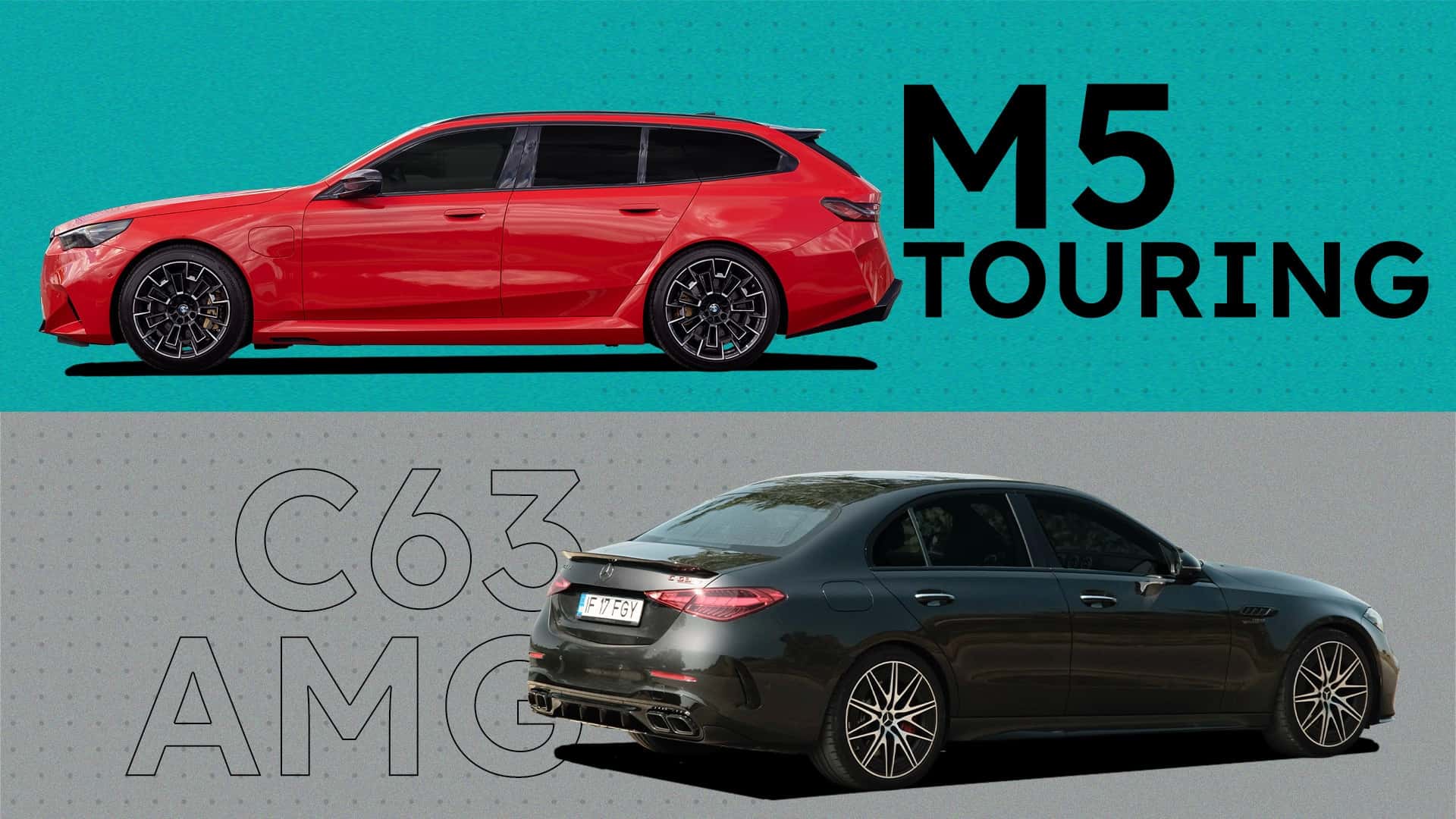
This dynamic was particularly evident during recent evaluations of two prominent models: the new G99 BMW M5 Touring and the Mercedes-AMG C63s E-Performance. Each represents a distinct philosophy in electrifying performance vehicles, leading to vastly different driving experiences. Both approaches have, for varied reasons, attracted significant scrutiny from dedicated automotive fans and keen drivers.
BMW M5 Touring: Power Meets Portly Mass
The latest iteration of the BMW M5 Touring presents an undeniably potent package. Its power output feels even more substantial than the officially claimed 717 horsepower. Indeed, one dyno test suggested nearly 700 hp at the wheels, implying a real-world engine output closer to 800 hp.
This immense power, coupled with 737 pound-feet (1,000 Nm) of torque from its 4.4-liter twin-turbocharged V-8 engine, delivers an alarming pace that firmly pins occupants to their seats, whether from a standing start or during rolling acceleration. The powertrain is, by all accounts, unequivocally brilliant in its raw force.

Electric Capabilities and Unexpected Comfort
A notable aspect of the M5’s powertrain is its surprising efficacy in pure electric mode. The 197 hp and 206 lb-ft (280 Nm) electric motor, seamlessly integrated into the eight-speed automatic gearbox, is more than capable of propelling the M5 on its own. Even in the hefty 5,456-pound (2,475 kg) Touring model, the car exhibits brisk performance in EV mode.
The M5 provides an estimated 35 miles of pure electric driving. Driving the M5 in EV mode often proved to be a surprisingly enjoyable experience. It generates a subtle, engaging acceleration sound through the speakers and simulates gear shifts even with the V-8 inactive. The electric motor directs power to all four wheels, ensuring reassuring all-wheel-drive traction, which makes it a practical choice for around-town electric commuting, regardless of weather conditions.
The Weight Conundrum and Handling Compromises
Despite the powertrain’s brilliance, extended time with the M5 Touring revealed a crucial trade-off. The new M5 is the first BMW M model that did not immediately inspire a sense of desire, a sentiment largely attributed to its substantial weight. Being heavier than even the fully electric i5, BMW engineers have had to extensively tune the suspension to manage this mass.
This tuning results in an inconsistent ride quality, creating a perplexing dichotomy where the car oscillates between a plush, Maybach-like composure and a bouncy, pogo-stick sensation, leaving the driver uncertain of the expected response. Mid-corner bumps can unsettlingly disturb the vehicle, and the substantial inertia causes noticeable force transfers when navigating winding roads.
The sheer mass of the M5 creates a sensation akin to an athlete competing with ankle weights, generating an uncomfortable amount of inertia that inclines the car towards understeer during spirited driving. This characteristic fundamentally impacts the desired agility in a high-performance PHEV.
Mercedes-AMG C63s E-Performance: Agility Through Focused Electrification
Transitioning from the M5 to the Mercedes-AMG C63s E-Performance immediately underscores the impact of vehicle weight. While still a heavy car, the C63 PHEV feels significantly more agile, offering a stark contrast to its Bavarian rival. Though it operates in a different size class than the M5, the comparison highlights divergent philosophies in developing a performance PHEV.
Despite featuring only four cylinders—half the M5’s complement—and slightly less horsepower, the C63 delivers a more ‘special’ driving experience. Its 2.0-liter engine is a genuine AMG unit, hand-assembled with a signature plaque proudly displayed under the hood, a detail that enhances its exclusivity compared to the M5’s more concealed engine architecture.
Innovative Powertrain and Shocking Performance
The M139 engine, derived from Mercedes-AMG’s potent compact offerings like the CLA 45, produces over 400 horsepower independently. Combined with its electric motor, the C63 churns out an impressive 670 hp and 752 lb-ft (1,020 Nm) of torque. This torque figure surpasses the BMW’s, and it is delivered in a vehicle approximately 880 pounds (400 kg) lighter, a difference profoundly felt on the road.
The force experienced during a ‘Race Start’ in the C63 is unparalleled in a combustion-engined car, making it feel perceptibly faster than the M5, even with comparable on-paper performance metrics. The C63 also leverages an electric supercharger for rapid boost buildup and minimal turbo lag, resulting in an exceptionally responsive powertrain.
The combined surge from the electric motor and gasoline engine is truly remarkable. Despite some criticism, the engine sound, even without enhancement, is characterful, complemented by the audible build and release of turbo pressure, which contributes to the overall driving enjoyment.
Cornering Prowess and Performance-Oriented Design
Crucially, the C63 exhibits far superior cornering dynamics compared to the M5. Unlike earlier C63s, which were known for their eagerness to induce oversteer, this new model feels like a track-focused machine, engineered to maximize corner exit speed with minimal drama. This enhanced agility is a direct result of Mercedes-AMG’s distinct approach to electrification.
Mercedes-AMG intentionally designed a lighter hybrid system for the C63. Unlike the M5, which shares battery and motor configurations with lesser PHEV variants, the C63 features a bespoke, smaller battery setup. Its electric motor is integrated into the rear axle, primarily serving to boost performance rather than provide extensive electric-only range (though it can manage approximately 5 miles).
The Philosophy of Electrification: Efficiency vs. Performance Boost
Mercedes’ astute decision with the C63 was to equip it with a significantly smaller battery. The M5 carries a 22.1-kilowatt-hour battery, a major contributor to its considerable mass. In contrast, the C63’s battery capacity is a mere 6.1 kWh. While small by conventional PHEV standards, this battery size effectively serves its purpose, which is largely regulatory compliance for stringent European Union emissions standards.
Efficiency Metrics and Real-World Consumption
The heavier, more powerful BMW M5 boasts a WLTP efficiency rating between 1.6 and 1.7 liters/100 km (nearly 150 mpg). However, this figure is contingent on consistently recharging the battery, a practice many PHEV drivers do not maintain. Consequently, the M5’s EPA combined rating of 13 mpg (18 l/100 km) offers a more realistic reflection of its fuel consumption in typical driving scenarios.
The C63, while not directly comparable in European efficiency ratings, claims an average of 6.9 l/100 km (34 mpg). Achieving this requires extremely gentle throttle inputs, yet it remains plausible even with a depleted battery. Driving the C63 in a spirited manner, similar to how the BMW was tested, yielded approximately 15 mpg, which is still commendable given its ferocious acceleration. The EPA rates the C63 at 20 mpg with a depleted battery, a figure that is realistically achievable without specific efforts to conserve fuel.
Conclusion: The True Essence of a Performance PHEV
As specialists in electrified vehicles, the appeal of electric power is undeniable. However, in the realm of high-performance cars, greater battery capacity does not always equate to a superior driving experience. The target demographic for these vehicles typically prioritizes performance and driving engagement over maximum fuel efficiency, and their financial capacity allows for higher fuel consumption.
Furthermore, performance cars constitute a small fraction of overall vehicle sales, meaning their individual emissions impact is minimal compared to mass-market vehicles that could be electrified more widely today. The BMW M5 unequivocally demonstrates that an oversized battery can become an impediment to the best possible driving dynamics.
Mercedes-AMG, despite initial criticisms regarding its engine downsizing, appears to have adopted the more effective strategy for a performance PHEV. The C63 is a superior driver’s car than the M5, which, while potent, is ultimately too heavy to deliver the unadulterated fun expected from an M car. The C63, while still heavier than a purely combustion-engined V-8 model would have been, provides an excellent and exciting driving experience for a PHEV. It truly feels more ‘special’ than the M5, even with half the cylinders.
A clear distinction must be drawn between electrified cars designed for efficiency and those where electrification serves primarily to enhance performance. Exemplary performance PHEVs like the second-generation Acura NSX, Corvette E-Ray, Ferrari 296 GTB, or the new Lamborghini Temerario underscore this philosophy. In these vehicles, efficiency is a secondary benefit; the main objective of electrification is to augment power and responsiveness. Battery sizes in such models, like the Ferrari SF90 and 296 GTB with capacities under 8 kWh, are chosen to avoid overburdening the chassis, thus preserving pure handling dynamics.
While a few miles of electric driving are a bonus, the core purpose remains performance. The potential drawback of this approach is that if the battery charge depletes, the engine might divert power to replenish it, potentially impacting peak performance. However, for most real-world driving scenarios, this is unlikely to be an issue. During a sustained, hard drive on a winding road for over half an hour, the C63 maintained approximately 33% battery, showing no perceptible loss in performance. This suggests that only extreme, prolonged track use might expose such a limitation.
FAQ Section
What is the primary difference in the hybrid approach of the BMW M5 Touring and Mercedes-AMG C63s E-Performance?
The BMW M5 Touring features a larger battery for significant electric range (around 35 miles), leading to increased weight. The Mercedes-AMG C63s E-Performance uses a smaller, performance-focused battery (around 5 miles EV range) primarily for power boost, prioritizing agility and driving dynamics over extended electric-only travel.
How does the weight of these performance PHEVs impact their driving experience?
The BMW M5 Touring’s substantial 5,456-pound weight compromises its agility, leading to inconsistent ride quality and unsettling handling on twisty roads. The lighter C63s E-Performance (approximately 880 pounds lighter) feels significantly more agile and track-focused, delivering a more engaging and responsive driving experience.
Which car offers better real-world fuel efficiency?
The C63s E-Performance generally offers better real-world fuel efficiency with a depleted battery (EPA-rated 20 mpg) compared to the M5 Touring (EPA-rated 13 mpg). The M5’s higher official WLTP figures are often only achievable with consistent battery charging, which many drivers do not maintain.
Is the four-cylinder engine in the C63s E-Performance a disadvantage compared to the M5’s V8?
While the M5 retains a V8, the C63s E-Performance’s hand-assembled 2.0-liter four-cylinder, combined with its electric motor, produces immense torque and feels remarkably quick. Its focused design, lighter weight, and innovative turbocharging contribute to a more dynamic and, for some, a more ‘special’ driving experience despite fewer cylinders.
What is the ‘sweet spot’ for battery size in a performance PHEV, according to the article?
The article suggests that for optimal driving experience in a performance PHEV, a smaller battery (like the C63’s 6.1 kWh) is preferable. This size contributes to regulatory compliance and provides a performance boost without excessively adding weight, thereby preserving the car’s handling and agility, akin to high-performance hybrids from Ferrari or Lamborghini.