
Key Takeaways:
- A pioneering **off-grid EV fast charging** station, developed by PowerStation Charging, has commenced operations in Baker, California, powered entirely by solar energy.
- The facility leverages 1,080 solar panels and a substantial 3.4-megawatt-hour (MWh) battery pack, ensuring round-the-clock availability without relying on the conventional power grid.
- Initially offering four CCS1 ports with a shared 360 kW output, the station plans to expand with six NACS ports and increase its shared power to 600 kW later this summer.
- Electric vehicle owners can currently charge their vehicles for free at this location until May 31, 2026, marking a significant incentive for EV adoption.
- PowerStation Charging has announced plans for three additional solar-powered DC **fast charging** stations across California’s major interstates by 2027, signifying a growing trend in sustainable EV infrastructure.
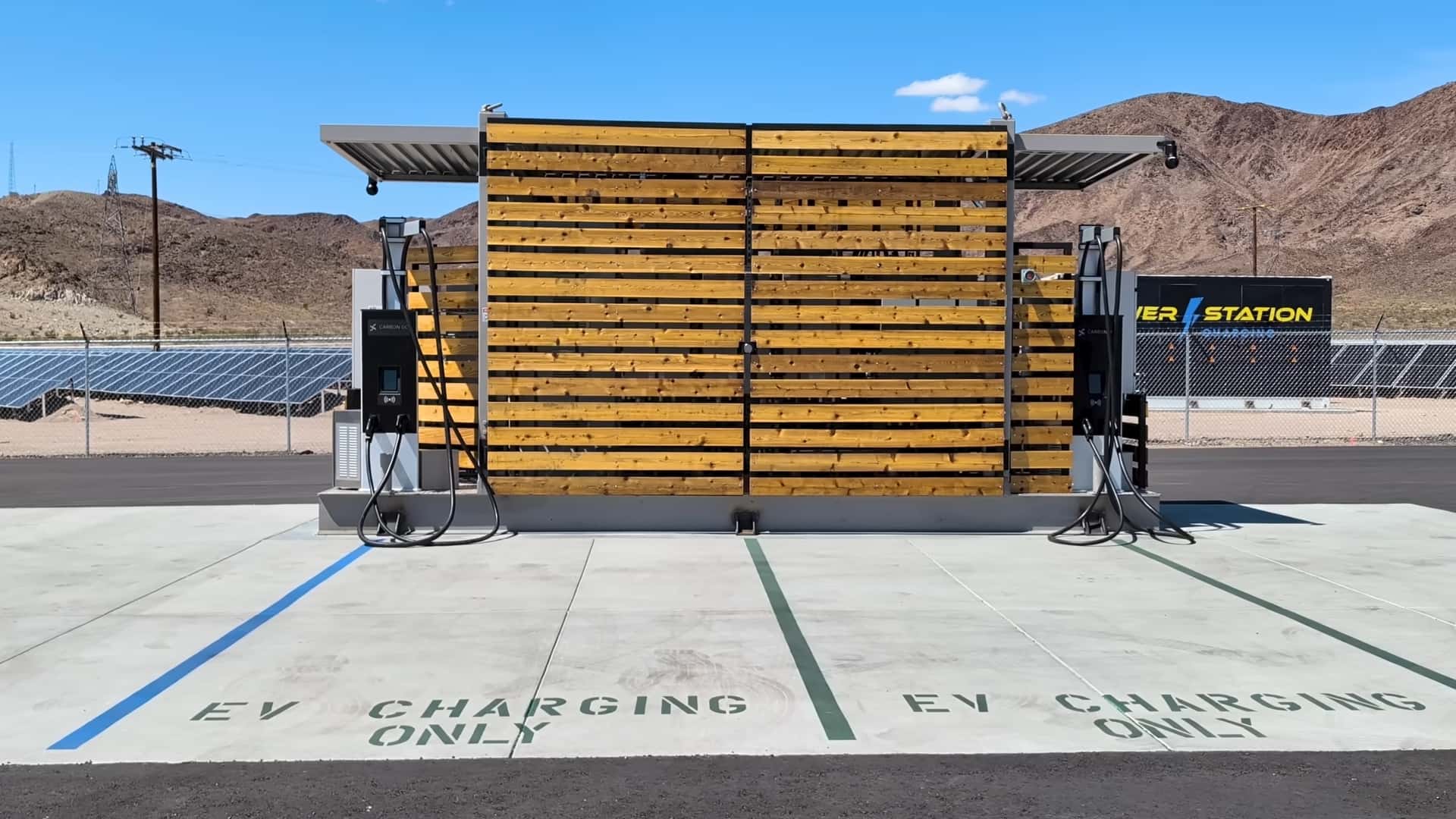
A significant development in the electric vehicle (EV) charging landscape has emerged from California, where a startup named PowerStation Charging has unveiled a groundbreaking **off-grid EV fast charging** station. This innovative facility, situated strategically on I-15 in Baker, operates entirely on solar power, demonstrating a robust model for sustainable transportation infrastructure. A key highlight of this pioneering initiative is its current offer of free charging services to EV drivers, at least for a limited period.
The newly operational station, located at the Rasor Road exit off I-15, functions independently of the traditional electrical grid. Its self-sufficiency is enabled by an expansive array of 1,080 solar panels, meticulously designed to generate up to 640 kilowatts (kW) of electricity. This substantial energy harvest is directed to a formidable 3.4-megawatt-hour (MWh) battery storage system, guaranteeing continuous power availability for charging electric vehicles day and night, regardless of solar conditions. The practical application of this technology was recently showcased by YouTuber Scott Allison, who documented his experience recharging a Kia EV9 at the site, affirming its operational readiness.

Powering Tomorrow: Technology and Capacity
At its current stage, the PowerStation Charging facility is equipped with four CCS1 ports, collectively providing a shared output of 360 kW. This design ensures that if a single vehicle is connected, it receives the full available power, allowing for rapid charging times. When multiple EVs are charging simultaneously, the total output is intelligently distributed among them. The company has ambitious expansion plans for this site, including the addition of six NACS ports later in the summer, which will further enhance its versatility and cater to a broader range of electric vehicles.
Crucially, the planned upgrade will also boost the shared power output to 600 kW, promising even faster charging speeds for users. Beyond the charging infrastructure, PowerStation Charging is investing in driver comfort and convenience, with an 8,000-square-foot underground bunker in development. This facility is slated to feature a lounge and bathrooms, transforming the charging stop into a more accommodating experience for travellers on the busy interstate.
The Incentive of Free Charging and Future Pricing Models
In a move designed to encourage EV adoption and introduce drivers to its innovative service, PowerStation Charging has made its first **off-grid EV fast charging** station completely free to use. There are no requirements for an app or membership, simplifying the charging process for all users. This complimentary service is slated to continue until May 31, 2026, providing a substantial window for electric vehicle owners to benefit from zero-cost charging.

Following this initial period, the pricing structure will transition to a variable model, with rates projected to range between $0.30/kWh and $0.45/kWh. These dynamic prices will be influenced by factors such as demand at the station and the brightness of the sun, reflecting the station’s reliance on renewable energy generation. This approach aims to balance accessibility with the long-term sustainability of the operation.
Expanding the Off-Grid Footprint Across California
PowerStation Charging’s commitment to developing a widespread network of sustainable **electric vehicle infrastructure** extends beyond its inaugural site. The company’s website outlines plans for three additional solar-powered DC **fast charging** stations, strategically located to serve key transportation corridors across California. A second location is anticipated to open this year near Barstow, also along the vital I-15 interstate.
Looking further ahead, two more stations are scheduled to become operational in 2027, positioned along I-10 and I-8. These planned expansions underscore a strategic vision to enhance charging accessibility in areas that might benefit from grid-independent solutions, thereby strengthening the overall **California EV charging network** and supporting long-distance electric travel.
The Broader Trend of Renewable-Fed Charging Stations
The emergence of PowerStation Charging’s off-grid solution is indicative of a broader and accelerating trend in the United States: the development of **renewable energy for EVs** through battery-backed charging stations. This approach addresses several challenges associated with traditional grid-tied charging, including grid strain, deployment complexities in remote areas, and vulnerability to power outages.
These self-sufficient stations not only promise environmental benefits by harnessing clean energy but also offer enhanced resilience and operational flexibility. By reducing reliance on existing grid infrastructure, such projects can significantly accelerate the rollout of EV charging points, particularly in locations where grid upgrades would be prohibitively expensive or time-consuming.
A Glimpse at Scale: Tesla’s Supercharger and Megapack Integration
The concept of large-scale, self-sufficient EV charging is not entirely new, with industry leaders already demonstrating its potential. Tesla, for instance, inaugurated its largest Supercharger station to date in Lost Hills, California, late last year. This monumental facility boasts the capacity to energize up to 164 electric vehicles concurrently, representing a significant leap in **sustainable EV charging** infrastructure.
Similar to PowerStation Charging’s model, Tesla’s Lost Hills Supercharger operates entirely on solar power. It integrates 11 megawatts (MW) of solar panels, ingeniously designed to double as canopies providing shade for parking spots. This massive solar array is complemented by 10 Megapack batteries, collectively offering an impressive 39 MWh of energy storage. This comparison highlights the industry’s growing confidence in, and commitment to, integrated solar and **battery storage solutions** for robust EV charging. The deployment of these technologies underscores a shared vision for grid-independent and environmentally friendly charging networks.
Advantages of Off-Grid Electric Vehicle Infrastructure
The development of **off-grid EV fast charging** stations offers a multitude of advantages crucial for the future of sustainable transportation. Firstly, grid independence provides unparalleled resilience, ensuring charging services remain operational even during widespread power disruptions or natural disasters. This feature is particularly valuable for emergency preparedness and maintaining connectivity in critical travel corridors.
Secondly, these stations alleviate potential strain on local power grids, which might otherwise struggle to accommodate the rapidly increasing demand from electric vehicles. By generating and storing their own power, off-grid solutions effectively decentralize energy consumption for EVs. Furthermore, the ability to deploy these stations in remote or underserved areas, where grid extensions are costly or impractical, significantly broadens the reach of **electric vehicle infrastructure**, making EV ownership more viable for a larger population.
Environmentally, the reliance on solar power for these stations drastically reduces the carbon footprint associated with EV charging, promoting truly clean transportation. From an economic perspective, while the initial investment in solar arrays and **battery storage solutions** can be substantial, the long-term operational costs can be lower due to reduced or eliminated utility bills, potentially leading to more stable or even lower charging rates for consumers over time.
Looking Ahead: The Future of EV Charging
The initiative by PowerStation Charging in Baker, California, serves as a powerful example of the evolving landscape of EV charging. By marrying advanced solar power generation with substantial battery storage, these **off-grid EV fast charging** stations are not just solving immediate infrastructure challenges but are also paving the way for a more resilient, sustainable, and accessible future for electric vehicles. As more such projects come online, they will undoubtedly play a pivotal role in accelerating global EV adoption and fostering a truly green transportation ecosystem.
FAQ Section
What is an off-grid EV fast charging station?
An **off-grid EV fast charging** station operates independently of the traditional electrical grid. It generates its own power, typically through renewable sources like solar panels, and stores this energy in large battery packs to provide reliable and consistent charging services around the clock, enhancing resilience and sustainability.
Where is the first PowerStation Charging facility located?
The inaugural **off-grid EV fast charging** station by PowerStation Charging is strategically located at the Rasor Road exit off Interstate 15 (I-15) in Baker, California. This placement aims to serve electric vehicle drivers traversing this key transportation corridor, offering convenient and sustainable charging options.
How is the PowerStation Charging station powered?
This innovative station is powered entirely by the sun. It utilizes an extensive array of 1,080 solar panels capable of generating up to 640 kilowatts of electricity. This power is then stored in a massive 3.4-megawatt-hour battery pack, ensuring the station’s continuous operation and ability to provide **renewable energy for EVs**.
Is charging at this California EV charging network site currently free?
Yes, charging at PowerStation Charging’s first location in Baker, California, is currently completely free for all electric vehicle owners. This complimentary service is scheduled to last until May 31, 2026, after which a variable pricing model will be implemented based on demand and solar availability.
What are PowerStation Charging’s expansion plans?
PowerStation Charging has ambitious plans to expand its **sustainable EV charging** network. The company intends to open a second off-grid station on I-15 near Barstow this year, with two additional sites planned for I-10 and I-8 by 2027. These expansions aim to broaden access to renewable-powered charging across California.
How does this off-grid station compare to Tesla’s largest Supercharger?
While PowerStation Charging’s facility is a significant step, Tesla’s largest Supercharger in Lost Hills, California, is currently larger. Tesla’s station powers 164 EVs simultaneously using 11 MW of solar panels and 10 Megapack batteries totaling 39 MWh of energy storage, showcasing the potential scale of **battery storage solutions** in EV infrastructure.