
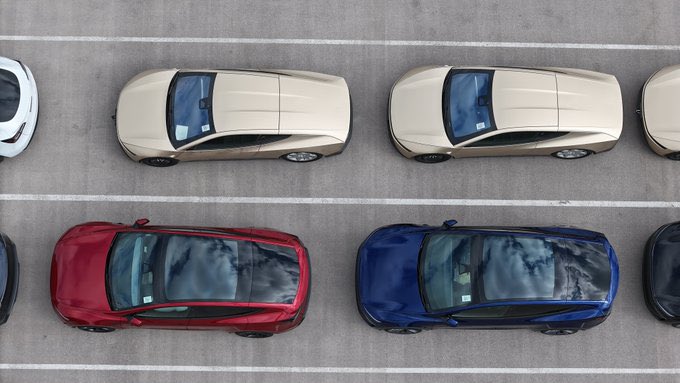
In a significant visual reveal, an aerial image has captured the Tesla Cybercab alongside the widely acclaimed Tesla Model Y, providing the clearest indication yet of their dimensional differences. This comparison offers crucial insights into how these two vehicles, while both pivotal to Tesla’s vision, are engineered for distinct market roles and operational philosophies.
The Model Y has cemented its position as Tesla’s most popular vehicle, consistently topping global best-selling rankings for the past three years. Its success underscores a strong market demand for versatile electric SUVs that blend performance, utility, and range.

However, anticipation is building around the Tesla Cybercab, an unreleased autonomous vehicle that some project could potentially surpass the Model Y in sales and impact. This ambitious forecast is rooted in its planned accessible price point, the potential for owners to generate passive income through ride-sharing networks, and its foundational focus on full autonomy.
The Dawn of a New Era: The Tesla Cybercab’s Vision
The Cybercab represents a bold step into the future of urban mobility. Conceived primarily as a dedicated ride-sharing vehicle, its design is optimized for efficiency and passenger experience within an autonomous ecosystem.
Equipped with only two seats, the **Tesla Cybercab** is engineered to transport two individuals to their various destinations with complete autonomy, fundamentally redefining the concept of personal transportation and car ownership.

Its imminent arrival on the production line marks a critical juncture for Tesla, signaling the company’s commitment to scaling autonomous services and expanding its influence beyond traditional vehicle sales.
Unveiling the Dimensions: A Striking Comparison
The recent aerial photograph, captured by drone operator and Gigafactory Texas observer Joe Tegtmeyer, offered an unprecedented side-by-side view of the two vehicles. This visual juxtaposition immediately highlighted their contrasting sizes and design intents.
The image quickly circulated, providing a tangible sense of how these theoretically different vehicles translate into physical forms, offering perhaps the first clear public look at their comparative dimensions.
A detailed breakdown of their measurements reveals significant differences, underscoring their unique design objectives.
Length and Agility for Urban Landscapes
The Model Y, designed as a comfortable family SUV, extends approximately 188.7 inches (4,794 mm) in overall length. This dimension provides ample cabin space and cargo capacity for multiple passengers and their belongings.
In stark contrast, the **Tesla Cybercab** measures around 175 inches (≈4,445 mm) in length. This makes it roughly 13 to 14 inches shorter than the Model Y, a reduction comparable to the length of a large suitcase. This compact length is a deliberate choice, prioritizing maneuverability and ease of navigation in congested urban environments, where space is often at a premium.
Width and Compact Design for City Living
When considering width, the Model Y, excluding its mirrors, spans 75.6 inches (1,920 mm). This provides a commanding road presence and contributes to its stable, spacious interior.
The **Tesla Cybercab**, however, is considerably narrower, measuring just 63 inches wide. This approximately 12.6-inch reduction in width results in a dramatically more compact silhouette. Such a slender design is advantageous for urban driving, allowing easier passage through narrow streets and simpler parking in standard, often tight, urban spaces that would challenge a larger vehicle like the Model Y.
Height and Aerodynamic Silhouette
The Model Y stands at 64 inches tall, contributing to its crossover SUV appeal with a commanding view of the road and generous headroom for occupants.
The Cybercab features a lower height, which, combined with its reduced length and width, contributes to its sleek, coupe-like profile. This lower stance and minimalist design emphasize agility and aerodynamic efficiency, contrasting sharply with the Model Y’s taller, more conventional crossover shape.
The dimensional differences between the two vehicles were further detailed in a post shared by TESLARATI on X (formerly Twitter), stating:
Tesla Model Y vs. Tesla Cybercab: ✅ Overall Length:⁰Model Y: 188.7 inches (4,794 mm)⁰Cybercab: ~175 inches (≈4,445 mm)⁰→ Cybercab is about 13–14 inches shorter (roughly the length of a large suitcase). ✅ Overall Width (excluding mirrors):⁰Model Y: 75.6 inches (1,920 mm)… https://t.co/PsVwzhw1pe
.
Design Philosophy: Form Follows Function
The visual and dimensional contrasts between the Model Y and the Cybercab are a testament to Tesla’s targeted design philosophies, with each vehicle meticulously crafted for its intended purpose and user experience.
Model Y: Versatility and Family Focus
The Model Y presents as a quintessential family-friendly SUV. Its design incorporates conventional doors, a prominent hood, and often a spacious glass roof, all contributing to an aesthetic of traditional utility and comfort.
Its interior is configured for versatility, accommodating up to five passengers with a layout that prioritizes ease of use and everyday practicality for families and individuals alike.
Cybercab: Minimalism for Autonomous Operation
The **Tesla Cybercab**, in stark contrast, embodies a radical departure from traditional automotive design. It famously eliminates the steering wheel and pedals entirely, a bold statement reflecting its complete reliance on autonomous driving technology.
This absence of conventional controls creates a clean, futuristic cabin environment that feels more akin to a lounge than a traditional cockpit. Its doors open in a distinctive, wide-swinging motion, facilitating easy entry and exit in a variety of urban settings.
The body features smoother, more aerodynamic lines, optimized for efficiency and the seamless operation of autonomous systems. Parked beside a Model Y, the Cybercab appears almost toy-like in its compact width and length, yet its low-slung stance and minimalist design strongly emphasize agility and efficiency over sheer bulk.
Another glimpse of the **Tesla Cybercab** in motion was shared by TESLARATI on X:
🚨 We caught up with the Tesla Cybercab today in The Bay Area: https://t.co/9awXiK26ue
.
Practical Utility: Cargo and Everyday Use
The design choices of each vehicle directly influence their practical utility, particularly concerning cargo capacity and passenger accommodation.
Model Y’s Expansive Capacity
The Model Y excels in providing generous real-world utility, catering to diverse needs. It offers 4.1 cubic feet of storage in its front trunk, complemented by 30.2 cubic feet behind the rear seats.
For larger loads, the cargo space expands significantly to 72 cubic feet with the second row of seats folded flat. This expansive capacity allows the Model Y to comfortably accommodate groceries, luggage for family trips, or sports equipment for five passengers, making it a highly versatile option.
Cybercab’s Targeted Efficiency
The **Tesla Cybercab**, designed for two riders and optimized for ride-sharing efficiency, trades the Model Y’s expansive volume for a more targeted utility. It features a rear hatch that provides sufficient space for two carry-on suitcases and essential personal items.
This capacity is perfectly adequate for the typical robotaxi trip, where passengers generally do not require extensive luggage space. Despite its compact exterior, the Cybercab ensures impressive legroom and headroom for its two occupants, prioritizing comfort within its efficient footprint.
Paving the Way for Tesla’s Autonomous Ecosystem
Ultimately, the Model Y and the **Tesla Cybercab** represent two sides of Tesla’s evolving strategy for the automotive and mobility sectors. The Model Y continues to serve as the benchmark for electric vehicle ownership, offering versatility and traditional appeal.
The Cybercab, conversely, embodies Tesla’s audacious vision for scalable, affordable autonomy. It sacrifices traditional vehicle size and multi-passenger utility for simplicity, cost-effectiveness, and unparalleled urban nimbleness.
At roughly 12 inches shorter and 12 inches narrower than the Model Y, the Cybercab is designed to be smaller on the outside, yet smarter inside, poised to redefine how individuals and goods move through dense urban environments.
Both vehicles are integral to Tesla’s overarching objective of realizing a fully autonomous future. The distinct size comparison between them offers a clear illustration of their unique roles, highlighting how they are both similar in their electric, technologically advanced nature, yet profoundly different in their intended applications.
As the **Tesla Cybercab** approaches production in the coming weeks, the industry and consumers alike will be closely watching how this innovative design translates into a transformative urban mobility solution, further cementing Tesla’s leadership in the future of transportation.