
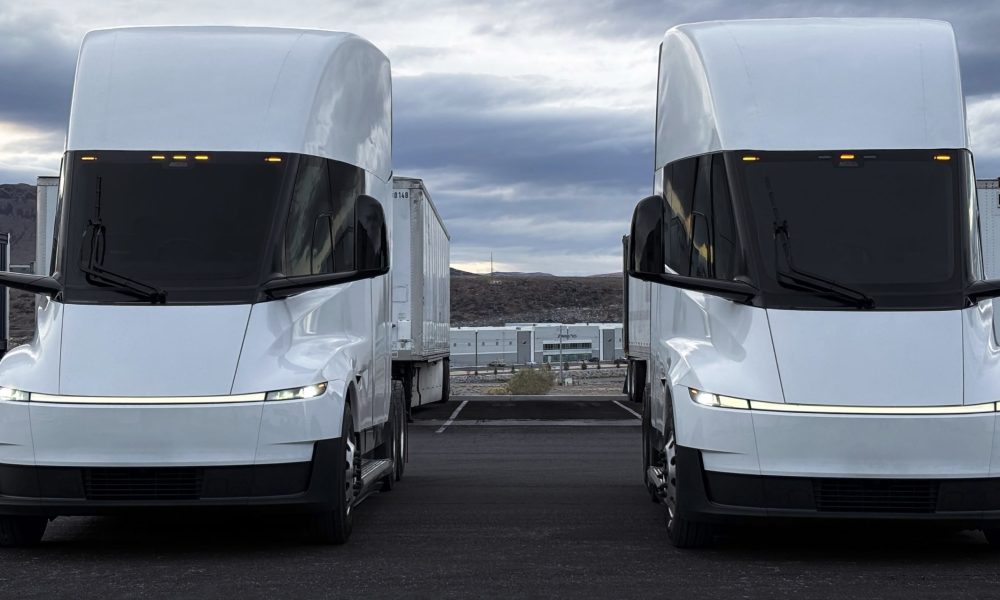
The landscape of commercial transportation is undergoing a significant transformation, led by the Tesla Semi. This all-electric Class 8 truck is not merely a futuristic concept; it is actively reshaping industry perceptions and earning enthusiastic endorsement from the very professionals who spend their lives behind the wheel: truck drivers.
Across North America, as fleets integrate pilot programs for the innovative Tesla Semi, a consistent narrative is emerging. Drivers report a quieter, quicker, and considerably less physically demanding experience compared to traditional diesel rigs. This electric powerhouse promises three times the power output and substantially reduced operating costs, marking a pivotal shift in heavy-duty logistics.

Unprecedented Driver Reception: A Shift in the Cab
The core of the Tesla Semi’s appeal lies in its design philosophy, which prioritizes driver comfort and operational efficiency. Features such as a centrally positioned driver’s seat offer unparalleled visibility, eliminating traditional blind spots that can prove challenging in conventional trucks.
Moreover, the inclusion of expansive touchscreen displays for instrumentation and navigation provides a modern, intuitive interface. Perhaps most impactful for daily operations is the instant torque delivery and the complete absence of gear-shifting, which significantly mitigates the physical fatigue often associated with long-haul trucking.
These design choices are not just conveniences; they are fundamentally altering the experience of a demanding profession. Drivers accustomed to the arduous nature of shifting multiple gears and contending with the vibrations and noise of diesel engines are finding their shifts noticeably easier and less stressful, leading to enhanced focus and reduced wear-and-tear on their bodies.

Real-World Testimony: Drivers Speak Out
The enthusiasm for the Tesla Semi is palpable in testimonials from early pilot participants. A recent Wall Street Journal profile highlighted insights from drivers navigating the new electric trucks.
Dakota Shearer of IMC Logistics recounted a particularly telling incident where the Semi’s advanced technology proved invaluable in a tight spot:
“I backed right out of there, no problem. It’s like I’d never done it in the first place. That right there showed me that the technology the Tesla has makes a big difference.”
His colleague, Angel Rodriguez of Hight Logistics, a seasoned driver who transitioned from a 13-speed diesel truck, echoed this sentiment, emphasizing the physical relief:
“It’s just easier on your body. It’s less stressful because you’re not really having to engage the clutch and the stick shift.”
Similar positive feedback has been reported from other pilot programs across the continent. Tom Sterba, a Senior Driver at Saia, expressed profound admiration after several days of testing the Tesla Semi, particularly praising its advanced navigation capabilities and overall operational feel:
“The navigation systems in these trucks are just unbelievable. That’s what I love about it.”
Sterba’s ultimate endorsement,
“I hope I retire in this truck,”
quickly resonated across the trucking community, encapsulating the deep satisfaction experienced by those who have piloted the electric vehicle.
Further tests involving fleets such as ArcBest, thyssenkrupp Supply Chain Services, and Mone Transport yielded consistent praise. Drivers universally commended the centered seat layout for improving spatial awareness, the seamless acceleration that electric powertrains provide, and the enhanced levels of comfort and safety perceived throughout their shifts.
Performance Beyond Expectation: Data Validates Driver Praise
Beyond anecdotal evidence, real-world operational data from these pilot programs is substantiating the Tesla Semi’s performance claims. ArcBest, for instance, has meticulously logged thousands of miles, demonstrating highly efficient consumption rates even when tackling notoriously challenging terrains like California’s Donner Pass.
Remarkably, several other fleets participating in pilot schemes have reported beating Tesla’s own internal efficiency targets for the vehicle. This data underscores the Semi’s robust engineering and its capacity to perform optimally under diverse and demanding conditions, providing a strong business case for its adoption.
The overarching consensus from all participants and data analysis is unequivocal: the Tesla Semi offers a significantly quieter cab environment, faster acceleration, and a far less strenuous driving experience compared to its diesel counterparts. Critically, it delivers superior power while promising dramatically lower operational expenses, which includes fuel and maintenance costs.
Engineering the Future: Key Upgrades and Innovations
The latest advancements for the Tesla Semi were recently showcased on Jay Leno’s Garage, where Jay Leno became the first external individual to drive the updated long-range production model. Accompanied by Tesla Chief Designer Franz von Holzhausen and Semi Program Director Dan Priestley, the episode provided a detailed look at the truck’s evolution.
Significant upgrades are slated for volume production this year, enhancing both performance and durability. The updated Tesla Semi has achieved a weight reduction of approximately 1,000 pounds, a crucial improvement for payload capacity and efficiency. It has also adopted a sophisticated 48-volt architecture, a move expected to improve power delivery and electrical system efficiency.
Further engineering enhancements include a transition to fully electric steering, incorporating actuators derived from the innovative Cybertruck, promising more precise and responsive handling. The Semi is now equipped with advanced 4680 battery cells, specifically engineered for an impressive lifespan exceeding one million miles, directly addressing concerns about battery longevity in heavy-duty applications.
Aerodynamic improvements have further bolstered the truck’s capabilities, contributing to an impressive estimated 500-mile range for the long-haul version. A shorter-wheelbase, standard-range model is projected to offer about 325 miles, catering to varied operational needs. Charging infrastructure has also seen significant advancement, with Megachargers now capable of delivering up to 1.2 megawatts of power, enabling the addition of approximately 300 miles of range in just about 30 minutes.
During the Jay Leno’s Garage segment, Leno personally experienced the Tesla Semi’s capabilities while hauling heavy loads, expressing astonishment at its agile turning radius and the seemingly effortless power delivery.
“I don’t feel like I’m pulling anything,”
he remarked, a testament to the electric powertrain’s smooth and potent performance.
The Road Ahead: Paving the Way for Electric Freight
With hundreds of Tesla Semis already in operation, collectively accumulating over 13.5 million fleet miles, the viability and reliability of electric heavy-duty trucking are becoming increasingly apparent. The reported high uptime across these vehicles further solidifies the case for their widespread adoption.
The consensus from professional drivers, bolstered by compelling performance data and continuous technological innovation, paints a clear picture: the future of heavy-duty transport is undeniably electric. Drivers are not just adapting to the Tesla Semi; they are actively embracing it, ready to integrate this advanced electric trucking solution into their careers for the long term, thereby steering the industry towards a more sustainable and efficient era.