
Key Takeaways
- The Rivian Adventure Network (RAN) has officially surpassed 1,000 DC fast charging ports across the United States.
- This significant milestone reflects an approximate 40% growth in the network’s size over the past year.
- Rivian is actively integrating Tesla-style NACS connectors, with 16% of stalls now featuring this standard alongside existing CCS1 ports.
- The network, powered by renewable energy, boasts a 98% uptime and has transitioned from free-for-Rivian charging to a paid service open to most EVs.
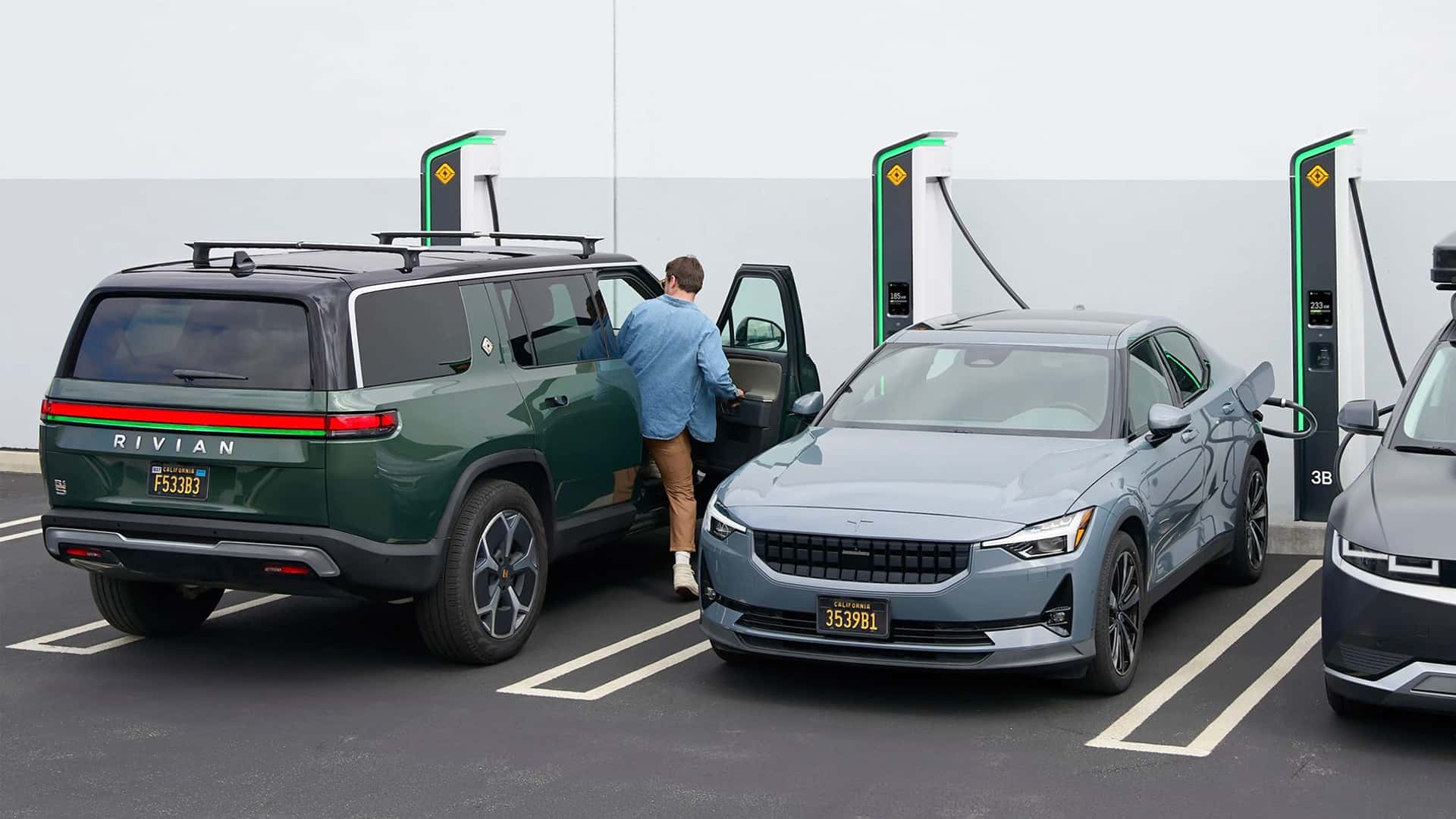
In a significant development for electric vehicle (EV) infrastructure, Rivian’s dedicated fast-charging network, the Rivian Adventure Network (RAN), has achieved a major milestone, officially exceeding 1,000 DC fast charging ports. This expansion positions the California-based EV manufacturer as a formidable player in the rapidly evolving landscape of public charging solutions.
According to data from the Department of Energy’s Alternative Fuels Data Center (AFDC), the Rivian Adventure Network now spans 148 locations across the United States. The growth has been particularly swift in recent weeks, with an impressive 44 new stalls added across four sites in just the last 30 days, underscoring Rivian’s accelerated deployment strategy.
Accelerated Growth and Strategic Expansion
The achievement of over 1,000 DC fast charging ports marks a substantial leap for Rivian’s charging infrastructure. A year ago, the network comprised just over 700 stalls, indicating a robust increase of approximately 40% in its capacity. This rapid expansion, as observed by EV Charging Stations, highlights Rivian’s commitment to mitigating range anxiety for its customers and the broader EV community.
Historically, the development of the Rivian Adventure Network, first announced in 2021, experienced a slower initial pace. However, the company has clearly shifted into high gear, demonstrating a concerted effort to build out its charging backbone. This accelerated deployment is critical for supporting the growing number of Rivian vehicles on the road, including the popular R1S SUV and R1T pickup, as well as upcoming models like the R2.
Renewable Energy and Universal Accessibility
A distinctive feature of the Rivian Adventure Network is its commitment to sustainability. Rivian asserts that its proprietary charging stalls are powered entirely by renewable energy, aligning with the company’s broader environmental ethos. This approach not only provides clean energy for EV charging but also reinforces Rivian’s brand identity as an eco-conscious automotive innovator.
Crucially, the vast majority of these Rivian Adventure Network stations, specifically 97%, are now open to all electric vehicles, not just those manufactured by Rivian. This shift towards universal accessibility began in 2024, moving away from an initial model where charging was exclusively free for Rivian EVs. This strategic pivot enhances the network’s utility and contributes significantly to the overall EV charging ecosystem.
Integrating NACS: A Step Towards Standardisation
In a move reflecting industry trends towards standardisation, Rivian’s expanding charging network is progressively integrating Tesla-style North American Charging Standard (NACS) ports. This is happening in addition to the Combined Charging System (CCS1) connectors that were initially deployed across the network. The adoption of NACS is a critical strategic decision that addresses the evolving landscape of EV charging.
Currently, 166 stalls, representing approximately 16% of the total network, are equipped with NACS connectors across about 50 locations. Interestingly, six Rivian Adventure Network stations exclusively feature NACS chargers. This dedicated NACS deployment is somewhat unique, as many non-Tesla charging operators typically offer both NACS and CCS1 connectors at the same stations to ensure broader compatibility.
The transition to NACS by Rivian is a logical progression, particularly given the design of its newer vehicles. While first-generation R1S and R1T EVs were factory-equipped with a CCS1 port, the facelifted flagship models and the highly anticipated new R2 series will feature a native NACS port. This eliminates the need for charging adapters at NACS-enabled stations, streamlining the charging experience for owners of these new vehicles.
Furthermore, all Rivian EVs, regardless of their native charging port, have gained access to the extensive Tesla Supercharger network. Since the vast majority of Supercharger stalls utilize NACS connectors, this integration significantly expands the charging options available to Rivian drivers, reducing concerns about charging availability during long journeys.
Ensuring Reliability and Uptime
Charging network reliability remains a paramount concern for EV owners. Rivian addresses this by vertically integrating the development and management of its Rivian Adventure Network. The company claims that by owning the hardware, software, and maintenance services for its charging infrastructure, it successfully maintained an impressive 98% uptime across its locations throughout the previous year. This high uptime figure is a critical trust-building element for consumers considering EV adoption.
The operational efficiency derived from this integrated approach is vital. Reliable charging infrastructure is not merely a convenience but a fundamental requirement for the widespread acceptance and practical utility of electric vehicles. Rivian’s emphasis on self-managed maintenance directly contributes to a consistent and dependable user experience.
Monetisation and Waypoints: A Broader Charging Strategy
The financial model of the Rivian Adventure Network also underwent a significant change in 2024. After initially offering free charging exclusively to Rivian EVs, the company commenced charging for top-ups when it opened its DC fast chargers to other EV brands. This transition to a paid service at an average price of $0.55 per kilowatt-hour, as reported by the DCFC Tracker website, ensures the economic sustainability and further expansion of the network.
Beyond its high-speed DC fast charging capabilities, Rivian also operates a complementary Level 2 charging network known as Rivian Waypoints. This slower, but widely accessible, network provides 540 charging ports across 208 locations throughout the U.S. Rivian Waypoints are typically found at destinations where vehicles are parked for longer durations, such as hotels, parks, and retail centers, offering convenient overnight or extended-stay charging options.
Outlook for Rivian’s Charging Ecosystem
The recent milestone of over 1,000 DC fast charging ports underscores Rivian’s unwavering commitment to building a robust and accessible EV charging infrastructure. This rapid expansion, coupled with the strategic integration of NACS connectors and a focus on renewable energy, positions Rivian as a key contributor to the broader electrification movement. As the EV market continues its exponential growth, the reliability and availability of charging networks like RAN will be instrumental in accelerating consumer adoption and ensuring a seamless transition to sustainable mobility.
Frequently Asked Questions (FAQs)
What is the Rivian Adventure Network (RAN)?
The Rivian Adventure Network (RAN) is Rivian’s proprietary DC fast-charging network for electric vehicles. It is designed to provide rapid charging services, primarily across the United States, supporting both Rivian vehicles and, increasingly, other EV brands. The network aims to be powered entirely by renewable energy sources.
How many charging ports does the Rivian Adventure Network currently have?
As of recent reports, the Rivian Adventure Network has surpassed 1,000 DC fast charging ports across 148 locations in the United States. This represents a significant expansion, with approximately 40% growth in its infrastructure over the past year, according to industry data.
Are Rivian Adventure Network chargers open to non-Rivian EVs?
Yes, the vast majority of Rivian Adventure Network stations, specifically 97%, are now open to electric vehicles from other manufacturers. This universal accessibility began in 2024, marking a shift from its initial policy of offering exclusive charging to Rivian vehicles.
What types of charging connectors are available at RAN stations?
Rivian Adventure Network stations primarily offer CCS1 (Combined Charging System) connectors. However, Rivian is actively integrating NACS (North American Charging Standard) connectors, similar to Tesla’s Superchargers, with approximately 16% of stalls now featuring NACS ports alongside CCS1.
Does Rivian offer any other charging options?
Yes, in addition to the DC fast-charging Rivian Adventure Network, the company also operates a Level 2 charging network called Rivian Waypoints. This network provides slower, destination-based charging with 540 ports located at 208 sites across the U.S., suitable for overnight or extended-stay charging.
What is the uptime reliability of the Rivian Adventure Network?
Rivian claims an impressive 98% uptime for its Rivian Adventure Network locations over the past year. This high reliability is attributed to the company’s strategy of owning and managing the hardware, software, and maintenance services for its charging infrastructure, ensuring consistent operation.