
Key Takeaways:
- Rocsys has launched the M1 system, a modular, multi-bay hands-free charging solution specifically designed to address the critical operational challenges faced by expanding robotaxi fleets.
- The M1 system leverages six years of operational data, combining advanced computer vision and motion intelligence to achieve a 99.9%+ plug-in success rate across diverse environmental conditions.
- Its flexible, overhead-mounted design ensures interoperability with various EV models, chargers, and connector types, enabling seamless automation for mixed fleets.
- The solution is an integral part of the comprehensive Rocsys Platform, offering integrated hardware, software, and services for enhanced operational visibility and fleet management.
- Rocsys recently secured a $13-million Series A funding extension, bringing its total funding to $56 million, underscoring investor confidence in its automated charging technology.
The burgeoning robotaxi market, poised to redefine urban mobility, faces a significant operational bottleneck that threatens to impede its large-scale deployment: the manual charging of autonomous electric vehicles. Addressing this critical challenge, Rocsys, a pioneer in automated EV charging systems, has officially unveiled its new multi-bay hands-free charging solution, the Rocsys M1, specifically engineered for the rigorous demands of robotaxi fleets.

This innovative system is positioned to unlock continuous, driverless operations by automating one of the most time-consuming and labor-intensive processes in electric fleet management. Its introduction marks a pivotal step towards realizing the full potential of autonomous transportation, moving beyond pilot projects to global deployment.
Automated Charging: A Crucial Leap for Autonomous Fleets
For years, Rocsys has been at the forefront of automated EV charging. While initially envisioning automated vehicles as its primary clientele, the company quickly identified a broader market need among conventional EV fleets. These operators, seeking to enhance efficiency and reduce labor costs, found immense value in automated charging processes that eliminated the need for human intervention.
Now, as the robotaxi sector begins its ascent, the imperative for fully automated depot operations has become acutely clear. Manual charging, despite being a seemingly minor task, scales into a major impediment for fleets operating thousands of vehicles daily.

The Operational Bottleneck of Manual Charging
Rocsys highlights the profound impact of this issue on the viability of autonomous services. “Manual charging is emerging as a critical barrier to operational continuity,” the company states. This sentiment underscores a core challenge that goes beyond mere inconvenience.
The repetitive nature of connecting and disconnecting charging cables thousands of times each day introduces a cascade of problems. These include escalating operational costs, significant friction in day-to-day management, and inherent safety risks associated with human interaction in busy depot environments. Collectively, these factors become a structural constraint on both fleet growth and, crucially, profitability.
Introducing the Rocsys M1: Precision and Scalability
The Rocsys M1 system represents the culmination of extensive development and real-world application. Drawing upon a robust foundation of six years of data, the M1 has been meticulously trained and refined through its predecessor’s deployment in active port operations and other high-duty industrial environments. This deep well of practical experience ensures the system’s resilience and reliability in demanding settings.
Currently undergoing pilot deployment, the Rocsys M1 is slated for a large-scale rollout in 2027. This phased approach allows for further optimization and integration ahead of its broad market introduction.
Modular Design for Maximum Efficiency
A hallmark of the M1’s design is its modular, multi-bay architecture. This innovative configuration allows a single Rocsys M1 system to seamlessly service multiple vehicles across an impressive array of up to 10 charging bays. Such scalability is paramount for large-scale robotaxi operations, where maximizing throughput and minimizing infrastructure footprint are key.
Furthermore, the system offers flexible overhead mounting options, including both ground- and roof-mounted configurations. This adaptability ensures that the Rocsys M1 can be integrated with virtually any depot layout, providing unparalleled flexibility for fleet operators. A significant advantage of this overhead design is its ability to facilitate other critical depot activities, such as vehicle cleaning and inspection, concurrently with the charging process, further boosting operational efficiency.
Advanced Robotics and Unwavering Reliability
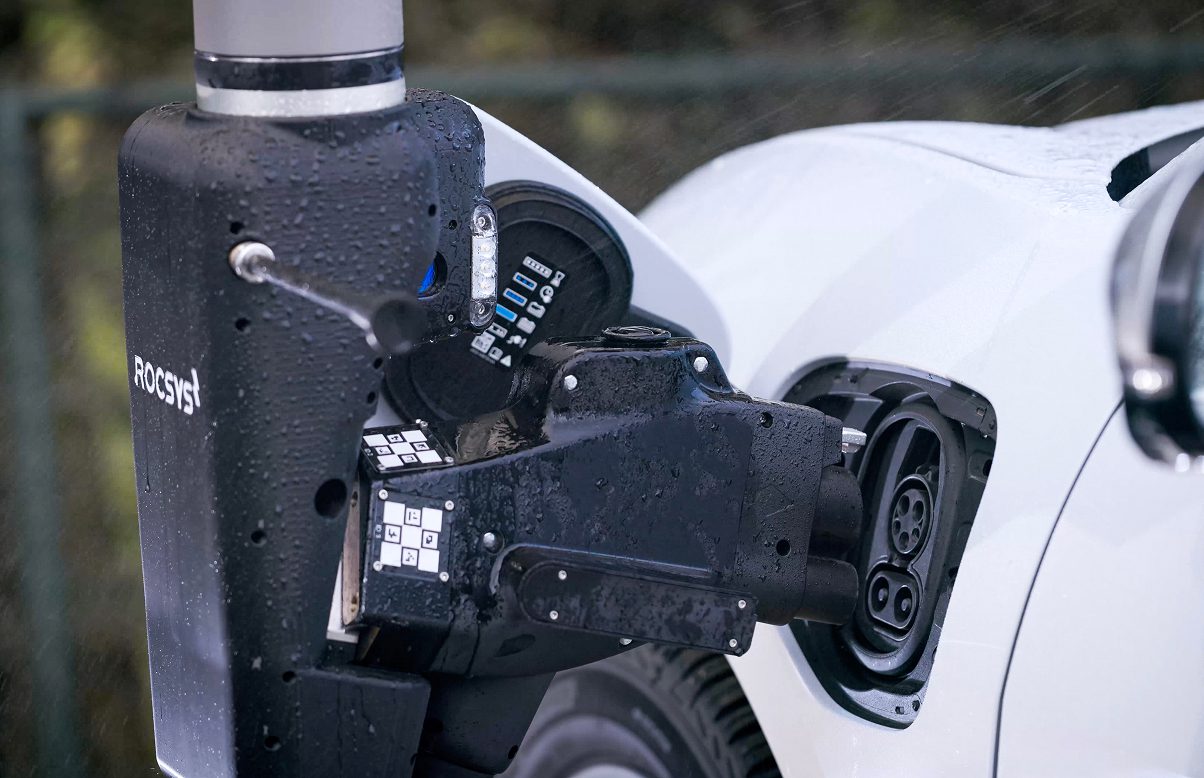
The M1 system’s core technological strength lies in its sophisticated integration of computer vision with advanced motion intelligence. This synergy allows the system to accurately perceive its environment and execute precise robotic movements, ensuring reliable connections every time.
This intelligence enables the system to adapt seamlessly to a variety of real-world conditions. Variations in lighting, adverse weather conditions, and slight discrepancies in vehicle positioning no longer pose a challenge. Rocsys proudly reports that the M1 achieves an exceptional 99.9%+ plug-in success rate in live operating environments, a testament to its robust design and intelligent algorithms.
Universal Compatibility and Future-Proofing
Recognizing the diverse nature of modern EV fleets, the Rocsys M1 is engineered for broad interoperability. It is compatible with different electric vehicles, various charger types, and a range of connector standards. This universality is crucial for operators managing mixed fleets, avoiding the need for specialized infrastructure for each vehicle type.
The system’s overhead rail-mounted design, coupled with a flexible, long-reach robotic arm, is specifically designed to enable reliable connection and disconnection across these mixed fleets, irrespective of where the charging inlet positions are located on different vehicles. This adaptability ensures future-proofing as new EV models and connector types emerge.
The Integrated Rocsys Platform
The Rocsys M1 is not a standalone product; it is an integral component of the broader Rocsys Platform. This comprehensive ecosystem integrates hardware, sophisticated software, and dedicated services, all designed to support the seamless operation of autonomous fleets.
Key elements of this platform include the Rocsys Portal, which provides fleet managers with crucial operational visibility and real-time data. Additionally, robust Application Programming Interfaces (APIs) facilitate effortless integration with existing customer IT systems, streamlining data flow and management. The platform is further enhanced by remote monitoring capabilities and expert field support, ensuring maximum uptime and operational continuity for critical robotaxi services.
Strategic Investment Fuels Expansion
Reinforcing its market position and growth trajectory, Rocsys recently announced a significant $13-million Series A funding extension. This latest investment round was led by Capricorn Partners, a prominent venture capital firm known for its focus on sustainable technology. This extension brings Rocsys’s total funding raised to date to an impressive $56 million, providing substantial capital to accelerate the development and deployment of its advanced charging solutions.
This substantial investment underscores the confidence of the financial community in Rocsys’s vision and its ability to deliver transformative technology for the electric vehicle and autonomous mobility sectors.
Leadership Vision: Unlocking Full Autonomy
Crijn Bouman, CEO and co-founder of Rocsys, articulated the profound implications of this new solution. “Without hands-free operations, autonomy stops at the depot,” he stated, highlighting the critical role automated charging plays in achieving true end-to-end autonomous mobility.
Bouman further elaborated on the strategic importance of the M1: “Based on a platform designed to extend beyond charging to automated interior cleaning and inspection, the Rocsys M1 introduces smart charging infrastructure for continuous, real-world use at scale. It enables operators to run mixed fleets autonomously, reliably and without interruption. This is the missing link for robotaxi operators to move from pilots to global deployment.” His statement emphasizes that Rocsys envisions a future where depot operations are entirely automated, paving the way for unprecedented efficiency and scalability in autonomous transportation.
The Road Ahead for Robotaxis
The introduction of the Rocsys M1 hands-free charging solution represents a significant advancement for the burgeoning robotaxi industry. By automating the crucial task of charging, Rocsys is not just solving a logistical problem; it is enabling a paradigm shift towards truly autonomous fleet operations. This innovation promises to reduce operational costs, enhance safety, and accelerate the transition of robotaxi services from experimental pilots to widespread, reliable transportation solutions across global markets.
As urban landscapes evolve and the demand for sustainable, autonomous mobility grows, solutions like the Rocsys M1 will be instrumental in shaping the future of transportation, ensuring that the promise of robotaxis can be fully realized without the constraints of manual intervention.
Source: Rocsys
Frequently Asked Questions (FAQs)
What is the Rocsys M1 system?
The Rocsys M1 is a newly unveiled multi-bay hands-free charging solution specifically designed for robotaxi fleets. It automates the charging process, eliminating the need for human intervention, which addresses a critical operational bottleneck for autonomous electric vehicle operations. The system is built on six years of data and experience from Rocsys’s prior automated charging systems.
How does the Rocsys M1 improve robotaxi operations?
By automating charging, the M1 system significantly enhances operational continuity, reduces labor costs, and mitigates safety risks associated with manual processes. It allows robotaxi fleets to operate autonomously 24/7 without interruption for charging, accelerating their transition from pilot phases to large-scale, profitable deployment. This automation is vital for scaling autonomous mobility services.
What are the key technical features of the Rocsys M1?
The M1 features a modular, multi-bay architecture capable of serving up to 10 vehicles, flexible overhead mounting options, and an advanced combination of computer vision and motion intelligence. This technology allows it to adapt to varying environmental conditions, ensuring a 99.9%+ plug-in success rate. It’s also interoperable with different EV models, chargers, and connector types.
When will the Rocsys M1 be widely available?
The Rocsys M1 is currently undergoing pilot deployment in select environments. Rocsys aims to commence a large-scale rollout of the system in 2027. This timeline allows for further testing, refinement, and strategic partnerships to ensure a smooth and effective market entry for this advanced hands-free charging solution.
How much funding has Rocsys raised for its automated charging solutions?
Rocsys recently secured a $13-million Series A funding extension, led by Capricorn Partners. This latest round brings the company’s total funding raised to date to $56 million. This substantial investment reflects strong confidence in Rocsys’s technology and its potential to revolutionize charging infrastructure for autonomous and electric vehicle fleets.
Is the M1 system compatible with different types of EVs and chargers?
Yes, the Rocsys M1 is designed for broad interoperability. Its overhead rail-mounted design and flexible robotic arm allow for reliable connection and disconnection across mixed fleets, regardless of the electric vehicle brand, charger type, or the specific position of the charging inlet. This ensures adaptability and future-proofs the investment for fleet operators.
What is the Rocsys Platform and how does the M1 integrate?
The Rocsys Platform is a comprehensive ecosystem that integrates hardware (like the M1), software, and services to support autonomous fleet operations. The M1 is a key hardware component. The platform also includes the Rocsys Portal for operational visibility, APIs for integration with customer IT systems, and remote monitoring with expert field support, providing an end-to-end solution.