
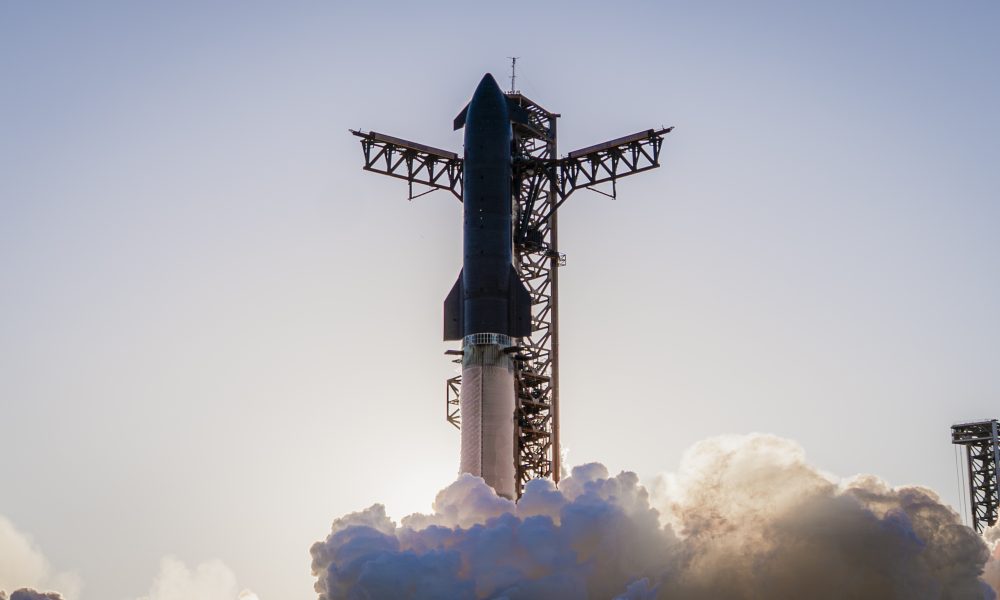
SpaceX is on the cusp of launching a groundbreaking new phase in space exploration with the anticipated debut of its Starship V3. The company is targeting an April test flight for the next-generation vehicle, a development that could significantly reshape humanity’s reach into the cosmos.
Starship V3: Advancements in Design and Capability
The latest iteration, Starship V3, features notable upgrades over its predecessors. Both the Super Heavy booster and the Starship upper stage are taller, designed to accommodate increased propellant capacity. This enhancement is crucial for SpaceX’s ambitious long-term goals.

Powering these advancements are SpaceX’s upgraded Raptor 3 engines. These engines are expected to produce stronger and more efficient thrust, a key factor in achieving greater payload capacity. The V3 variant targets a payload capability exceeding 100 tons to low Earth orbit, a substantial leap from the approximately 35 tons of earlier versions.
Orbital Refueling: The Key to Deep Space Missions
A pivotal upgrade for Starship V3 is the anticipated capability for orbital refueling. This feature is central to SpaceX’s deep space architecture, enabling the transfer of large amounts of propellant in orbit. Without this capability, missions to destinations like Mars would be significantly constrained.
Orbital refueling effectively transforms Starship from merely a powerful rocket into a versatile transport system. Experts suggest that this capability is indispensable for establishing a sustainable presence on the Moon and Mars, facilitating the movement of necessary cargo, fuel, and eventually, people.

Initial Super Heavy V3 and Starbase Pad 2 activation campaign complete, wrapping up several days of testing that loaded cryogenic fuel and oxidizer on a V3 vehicle for the first time. While the 10-engine static fire ended early due to a ground-side issue, we saw successful… pic.twitter.com/uHGji17srv
— SpaceX (@SpaceX) March 18, 2026
Driving Down Launch Costs for Accessibility
SpaceX’s vision extends beyond reaching new destinations; it encompasses making space more accessible. The company aims for Starship and its Super Heavy booster to be fully reusable, a strategy designed to drastically reduce launch costs.
The goal is to achieve a tenfold reduction in marginal launch costs compared to current market leaders. This would bring the cost per kilogram of cargo to orbit down from thousands of dollars to a fraction of that amount. Such a reduction is expected to unlock new possibilities.
This cost reduction could facilitate the mass deployment of satellite constellations, enable the launch of large-scale scientific payloads, and make human space transport beyond Earth orbit more affordable. Ultimately, it could shift the perception of the Moon from a distant destination to a place for sustained human inhabitation.
Shifting Focus to Lunar Habitation Before Mars
In line with its long-term ambitions, SpaceX’s plans have seen a strategic shift. NASA anticipates Starship playing a key role in lunar missions, with a projected takeoff for the Moon’s South Pole in 2028. The ultimate objective is the establishment of a permanent, crewed science station.
A successful Starship V3 flight in the coming spring is critical for maintaining this timeline. While Mars remains the ultimate horizon for human colonization, Elon Musk has indicated a pivot towards establishing a self-sustaining city on the Moon first.
Musk’s reasoning centers on accessibility: the Moon can be reached approximately every 10 days, in contrast to Mars’s 26-month alignment window for efficient travel. The Moon is thus viewed as a crucial proving ground for the technologies and operational strategies required for longer, more complex Martian missions.
Preparations Underway for V3 Launch
Elon Musk has been vocal about the impending Starship V3 launch, frequently sharing updates on its progress. He recently confirmed via social media that the first flight of V3 is drawing nearer.
SpaceX also announced the completion of its initial activation campaign for Starship V3 and Starbase Pad 2. This multi-day testing period involved loading cryogenic fuel and oxidizer onto a V3 vehicle for the first time, a significant step in the launch preparation sequence. Despite an early conclusion to a 10-engine static fire test due to a ground-side issue, the company reported successful observations during the campaign.
The progress indicates that the countdown to launch is actively underway, generating considerable anticipation for the April debut.