
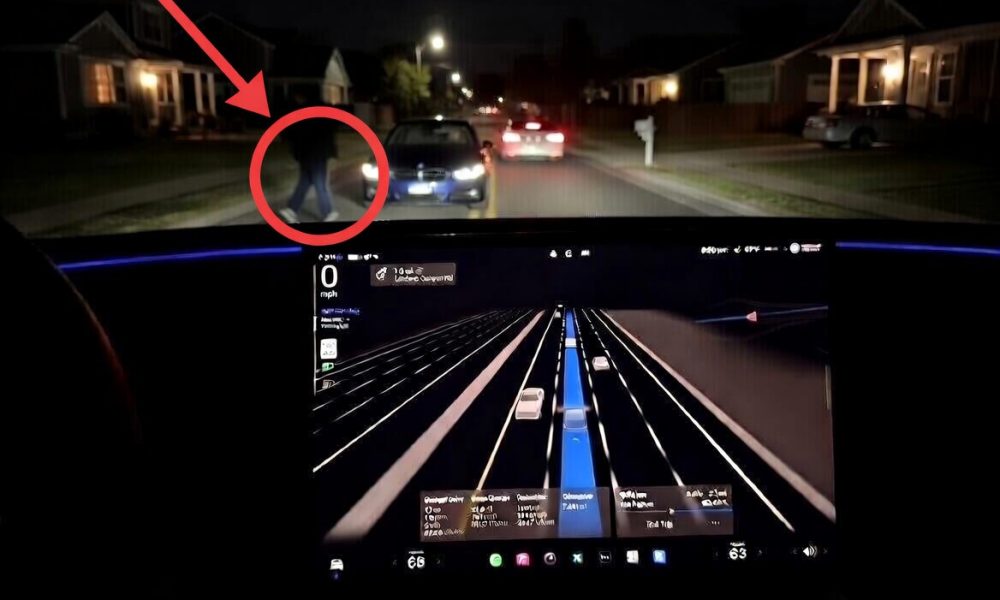
A recent incident captured on video and widely shared across online platforms has underscored the advanced capabilities of Tesla’s Full Self-Driving (FSD) software, particularly its ability to anticipate pedestrian intent more effectively than a human driver. The footage, originally posted to the r/TeslaFSD community on Reddit, details a critical moment where the autonomous system proactively detected a potential hazard, preventing a near-miss scenario on a residential street.
The event involved a Tesla operating on FSD and a BMW vehicle, both navigating a neighborhood. The video clearly depicted the BMW driver proceeding without apparent awareness of a pedestrian preparing to cross the street. In contrast, the Tesla, under the control of its Full Self-Driving system, had already initiated a slowdown before the pedestrian even began to step into the roadway.
The Incident Unfolds: A Closer Look
As the BMW continued its trajectory, the pedestrian was forced to abruptly halt their crossing attempt, retreating to the safety of the curb. Simultaneously, the Tesla Full Self-Driving system brought the vehicle to a complete stop, offering the right-of-way and allowing the individual to cross safely once the path was clear. This sequence of events starkly highlighted the disparity in perception and reaction time between the human operator in the BMW and the artificial intelligence governing the Tesla.
The core narrative of this incident revolves around a significant gap: the difference between what the BMW driver perceived and what Tesla Full Self-Driving had already processed. The FSD system did not merely react to a person physically entering the street; rather, it was actively interpreting a confluence of subtle signals. These included the pedestrian’s body language, movement patterns, and their projected trajectory, all of which telegraphed an imminent intention to cross.
This proactive detection capability allowed the Tesla FSD to respond to a developing situation well before it escalated into a direct threat, thereby demonstrating a predictive intelligence that surpassed the immediate, reactive awareness of the human driver involved.

Understanding Tesla’s Full Self-Driving Technology
The foundation of Tesla’s Full Self-Driving system lies in its sophisticated end-to-end neural network. This advanced artificial intelligence architecture has been rigorously trained on an enormous dataset, encompassing billions of miles of real-world driving scenarios. Through this extensive training, the system has developed an unparalleled capacity to interpret intricate human behavioral cues, mirroring the instinctive understanding that an experienced human driver possesses.
However, a key differentiator is consistency. While human drivers can possess excellent instincts, their performance can be compromised by factors such as distraction, fatigue, or momentary inattention. Even a two-second lapse in focus can lead a human driver to miss critical environmental cues. Tesla Full Self-Driving, by design, maintains a constant, vigilant awareness, processing sensory input without such human limitations.
This unwavering attention allows Tesla FSD to consistently identify and react to subtle indicators that might elude a human driver, especially in dynamic urban environments where interactions with pedestrians are frequent and often unpredictable.
The Critical Role of Intent Prediction
The ability of Tesla Full Self-Driving to predict intent, rather than simply react to an event, represents a monumental leap in automotive safety technology. Instead of waiting for a pedestrian to physically step into the path of the vehicle, the system actively analyzes cues that indicate a *likelihood* of them doing so. This includes analyzing head movements, gait, eye direction, and proximity to the curb, piecing together a comprehensive understanding of the pedestrian’s likely next action.
For vulnerable road users such as pedestrians, this predictive capacity is paramount. It shifts the safety paradigm from evasive action after a threat emerges to preventative intervention before a threat fully materializes. By anticipating potential conflicts, Tesla FSD can initiate braking or steering adjustments much earlier, creating a larger margin of safety than typically afforded by human reaction times alone.
Safety Metrics and Future Outlook
Tesla has publicly shared data to substantiate the safety advantages of its autonomous driving systems. According to company statistics, Full Self-Driving (Supervised) has been shown to be 54% safer than human driving, a conclusion drawn from billions of miles accumulated on the system. These figures highlight the significant potential for advanced driver-assistance systems to reduce accident rates and improve overall road safety.
Looking ahead, Tesla CEO Elon Musk has expressed ambitious projections for the software’s performance. Musk stated that FSD v14 is anticipated to outperform human drivers by a factor of two to three. Furthermore, he suggested that the subsequent iteration, v15, has a “shot” at achieving an extraordinary tenfold improvement in performance compared to human driving. Such advancements underscore the continuous development cycle aimed at enhancing the system’s capabilities.
Within this progression, pedestrian safety remains a top priority. The continuous refinement of intent prediction algorithms is crucial for closing the gap between human and machine perception, especially where the stakes for human life are highest.
Real-World Implications: Seconds Save Lives
The speed at which vehicles travel makes every fraction of a second critical in preventing accidents. At a speed of 30 miles per hour, a car covers approximately 44 feet every second. This simple metric underscores the immense value of even a single extra second of awareness. The ability of Tesla Full Self-Driving to read a person’s body language and predict their intent, rather than waiting for them to physically step into the street, can provide precisely that crucial margin.
This early warning can be the decisive factor, often representing the difference between a minor near-miss incident and a severe injury or fatality. The proactive nature of the FSD system, as demonstrated in the Reddit video, provides a tangible example of how artificial intelligence can enhance situational awareness beyond typical human limitations, potentially mitigating countless accidents globally.
Public Discourse and Regulatory Scrutiny
The incident resonated strongly within online communities, particularly among Reddit users who weighed in on the BMW driver’s performance. Commenters were quick to point out that the pedestrian was visible well in advance of the crossing, emphasizing the human driver’s apparent lapse in attention. One popular sentiment highlighted that the Tesla Full Self-Driving system had already registered and responded to the developing situation before the human in the other vehicle had even acknowledged it.
The broader deployment and evolution of autonomous driving technologies like Tesla FSD are also subjects of ongoing regulatory discussions. The debate surrounding the nomenclature and capabilities of such systems has led to various challenges, including Tesla’s ongoing legal proceedings with the California Department of Motor Vehicles concerning advertising rulings related to Autopilot and Full Self-Driving features. Such legal and regulatory frameworks continue to adapt as autonomous technology advances, seeking to balance innovation with public safety and clear communication.
Conclusion
The recent incident involving a Tesla Full Self-Driving vehicle and a human-driven BMW serves as a compelling illustration of the rapidly evolving capabilities of autonomous technology. By demonstrating a proactive and predictive approach to pedestrian safety, particularly through advanced intent recognition, Tesla FSD highlights its potential to significantly enhance road safety. As these systems continue to develop and integrate into daily driving, their consistent vigilance and ability to anticipate human actions promise to play a pivotal role in preventing accidents and safeguarding vulnerable road users.