
Key Takeaways
Many Tesla Model Y owners have long grappled with ineffective and overheating wireless phone chargers, often halting smartphone charging. Software engineer and Model Y owner Michał Gapiński has pioneered a compelling DIY fix by retrofitting a cooled wireless charging pad from the China-made Model YL into his U.S.-built vehicle. This innovative upgrade, costing under $200, introduces active cooling where none existed, successfully keeping phones at a stable 86 degrees Fahrenheit during charging. The solution underscores owner ingenuity and highlights a path for Tesla to address a widespread customer complaint, potentially through official retrofits or standard integration in future models.

The Persistent Challenge of In-Car Wireless Charging
For many Tesla Model Y owners, the integrated wireless phone charger has been a source of frustration rather than convenience. Instead of reliably topping up smartphones, the charging pad frequently transforms devices into miniature ovens, triggering overheating warnings and prematurely halting the charging process.
This widespread complaint has led numerous drivers to abandon the wireless feature altogether, reverting to traditional charging cords. The issue effectively renders the built-in pad little more than a phone holder, falling short of its intended functionality in a premium electric vehicle.
Tesla’s Acknowledged Problem and Interim Solutions
Tesla has not been entirely unaware of the problem. Over time, the automaker has rolled out several software solutions aimed at mitigating the issue. These include features that allow users to simply deactivate the charging function, letting the pad serve solely as a physical resting place for a phone while driving.
However, these software-based workarounds fail to address the core hardware deficiency: the lack of active cooling. Consequently, many owners continue to seek more definitive solutions to ensure their devices charge efficiently without succumbing to excessive heat.
An Owner’s Ingenious DIY Solution Emerges
In response to this prevalent issue, software engineer and dedicated Tesla Model Y owner Michał Gapiński took matters into his own hands. Gapiński embarked on a resourceful do-it-yourself (DIY) upgrade, opting to replace his vehicle’s standard wireless charging pad with an actively cooled unit typically found in the China-manufactured Model YL variant.
This ambitious retrofit exemplifies the spirit of innovation within the Tesla owner community, where enthusiasts often devise clever solutions to perceived factory shortcomings. Gapiński’s initiative provides a practical and effective Model Y wireless charging solution that could inspire many others.
Understanding the Design Discrepancy
The fundamental difference between the wireless charging pads installed in U.S.-built Model Y vehicles and the Model YL is crucial. Standard U.S. models rely on basic heat dissipation methods, lacking any active cooling mechanisms. This passive approach quickly leads to significant temperature buildup during charging cycles, particularly in warmer ambient conditions.
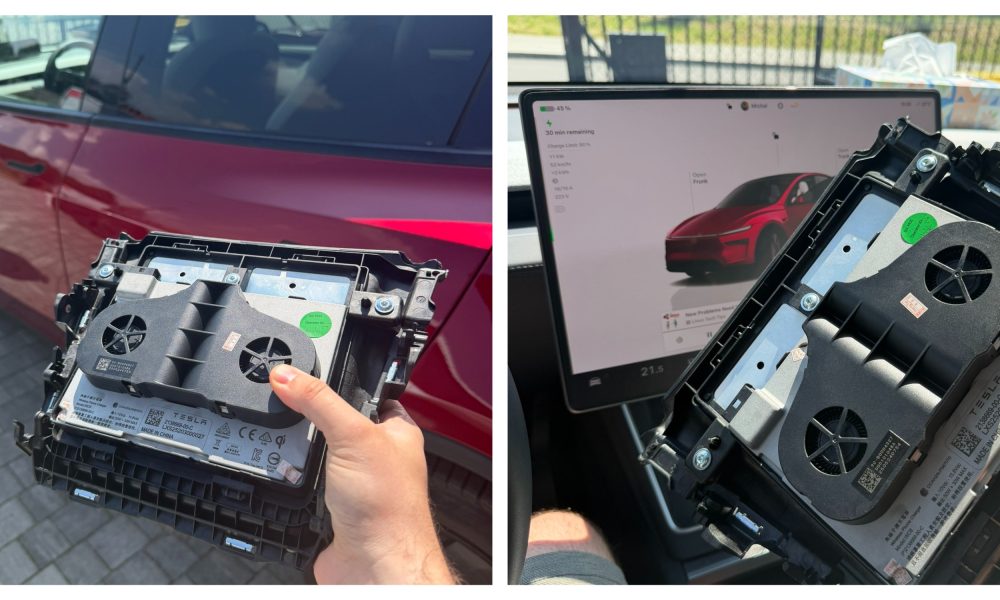
Conversely, the Model YL’s charging pad integrates a small, dedicated fan for active cooling. This design proactively manages heat, maintaining lower temperatures and allowing for more consistent and efficient charging. While the cooled Model YL pad does not support the faster Qi2 charging standard for iPhones, its ability to mitigate overheating is a substantial advantage.
Gapiński highlighted the initial step in his project on social media, sparking interest among fellow owners:
Will it fit? Fingers crossed, I want a first YL charger deployed in the regular juniper pic.twitter.com/wWDqSNFVkW
— Michał Gapiński (@mikegapinski) June 2, 2026
The Retrofit Process: Sourcing and Installation
Gapiński managed to source the actively cooled charging pad from China, acquiring the essential part for an affordable sum of under $200. This demonstrated that a significant upgrade could be achieved without exorbitant costs.
The installation process involved carefully removing the existing console charger from his Model Y and then fitting the new unit. Critically, the connector for the cooled pad was identical to the original, ensuring a seamless physical swap. While there were minor trim differences, Gapiński adeptly managed these to ensure a professional finish.
The physical compatibility was a key discovery, paving the way for the functional integration. He confirmed this breakthrough during the installation:
Connector is identical, she fits, now time to code it. https://t.co/Y9idgDrpCq pic.twitter.com/uwwgq6blg7
— Michał Gapiński (@mikegapinski) June 2, 2026
Enabling Functionality Through Custom Coding
Beyond the physical swap, a crucial step involved custom coding to enable the full functionality of the new charging pad. Since the necessary parameter for the cooled charger isn’t fully secured within the official Tesla Toolbox, Gapiński utilized an external method to activate it. This technical expertise underscores the depth of his solution, moving beyond a simple hardware exchange to a complete functional integration.
Tangible Results: A Cooler, More Effective Charging Experience
Following the successful retrofit and activation, Gapiński reported highly positive results. The fan within the new charging pad activated quietly, its operation blending seamlessly with the vehicle’s air conditioning and seat cooling systems, ensuring no discernible increase in cabin noise.
Crucially, the wireless charging pad performed flawlessly, maintaining a significantly lower temperature for the smartphone. While charging, the phone’s temperature remained a consistent 86 degrees Fahrenheit. This is a dramatic improvement over the previous experience, where phones often reached temperatures well above 100 degrees Fahrenheit, becoming uncomfortably hot to the touch and frequently triggering overheating alerts that ceased charging.
Gapiński’s ultimate assessment solidified the success of his efforts, providing a viable Tesla wireless charging solution:
The retrofit worked, no issues. First Model Y with a cooled wireless charger! No QI2/faster charging on the iPhone but it does not boil the phone even when it is 30 degrees outside.
The fan kicks in, it is not audible especially with the air conditioning and seat cooling. The… https://t.co/JOyR8Tb1Yo pic.twitter.com/kJcYhQIlYq
— Michał Gapiński (@mikegapinski) June 2, 2026
Implications for Tesla and the Future of In-Car Technology
This innovative, owner-driven solution highlights a significant factory shortcoming that has vexed many Tesla owners. The success of Gapiński’s retrofit places implicit pressure on Tesla to address the issue on a broader scale.
Industry observers and owners alike anticipate that Tesla will soon begin installing actively cooled charging pads as a standard feature in new Model Y vehicles destined for the U.S. market. Furthermore, there is considerable hope that the company will offer an official retrofit service or a dedicated kit, allowing existing owners to upgrade their vehicles and finally utilize the wireless charging pad effectively.
For those with a penchant for tinkering and a desire for an optimized in-car experience, Gapiński’s project serves as an accessible and inspiring upgrade. It powerfully demonstrates that innovation and practical problem-solving continue to thrive beyond the confines of automotive production lines, often driven by the very community that embraces these advanced vehicles.
Frequently Asked Questions (FAQ)
What is the common complaint about Tesla’s wireless charger?
Many Tesla Model Y owners report that the integrated wireless phone charger causes smartphones to overheat rapidly. This overheating often triggers warning messages on phones, which then halt the charging process, essentially turning the pad into a non-charging holder.
How did Michał Gapiński address the overheating issue?
Michał Gapiński, a software engineer and Model Y owner, performed a DIY retrofit. He replaced his U.S.-built Model Y’s standard wireless charging pad with an actively cooled version sourced from a China-made Model YL, which features a small fan to manage heat.
What is the key difference between the U.S. and China Model Y charging pads?
The primary difference is the cooling mechanism. U.S.-built Model Y vehicles typically come with a passive wireless charging pad that relies on basic heat dissipation. In contrast, the Model YL (China-made) integrates a small fan for active cooling, which significantly reduces heat buildup during charging.
Was the retrofit difficult or expensive?
Gapiński sourced the cooled pad affordably from China for under $200. While the physical connector was identical, making the swap feasible, enabling full functionality required custom coding outside of Tesla’s official Toolbox. This indicates a degree of technical proficiency is needed beyond basic installation.
What were the results of Gapiński’s upgrade?
The retrofit proved highly effective. Gapiński reported that the wireless charging pad worked perfectly, keeping his phone cool at approximately 86 degrees Fahrenheit, even in warm ambient conditions. The fan operated quietly, blending with the vehicle’s existing climate control systems, and sustained charging was achieved without overheating.
Will Tesla offer this upgrade officially?
While not confirmed, it is anticipated that Tesla may soon begin installing actively cooled charging pads in new U.S. vehicles. There is also hope within the owner community that Tesla will offer an official retrofit service or kit for existing owners who wish to upgrade their wireless charging capabilities.