
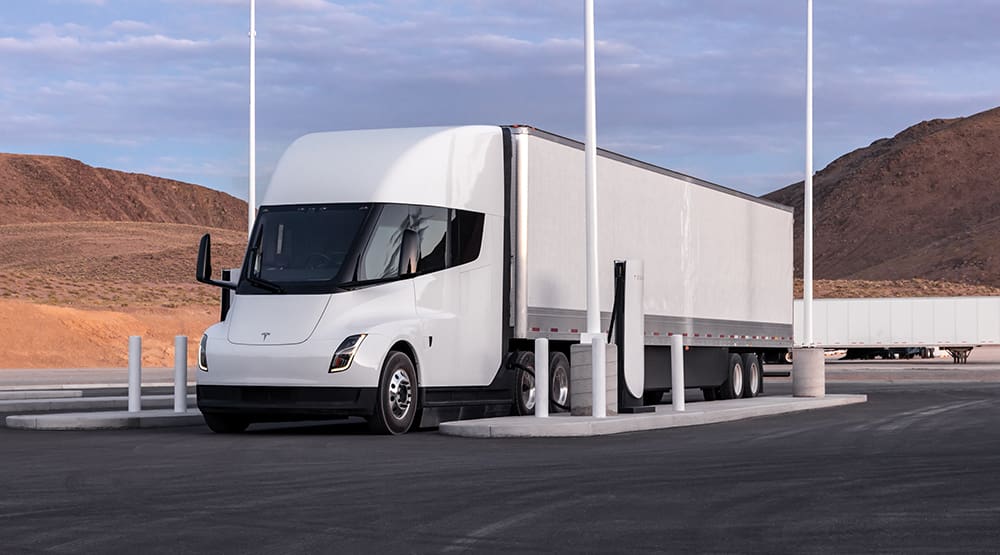
Tesla is accelerating its electric semi-truck strategy, officially opening its first Megacharger station designed to serve external customers in Ontario, California. This move signifies a crucial step in transitioning the Tesla Semi from its development and pilot phases into full commercial operation.
Expanding the Electric Freight Network
The new station in Ontario places Tesla’s charging infrastructure directly within a major logistics hub. Located in the Inland Empire, a region known for its high volume of freight traffic, the site is strategically positioned near the intersection of major highways I-10 and I-15. This proximity also offers convenient access to the vital Ports of Los Angeles and Long Beach, underscoring Tesla’s focus on serving key commercial shipping routes.

This Ontario location is the latest development in Tesla’s ambitious plan to establish a robust charging network for its electric trucks. The company has outlined a strategy to deploy a total of 66 Megacharger locations across the United States. Currently, two Megacharger sites are already operational, situated at Gigafactory Nevada and in Carson, California. However, these existing facilities have primarily served Tesla’s internal fleet operations.
Strategic Placement for Busiest Corridors
Tesla’s long-term vision for its Megacharger network targets the busiest freight corridors in North America. Key routes identified for future installations include the West Coast’s I-5, the east-west artery of I-10, and the I-95 and I-75 corridors along the East Coast. The company has set ambitious targets for network expansion, aiming to have 37 Megacharger sites operational by the end of 2026, with an increase to 46 sites by early 2027.
Megacharger Technology and Performance
The Megacharger technology developed by Tesla is engineered for high-power delivery, capable of providing up to 1.2 megawatts (MW) of charging power. While the full capability of the Megachargers can reach 1.2 MW, the newly opened customer-facing station in Ontario is currently operating at a capacity of 750 kilowatts (kW).

Industry observers, such as Electrek’s Fred Lambert, view the opening of this customer-oriented station as a landmark achievement. This development is seen as a clear indicator of the Tesla Semi’s graduation from a testing program to active commercial deployment. Tesla has demonstrated a consistent pace of progress in recent months, including showcasing 1.2 MW charging capabilities in December, announcing a significant partnership with truck stop operator Pilot in January, and now launching its first public customer charging station in March.
Navigating Infrastructure Challenges
Despite the rapid advancements, the path to widespread electric truck adoption involves overcoming numerous logistical and regulatory hurdles. As noted by Charged readers, the process from initial planning to final operation of charging infrastructure is complex. It involves navigating challenges such as obtaining permits, securing utility interconnections, managing construction, and final commissioning of the sites.
The timeline for Tesla’s infrastructure rollout will be closely monitored by stakeholders in the electric truck industry. The company’s ability to efficiently deploy these charging solutions will be a critical factor in the broader adoption of its electric fleet vehicles.
Competitive Landscape and Emerging Standards
Tesla is not alone in developing high-power charging solutions for electric trucks. Competitors are also making significant strides. The Megawatt Charging System (MCS), an open industry standard, is already being deployed and supports charging speeds of up to 3.75 MW. Major truck manufacturers, including Daimler, Volvo, and Scania, have announced plans to introduce MCS-compatible electric trucks in 2026.
Companies like Kempower, a manufacturer of electric vehicle supply equipment (EVSE), have already established MCS charging hubs in Europe and the United States. Notably, a Kempower MCS charging hub is operational in San Bernardino, California, a location geographically close to Tesla’s new Ontario Megacharger station. This indicates a growing ecosystem of high-power charging solutions entering the market.
The ongoing development and deployment of both proprietary and open-standard charging infrastructure highlight the accelerating momentum behind electrification in the heavy-duty trucking sector. The coming years will be pivotal in observing how these competing and complementary technologies shape the future of freight transportation.