
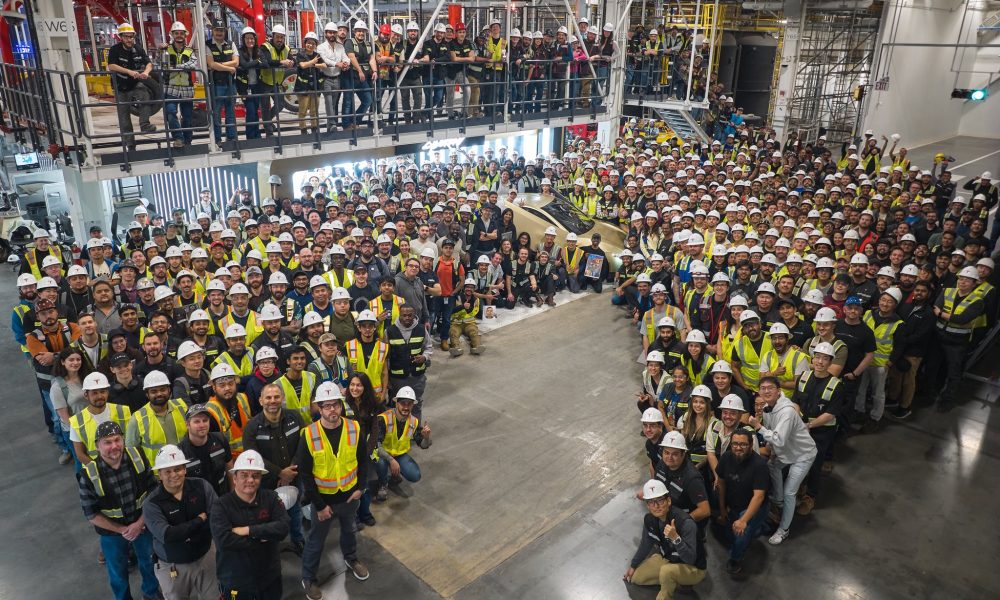
Tesla Gears Up for Cybercab Production at Gigafactory Texas
Tesla is reportedly making significant strides in establishing its production line for the Cybercab, with plans to manufacture hundreds of the autonomous vehicles weekly once mass production commences. The ambitious undertaking is centered at the company’s Gigafactory Texas in Austin, as Tesla readies itself to scale the production of its revolutionary Robotaxi.
Key Details Emerge from Industry Sources
These developments were detailed in a report by The Wall Street Journal, which cited individuals with knowledge of the company’s plans. The report suggests that Tesla has been actively augmenting its workforce and integrating new equipment at the Austin facility.

Sources close to Tesla’s strategic initiatives indicated that the company has been focused on both expanding its employee base and acquiring necessary machinery. This preparatory phase is crucial for initiating the mass production of the Cybercab, with an anticipated start date as early as April.
Introducing the Cybercab: A Glimpse into Autonomous Mobility
The Cybercab is envisioned as a pioneering, fully autonomous, two-seat vehicle. Notably, it is designed without traditional controls such as a steering wheel or pedals, underscoring its intended function as a driverless mode of transportation.
This innovative vehicle is slated to be a cornerstone of Tesla’s planned Robotaxi ride-hailing service. The autonomous nature is fundamental to its operation within this network.

During a previous earnings call, Elon Musk emphasized the vehicle’s reliance on its autonomous capabilities. “There’s no fallback mechanism here. Like this car either drives itself or it does not drive,” Musk stated, highlighting the singular focus on self-driving technology.
Production Ramp-Up and Cost Projections
Tesla has signaled that Cybercab production could potentially begin in April. However, Elon Musk has also managed expectations by noting that initial production volumes are expected to be modest, with a gradual increase over time.
Musk attributed the anticipated slow ramp-up to the Cybercab’s status as a completely new vehicle platform, presenting unique manufacturing challenges. This suggests a carefully managed and phased approach to production scaling.
The Cybercab is engineered to seamlessly integrate with Tesla’s Full Self-Driving (FSD) system, forming the technological backbone for its proposed autonomous ride-hailing service. The company has put forth a compelling price point for the vehicle, suggesting it could be available for under $30,000.
This projected cost would position the Cybercab as one of Tesla’s most economically accessible models, provided it can achieve scaled production. Elon Musk has confirmed this affordability through an X post, stating the vehicle would indeed be offered to consumers at a price point below $30,000.
Long-Term Vision: Millions of Cybercabs Annually
Looking further ahead, Elon Musk has articulated a vision where Tesla could potentially produce millions of Cybercabs each year. This ambitious target hinges on the successful scaling of both market demand and production capacity.
The development of the Cybercab and its integration into a ride-hailing network represents a significant step in Tesla’s pursuit of autonomous transportation solutions. The company’s efforts at Gigafactory Texas are a critical indicator of its commitment to bringing this futuristic mobility concept to fruition.